Brisket & Bark

The Best Cutting Board for Brisket

A finished packer is roughly two feet of meat that has spent twelve hours accumulating juice. Most kitchen boards are too small to hold it and have nowhere for the liquid to go — which is how brisket juice ends up on the floor.

By Stephen V.Last updated How we pick

The cutting board is the piece of brisket gear people discover they need at the worst possible moment: brisket rested, knife sharpened, guests waiting, and the realization that the packer overhangs the board by four inches on each side while a puddle spreads across the counter. It is an unglamorous purchase that solves a genuinely annoying problem.

Two specs decide it. Sizecomes first — a whole packer wants something in the region of 24 by 18 inches to sit flat with room to work, though 18 by 14 is plenty if you separate the point from the flat before slicing (which you should be doing anyway). A juice groovecomes second, and it matters more on brisket than on any other cut, because a rested brisket releases a startling volume of liquid the moment you cut it. After those two, it’s about material: teak needs the least maintenance, walnut is kindest to a knife edge, maple lasts longest, bamboo is cheapest and hardest on your blade. Pair whichever you choose with a proper brisket slicing knife.

How this is funded: we earn a commission if you buy through our links, at no extra cost to you. It never changes which product we recommend, and we’ll tell you plainly when we’d skip one. Full disclosure.

Quick picks

Ranked on the published specs and how each one fits a brisket cook. Select a row to jump to the full write-up. We have not run this gear in a lab — here is exactly what we do instead.

#ProductBest forPrice
1
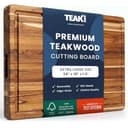
Teakhaus Carving Board with Juice Groove, XL 24" x 18"

Teakhaus Carving Board with Juice Groove, XL 24" x 18"

24 by 18 inches is the first board size that actually holds a full packer without the point hanging off the edge, and the juice groove catches what a brisket releases — which is a startling amount. Teak's natural oil content means it needs far less maintenance than maple.

Best overall
$119.74 · View on Amazon

Price as of September 6, 2026. #ad How we’re funded

2
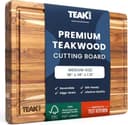
Teakhaus Carving Board with Juice Groove, M 18" x 14"

Teakhaus Carving Board with Juice Groove, M 18" x 14"

The same teak and the same juice groove as the XL in a size that fits a normal kitchen and a normal sink. A whole packer will overhang slightly, but if you separate the point from the flat before slicing — which you should anyway — it is entirely enough board.

Best value
$54.99 · View on Amazon

Price as of September 6, 2026. #ad How we’re funded

3
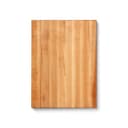
John Boos R-Board Reversible Maple Board 20" x 15"

John Boos R-Board Reversible Maple Board 20" x 15"

The American butcher-block standard, at 1.5 inches thick and twelve pounds. It has no juice groove, which is a real limitation for brisket — but it is reversible, will outlive you, and is the board most likely to be handed down rather than replaced.

Best lifetime butcher block
$124.95 · View on Amazon

Price as of September 6, 2026. #ad How we’re funded

4
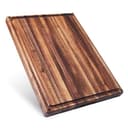
Sonder Los Angeles Franklin Edge Grain Walnut Board 20" x 15"

Sonder Los Angeles Franklin Edge Grain Walnut Board 20" x 15"

Walnut is softer than maple, which sounds like a downside and is actually the reason chefs like it — a softer board is kinder to a knife edge, and a brisket slicer is a thin blade you would rather not keep re-honing. At 20 by 15 by 1.5 inches it is a serious board.

Best for knife edges
$139.99 · View on Amazon

$149.997% off

Price as of September 6, 2026. #ad How we’re funded

5
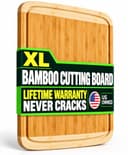
Greener Chef Extra Large Bamboo Cutting Board

Greener Chef Extra Large Bamboo Cutting Board

Bamboo is harder on a knife edge than hardwood and it is the cheapest large board that will not flex under a packer. If your current setup is slicing brisket on a warped plastic sheet, this is a large upgrade for very little money.

Best budget
$27.99 · View on Amazon

Price as of September 6, 2026. #ad How we’re funded

The picks in full

#1Best overall

Teakhaus Carving Board with Juice Groove, XL 24" x 18"

24 by 18 inches is the first board size that actually holds a full packer without the point hanging off the edge, and the juice groove catches what a brisket releases — which is a startling amount. Teak's natural oil content means it needs far less maintenance than maple.

Strengths

  • 24" x 18" (stated) genuinely fits a whole packer
  • Juice groove catches what a rested brisket releases
  • Naturally oily teak needs less conditioning than maple

Trade-offs

  • Heavy and awkward to wash in a domestic sink
  • Premium price for what is, ultimately, a board
Fuel / powerNot published
MaterialTeak
Dimensions24"L x 18"W x 1.5" thick (stated)
Juice grooveYes
GrainEdge grain

Specs read from the manufacturer listing, on August 10, 2026. “Not published” means the maker does not state that figure.

#2Best value

Teakhaus Carving Board with Juice Groove, M 18" x 14"

The same teak and the same juice groove as the XL in a size that fits a normal kitchen and a normal sink. A whole packer will overhang slightly, but if you separate the point from the flat before slicing — which you should anyway — it is entirely enough board.

Strengths

  • Juice groove at roughly half the price of the XL
  • 18" x 14" (stated) fits a standard sink and cupboard
  • Same low-maintenance teak as the larger board

Trade-offs

  • A whole untrimmed packer will overhang the edges
  • 1" thickness is less substantial than the XL's 1.5"
Fuel / powerNot published
MaterialTeak
Dimensions18"L x 14"W x 1" thick (stated)
Juice grooveYes
GrainEdge grain

Specs read from the manufacturer listing, on August 10, 2026. “Not published” means the maker does not state that figure.

#3Best lifetime butcher block

John Boos R-Board Reversible Maple Board 20" x 15"

The American butcher-block standard, at 1.5 inches thick and twelve pounds. It has no juice groove, which is a real limitation for brisket — but it is reversible, will outlive you, and is the board most likely to be handed down rather than replaced.

Strengths

  • 1.5" thick, 12 lb (stated) — will not warp or slide
  • Reversible, so both faces are usable work surface
  • Hard maple that can be resurfaced for decades

Trade-offs

  • No juice groove — brisket juices run onto the counter
  • Maple needs regular oiling, unlike teak
Fuel / powerNot published
MaterialHard maple
Dimensions20"L x 15"W x 1.5" thick (stated)
Juice grooveNo
Weight12 lb (stated)

Specs read from the manufacturer listing, on August 10, 2026. “Not published” means the maker does not state that figure.

#4Best for knife edges

Sonder Los Angeles Franklin Edge Grain Walnut Board 20" x 15"

Walnut is softer than maple, which sounds like a downside and is actually the reason chefs like it — a softer board is kinder to a knife edge, and a brisket slicer is a thin blade you would rather not keep re-honing. At 20 by 15 by 1.5 inches it is a serious board.

Strengths

  • Walnut is gentler on a thin slicer's edge than maple
  • 20" x 15" x 1.5" (stated) — substantial and stable
  • Edge grain construction resists warping

Trade-offs

  • No juice groove on this model
  • Softer wood shows knife marks sooner
Fuel / powerNot published
MaterialWalnut
Dimensions20"L x 15"W x 1.5" thick (stated)
GrainEdge grain (stated)
Juice grooveNo

Specs read from the manufacturer listing, on August 10, 2026. “Not published” means the maker does not state that figure.

#5Best budget

Greener Chef Extra Large Bamboo Cutting Board

Bamboo is harder on a knife edge than hardwood and it is the cheapest large board that will not flex under a packer. If your current setup is slicing brisket on a warped plastic sheet, this is a large upgrade for very little money.

Strengths

  • Large surface for a fraction of a hardwood board's price
  • Bamboo is dimensionally stable and resists warping
  • Light enough to move and wash one-handed

Trade-offs

  • Bamboo is harder on a knife edge than maple or walnut
  • No juice groove on this model
Fuel / powerNot published
MaterialBamboo
SizeExtra large (stated)
Juice grooveNo
DimensionsNot published

Specs read from the manufacturer listing, on August 10, 2026. “Not published” means the maker does not state that figure.

How big does a brisket board actually need to be?

A trimmed whole packer typically runs 16 to 20 inches long and 10 to 12 inches across at the point. To lay it flat with enough margin to run a knife through it without your knuckles hitting the counter, you want roughly 24 by 18 inches. That is a large board by domestic standards — bigger than most kitchens own, and often bigger than a standard sink, which is worth checking before you buy.

You can go smaller with one change of technique. If you separate the point from the flat along the fat seam before slicing — which the slicing guiderecommends regardless, because the two muscles’ grains run about 90 degrees apart — you are never handling more than half a brisket at a time. An 18 by 14 board handles that comfortably. Buy the big board if you have the storage; buy the medium one and separate the muscles if you don’t.

The juice groove is not a luxury

On most cuts a juice groove is a nice detail. On brisket it is close to essential. A properly rested packer holds a large volume of rendered fat and juice, and the first cut releases it all at once. Without a groove that liquid goes over the edge of the board and onto the counter, the floor, or you — and it is hot, greasy, and stains. With a groove it collects in the channel, where you can spoon it back over the slices, which is genuinely what you want to do with it.

The two boards here without grooves — the John Boos block and the Sonder walnut — earn their places on other merits, and both are excellent boards. But if you only buy one board and it is specifically for brisket, get the groove.

Material: what each one is actually good at

Teakis naturally high in oils, so it resists moisture and needs far less conditioning than other hardwoods — which is exactly what you want on a board that regularly meets a lot of hot grease. Hard maple is the American butcher-block standard: dense, extremely durable, resurfaceable, and the wood most likely to still be in use in thirty years. It does need regular oiling. Walnutis softer than maple, which sounds like a flaw and is actually a feature — a softer surface is gentler on a thin slicing blade’s edge, so you hone less often. It shows knife marks sooner in exchange. Bamboois technically a grass, is very hard, and is by far the cheapest way to get a large stable surface — at the cost of dulling your knife faster than any wood here.

Care, briefly

None of these go in a dishwasher. Wash by hand with hot soapy water, dry standing on edge rather than flat so both faces dry evenly, and oil periodically with food- grade mineral oil or a beeswax conditioner — monthly for maple, considerably less often for teak. A board that is allowed to sit wet, or dried flat on a counter, is a board that will cup and warp. That is the entire maintenance regime, and following it is the difference between a board that lasts two years and one that lasts twenty.
Frequently asked questions

What size cutting board do I need for a brisket?

Around 24 by 18 inches to lay a whole packer flat with working room. If you separate the point from the flat before slicing — which is the correct technique anyway, since their grains run about 90 degrees apart — an 18 by 14 inch board is comfortably enough, because you are only ever handling half a brisket at once.

Do I really need a juice groove?

For brisket, yes, more than for almost any other cut. A rested packer releases a large volume of hot rendered fat and juice the moment you cut into it. A groove channels that liquid where you can collect and spoon it back over the slices; without one it runs off the edge onto your counter. It is the single most useful feature on a brisket board.

Wood or plastic for brisket?

Wood, for a board this size. Plastic boards large enough for a packer tend to flex and slide, they warp permanently in a dishwasher, and they groove deeply under a long slicing stroke. Wood is heavier, stays put, is kinder to a knife edge, and looks like something you would serve from. Plastic boards remain a sensible choice for raw poultry prep — just not for carving brisket.

Which wood is best for a brisket board?

Teak if you want the least maintenance, because its natural oil content resists moisture and grease. Hard maple if you want a board that lasts a lifetime and can be resurfaced. Walnut if you care most about your knife's edge, since the softer surface dulls a thin slicer more slowly. Bamboo if price is the deciding factor, accepting that it is the hardest on your blade.

How do I stop the board sliding while I slice?

Weight does most of the work — a 12-pound board simply does not move. For lighter boards, a damp dish towel or a sheet of damp paper towel underneath grips well and costs nothing. Silicone corner grips also work. A sliding board while you are pulling a long slicing knife toward yourself is a genuine hazard, so it is worth solving before you start.

Can I put a wooden board in the dishwasher?

No. Sustained heat and prolonged water exposure will crack, warp and delaminate a wooden board, often permanently, and often the first time. Wash by hand in hot soapy water, rinse, and dry standing on edge so air reaches both faces. Oil periodically with food-grade mineral oil or a beeswax conditioner. That is the whole routine.

Sources

Keep reading