BBQ Gloves vs Welding Gloves
Welding gauntlets are longer, tougher and often cheaper than barbecue gloves, which is why the swap gets recommended constantly. For brisket it is still the wrong glove, and the reason has nothing to do with how much heat either one survives.
How this is funded: we earn a commission if you buy through our links, at no extra cost to you. It never changes which product we recommend, and we’ll tell you plainly when we’d skip one. Full disclosure.
Buy barbecue gloves for the brisket and keep welding gloves for the fire. The deciding property is not heat resistance — both survive everything a brisket cook involves — it is whether the glove is waterproof. Brisket is the fattiest thing most people ever smoke, and at the moments you need gloves most — lifting it, wrapping it, moving it to rest — it is streaming rendered fat at over 200°F. A coated barbecue glove sheds that. Leather drinks it. If you want one pick, it is the RAPICCA 17-inch gauntlet, which is the waterproof version of exactly the long-cuff shape welding gloves get bought for.
That said, the people recommending welding gloves are not fools and the advice is half right. There are real jobs on a smoker where a leather gauntlet is the better glove, and this page draws the line in the right place rather than pretending one glove wins everything.
What each glove was actually designed to do
A welding glove exists to stop sparks, molten spatter and radiant heat while you hold a torch. The design brief is abrasion resistance and protection from brief, intense, dryheat. Leather is excellent at that. It is also, by nature, porous — which is a feature when the hazard is a spark and a serious problem when the hazard is a liquid.
A barbecue glove exists to let you handle hot food and hot cookware. The two dominant designs in our registry reflect two different readings of that job. Coated neoprene gauntlets, like both RAPICCA gloves, are waterproof and long; they are a liquid barrier first. Knit gloves with five fingers, like the Grill Armor, prioritize dexterity and washability, and the listing is explicit that they are not waterproof.
So the comparison is not “which glove is tougher.” It is which hazard you are actually dressing for. On a brisket, the hazard is fat.
The fat problem, which is the whole argument
Here is what happens in practice. You open the smoker to wrap at the eight-hour mark. The fat cap has been rendering for hours and the packer is sitting in a shallow pool of its own liquid fat. You get both hands under it. Some of that fat runs down over your wrists.
With a waterproof neoprene glove it beads and runs off, and afterwards you wipe the glove down. With a leather welding glove it soaks in. Two consequences follow, and the second is the one people underestimate.
1. Soaked material conducts heat into your hand.A dry glove works partly because air trapped in the material is a poor conductor. Replace that air with 200°F liquid fat and you have turned the glove into something that holds heat against your skin. It is the same reason a wet oven mitt scalds you and a dry one does not.
2. You cannot get it clean.Rendered beef fat in leather does not wash out — leather is not machine washable, and soap and hot water will ruin it. So the glove goes back in the drawer with fat in it and comes out next month smelling the way you would expect. That is a food-handling problem, not a fussiness problem.
There is a third point worth stating plainly even though we cannot quantify it: welding gloves are not sold as food-contact equipment. Many are treated, dyed or lined with materials chosen for a welding bay. The barbecue gloves in our registry are sold for handling food. We are not going to claim a specific hazard we have not verified, but if you are choosing between a product built for your job and one built for someone else’s, the choice is not difficult.
Where welding gloves genuinely win
Three jobs — and if you run an offset smoker you will do all three every cook.
Handling a firebox. Adding a split, raking coals, moving a hot grate. This is dry, abrasive, radiant work and leather is better at it than neoprene. It is also work where a snag or a scrape matters more than a stain.
Pouring a chimney starter. A full chimney is heavy, radiating hard, and has a metal handle that has been sitting above a flame. A long leather gauntlet is a perfectly sensible glove for that lift.
Anything involving a grate, a grill brush or a hot cast-iron pan. Again: dry, hot, abrasive, and no food contact.
The practical answer for an offset owner is therefore both, kept in different places so you never grab the wrong pair. The barbecue gloves live with the meat gear; the welding gloves live by the firebox. That is not a cop-out, it is what each tool is for.
Side by side, on what each is sold as
| Property | Barbecue gloves (as in our registry) | Welding gloves (as a class) |
|---|---|---|
| Primary hazard designed for | Hot food, hot liquid, hot cookware | Sparks, molten spatter, radiant heat, abrasion |
| Material | Coated neoprene, or an aramid-type knit | Leather |
| Waterproof | Yes on both RAPICCA gloves (stated); no on the Grill Armor knit (stated) | No — leather is porous |
| Stated heat rating | 932°F and 700°F on the gloves we carry (stated) | Varies by maker and class; not published in a form comparable to the above |
| Cleaning | Wipe clean (neoprene) or machine washable (knit) | Neither — leather cannot be washed |
| Sold for food contact | Yes | No |
| Dexterity | Poor in a gauntlet, good in a five-finger knit | Poor — stiff leather, long cuff |
| Abrasion resistance | Moderate | Excellent |
The barbecue column cites the stated figures on the five gloves in our registry, read on the dates in each product’s spec table. The welding column describes the category rather than a product, because we carry no welding gloves and will not print a heat rating for a glove we have not sourced. Nothing in this table is a test result of ours.
What to look for in a brisket glove, in order
If you take nothing else from this page, take the priority order. It is not the order glove listings advertise.
1. Waterproof. First, by a distance, for the reasons above. If the listing does not say waterproof, assume it is not.
2. Cuff length. The burns people actually get handling brisket are on the inside of the forearm, from the edge of a hot grate or the lip of a smoker, not on the palm. A 14-inch cuff clears the wrist; 17 inches covers most of the forearm. This is the one place welding gloves had the right instinct.
3. Whether it washes.You will get fat on these every single cook. Wipe clean or machine washable — pick one.
4. Heat rating, last.Genuinely last. Every glove in this category is rated far above anything a brisket cook does, the numbers describe brief contact under the maker’s own conditions, and no two makers test the same way. A bigger number on the box is not a reason to choose one glove over another here.
And one thing not to look for: a glove that does everything. The roundup splits this into a long waterproof gauntlet for lifting and a liner-plus-nitrile system for anything that needs fingers, because no single glove is both a liquid barrier and dexterous.
Three gloves that do the job welding gloves cannot
All three are in our registry with the maker’s or the listing’s own stated figures, read on the date in each product’s spec table. Prices are live and refresh daily.
The direct welding-glove replacement
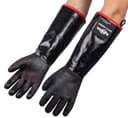
RAPICCA 932°F BBQ Grill Gloves, 17"
This is the glove people reach for welding gauntlets to get: full forearm coverage at a stated 17 in length, plus a stated 932°F rating. The difference is the neoprene coating, which is waterproof - so rendered fat runs off it instead of soaking in. It is also the glove our brisket-handling roundup ranks first.
$35.99 · View on AmazonSee all glove picksPrice as of October 20, 2026. #ad How we’re funded
If you want fingers, not a mitt
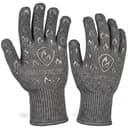
Grill Armor 932°F Oven Gloves with Fingers
A welding gauntlet's one real advantage over a cheap BBQ mitt is that it is a glove with fingers rather than a lobster claw. This keeps that, with a stated 932°F rating and stated cut resistance, and it is machine washable. The trade is published rather than hidden: it is not waterproof, so hot grease will get through.
$29.95 · View on AmazonRead our glove reviewPrice as of October 20, 2026. #ad How we’re funded
The cheapest honest swap
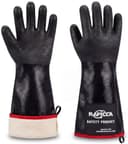
RAPICCA 700°F BBQ Grill Gloves, 14"
If the appeal of welding gloves was the price, start here instead. Same waterproof neoprene construction as our top pick with a stated 700°F rating and a stated 14 in cuff - less forearm than the 17 in version, still well past the wrist, and ample for lifting a packer off a grate.
Compare on specs
Frequently asked questions
Can you use welding gloves for BBQ?
For dry work around a fire - moving a hot grate, adjusting a log, lifting a chimney starter - welding gloves are genuinely good, and a leather gauntlet is more abrasion-resistant than any neoprene BBQ glove. For handling meat they are the wrong tool, because leather is porous and a brisket is covered in hot rendered fat. The fat soaks into the glove, which then cannot be washed clean and carries that residue into the next cook. Welding gloves are also not sold as food-contact equipment, and many are treated or lined with materials chosen for a welding bay.
Are welding gloves heat resistant enough for brisket?
Comfortably, and that is exactly why the comparison misleads people. A brisket comes off the smoker somewhere around 200-205°F and the grate above a 250°F fire is nowhere near the temperatures a welding glove is built for. Heat resistance is not the limiting factor for either glove type. The limiting factor is liquid: hot fat and juice running off a packer, which a waterproof coated glove sheds and a leather gauntlet absorbs.
What is the difference between BBQ gloves and welding gloves?
Three things. Material: barbecue gloves are usually coated neoprene or an aramid-type knit, welding gloves are leather. Waterproofing: a coated BBQ glove is sold as waterproof, leather is not. Intended contact: BBQ gloves are built and marketed for handling food, welding gloves for sparks, spatter and abrasion. The published heat ratings on BBQ gloves - 932°F and 700°F on the gloves in our registry - describe brief contact under the maker's own conditions, not an oven you can live in, and the same caveat applies to any glove.
Do you need waterproof BBQ gloves?
For brisket specifically, yes, and it is the single most useful thing to know about buying gloves for this cut. Brisket is a fat cap rendering for twelve hours; when you lift, wrap or turn one, liquid fat at well over 200°F runs onto your hands. Fabric and leather wick it straight through to your skin, which is both a burn risk and a glove you can never properly clean. A waterproof coated glove sheds it and wipes down afterwards.
What about the cotton liner and nitrile glove trick?
It is what a lot of competition cooks actually use, and it is the better answer for fiddly work - trimming, slicing, pulling probes - rather than for lifting. A cotton liner takes the brief heat, a disposable food-grade nitrile glove over the top keeps grease off the liner and your hand, and you get far more dexterity than any gauntlet allows. It is not sustained-heat protection, so it does not replace a long glove for reaching into a hot smoker. Both halves are in our glove roundup.
Will a BBQ glove's 932°F rating let me pick up a hot coal?
No, and no glove rating works the way the number suggests. These are stated figures for brief contact under the maker's own test conditions, not a promise that you can hold something at that temperature indefinitely. The practical rule for any glove is the same: the longer the contact, the more heat gets through. Pick the grate up, move it, put it down. Do not stand there holding it while you decide where it goes.
Sources
- USDA FSIS — Smoking Meat and Poultry — USDA on safe smoking practices, thermometer use and approved smoker materials (accessed July 22, 2026)
- USDA FSIS — Beef From Farm to Table — USDA on safe handling, cooking and resting of beef, including brisket (accessed July 22, 2026)
Keep reading
Best Gloves for Handling Brisket
Five gloves ranked on stated heat rating, cuff length, waterproofing and dexterity.
See the roundupRAPICCA BBQ Gloves Review
The long-cuff neoprene gauntlet in detail, including what the 932°F figure does and does not mean.
Read the reviewWrapping a Brisket
The moment gloves matter most: lifting a 200°F packer onto paper without tearing the bark.
Read the guideHow to Transport a Cooked Brisket
Getting a hot packer from the smoker into a carrier, and the food-safety numbers that govern it.
Read the guideBrisket Fire Management
The dry, hot jobs around a firebox where a leather gauntlet genuinely is the better glove.
Read the guideBest BBQ Stocking Stuffers
Glove liners, nitriles and the other cheap consumables a smoker owner runs out of.
See the picks