How to Smoke a Brisket on a Charcoal Grill
A kettle can absolutely cook a brisket, and thousands of good ones are made on kettles every weekend. But charcoal asks you to solve two problems the manual never mentions: making the fuel last twelve hours, and fitting a twenty-inch packer onto an eighteen-inch grate.
How this is funded: we earn a commission if you buy through our links, at no extra cost to you. It never changes which product we recommend, and we’ll tell you plainly when we’d skip one. Full disclosure.
There are two genuinely separate problems with cooking a brisket on charcoal, and most guides only deal with one of them.
The first is duration. A packer needs ten to fourteen hours at 250°F, and a pile of lit charcoal burns hot and dies in about two. The second is geometry. A whole packer is roughly twenty inches long and a standard kettle grate is not much bigger than that once you account for the coals. Solve both and charcoal is a superb brisket cooker. Ignore either and you get a stressful day.
Solve the size problem before you light anything
Measure your grate now, not at 5am with a wet brisket in your hands. On an 18-inch kettle a full packer simply does not lie flat. Your options, in order of how much we like them:
- Cook on a 22-inch bullet instead. Two 22-inch grates and a deep charcoal ring solve duration and geometry at once. This is why the Weber Smokey Mountain has made so much competition brisket.
- Curl the flat. Roll the thin end of the flat up against the side of the kettle. It works, but the curled section cooks differently and you will get an uneven finish.
- Separate the point from the flat before cooking. Two smaller pieces fit easily, finish at different times (which is fine — they are different muscles), and the point is already halfway to burnt ends.
- Buy a flat only and accept a different, leaner cook — see smoking a brisket flat.
The snake: how a kettle becomes a smoker
The technique that makes all of this viable is simple. Instead of lighting all your fuel, you lay it out so it burns a little at a time.
Arrange briquettes around the outer edge of the charcoal grate in a curved line — two briquettes wide, two high, overlapping like fallen dominoes — leaving a gap so the burn cannot loop back on itself. Space four or five wood chunks along the top of the snake. Then light eight to twelve briquettes in a chimney and tip them onto one end.
The fire creeps. Each briquette lights its neighbor, each chunk catches as the front reaches it, and you get hours of steady low heat and progressive smoke from a cooker with no controller at all. On a bullet the same principle is executed as the Minion method: fill the ring with unlit fuel, bury chunks through it, and drop a small number of lit coals into a well in the middle.
Both methods depend on uniform fuel, which is the one situation where briquettes beat lump — see lump vs briquettes for the full argument.
Vents are the only throttle you have
Charcoal cookers are controlled by airflow and nothing else. The rules are short:
- Top vent fully open, always, and positioned over the meat rather than over the fire so heat and smoke draw across the brisket on their way out. A closed top vent traps stale smoke and makes food taste acrid.
- Bottom vent is your dial. Start at about a quarter open for 250°F and adjust from there in small movements.
- Catch it on the way up. A charcoal cooker is far easier to hold down than to bring down. If it sails past your target you are waiting a long time for it to fall. Start closing the intake as you approach 225°F, not when you hit 275°F.
The water pan
Put a foil pan of hot water between the fire and the meat. On a bullet this is built into the design; on a kettle you improvise it. The thermal mass smooths out the swings a thin steel cooker is prone to, and the humidity slows the surface drying that punishes a lean flat.
It will not make the meat juicier from the inside — nothing applied to the outside does — and it will lengthen the stall slightly, because a more humid chamber means slower evaporative cooling relief. For brisket on a small charcoal cooker, the stability is worth the trade.
Fat side up, here
On an offset the fat cap goes down, toward the firebox. On a water-pan bullet or an indirect kettle setup the dominant heat is not radiating up from directly below — the pan is in the way — so fat side up is the conventional and sensible choice. The exposed meat side also builds better bark. The full reasoning is in fat side up or down, and it matters less than almost anything else on this page.
From there it is just brisket
Once the fire is behaving, nothing is charcoal-specific. Expect the stall at 150-170°F, wrap in butcher paper once the bark has set, cook to probe tenderness rather than a number, and rest properly before slicing.
One food-safety note specific to charcoal: if you are running long and topping up fuel, keep the chamber above 225°F and do not let a stalled fire sit with meat in it. USDA guidance is clear that meat should not linger between 40 and 140°F for extended periods, and a kettle whose snake has gone out at 3am is the realistic way that happens.
What a charcoal brisket depends on
On a charcoal cooker the fuel is not a detail — it is the temperature control system. Prices are live and refresh daily.
The fuel
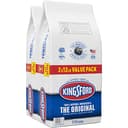
Kingsford Original Charcoal Briquettes
Briquettes, not lump, for a long charcoal burn. Uniform size and shape is what makes a snake or Minion burn predictably instead of racing.
See charcoal picksThe smoke
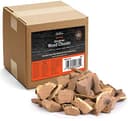
Camerons Products Oak Smoking Wood Chunks
Four or five fist-sized chunks buried in the unlit fuel, so each one catches as the burn reaches it rather than all at once.
$34.95 · View on AmazonSee wood picksPrice as of October 20, 2026. #ad How we’re funded
The cooker
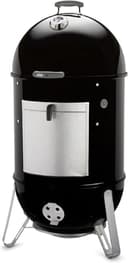
Weber Smokey Mountain Cooker 22"
If a kettle keeps defeating you, a bullet is the cheapest real fix: two grates, a water pan and enough charcoal ring for an overnight burn.
$549.00 · View on AmazonSee charcoal smokersPrice as of October 20, 2026. #ad How we’re funded
Frequently asked questions
Can you smoke a brisket on a Weber kettle?
Yes, with two caveats. The first is size: a 22-inch kettle has roughly a 22-inch grate but the charcoal and water pan eat into the usable space, and a full 20-inch packer is a tight, awkward fit that usually needs the flat end curled up against the side. The second is duration: a kettle holds far less fuel than a dedicated smoker, so you will be adding charcoal partway through a twelve-hour cook. Both are workable. Neither is convenient.
What is the snake method?
You arrange unlit briquettes in a curved line around the outer edge of the charcoal grate — typically two wide and two high — and light only one end. The fire creeps along the line at a fairly predictable rate, which turns a kettle into a long-burn smoker without a controller. Wood chunks get spaced along the snake so they catch progressively. It is the single most useful charcoal technique for brisket and it costs nothing.
Snake method or Minion method?
The snake suits kettles, because a kettle's charcoal grate is wide and shallow and a line of fuel around the edge keeps the fire away from the meat. The Minion method — a ring of unlit briquettes with a small well of lit coals dropped into the middle — suits bullet smokers, where the charcoal ring is deep and the fire is well below the food. Both do the same job: burn a small fraction of the fuel at a time.
Lump charcoal or briquettes for a long brisket cook?
Briquettes, for this specific job. Lump burns hotter and cleaner and is the better fuel in a firebox, but its pieces are wildly irregular in size and density, which makes a snake burn unpredictably — it can jump gaps or race through a run of small pieces. Briquettes are uniform by manufacture, which is exactly the property a slow creeping burn needs. Use lump on an offset and briquettes on a kettle.
Do I need a water pan?
On a small charcoal cooker it genuinely helps. Water absorbs and releases heat slowly, which damps out the temperature swings a thin-walled kettle is prone to, and the evaporating moisture slows surface drying on the flat. It does not add moisture to the inside of the meat — nothing does — and it will deepen the stall slightly by increasing evaporative cooling. On balance, for brisket, worth it.
How often do you add charcoal on a kettle?
Plan on topping up once or twice across a full packer cook, depending on your kettle, the weather and how well the snake is laid. Add unlit briquettes to the leading edge of the burn rather than dumping lit coals in, which spikes the temperature. This is the practical reason people move from a kettle to a bullet: a 22-inch bullet's charcoal ring will usually run an entire brisket on one load.
Sources
- USDA FSIS — Smoking Meat and Poultry — USDA on safe smoking practices, thermometer use and approved smoker materials (accessed July 22, 2026)
- USDA FSIS — "Danger Zone" (40°F - 140°F) — USDA: bacteria multiply fastest between 40°F and 140°F — the food-safety basis for the 4-hour rule (accessed July 22, 2026)
- ThermoWorks — Smoked Brisket: A How-To Primer — ThermoWorks on brisket internal temperature, probe tenderness and the stall (accessed July 22, 2026)
Keep reading
The Snake Method for Brisket
The geometry, the briquette count, and why it has to be briquettes.
Read the guideBest Charcoal Smoker for Brisket
Bullets, drums and cabinets compared on capacity and airflow.
See charcoal smokersLump Charcoal vs Briquettes
Why briquettes win for a snake burn and lump wins for heat.
Read the comparisonWeber Smokey Mountain 22" Review
The bullet that solves both the fuel problem and the size problem.
Read the reviewSeparating the Point and the Flat
The fix when a whole packer will not fit your grate.
Read the guideBrisket on a Gas Grill
The same improvisation with a burner instead of a fire, and where you have to add the smoke.
Read the guide