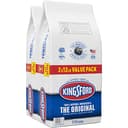
Lump or briquettes? It depends on your smoker
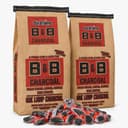
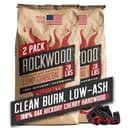
Lump charcoalis carbonized hardwood and nothing else. It lights faster, burns hotter, produces markedly less ash, and has a cleaner flavor profile. Its weakness is inconsistency — a bag contains pieces ranging from fist-sized to dust, which makes a burn less predictable and can make precise low-temperature control fiddly.
Briquettes are compressed charcoal dust with binders and additives, formed into identical pillows. That uniformity is their whole advantage: if every piece is the same size, a snake or Minion burn advances at a predictable rate, which is exactly what a bullet smoker running a twelve-hour overnight wants. You pay for it in significantly more ash and a slightly lower peak temperature.
The practical rule: bullet and kettle smokers running a snake or Minion method are usually better on briquettes, because predictability is the whole method. Offsets, kamados and gravity feeders are usually better on lump, because they want heat and airflow and they hate ash. Neither choice will ruin a brisket.
Ash is the underrated problem
Ash gets ignored in charcoal discussions and it shouldn’t, because it is a time-dependent failure. In the first four hours of a cook, ash volume is irrelevant. By hour ten, a briquette fire in a smoker with a small ash pan can be genuinely choking — ash smothers the coals below it and restricts the airflow coming up through the fire, and the symptom is a pit temperature that slowly sags no matter what you do with the vents.
This is why lump is the more common choice for very long cooks, and why anyone running briquettes on a long brisket should plan to clear the ash pan partway through, or start with a deliberately over-large fuel load in a deep ash pan. It is a solvable problem, but only if you know it’s coming.
What about “instant light” charcoal?
Don’t. Match-light and pre-treated charcoal is impregnated with lighter fluid, and while most of it does burn off, it burns off into your food during the phase where the meat surface is coolest and most receptive to deposits. On a fifteen-minute burger cook the effect is negligible. On a brisket that sits in that environment for twelve hours it is not.
The same goes for lighter fluid itself. Use a chimney starter — it is faster, costs almost nothing, uses a sheet of newspaper, and produces coals that are genuinely ready rather than coals that are still off-gassing solvent. Whatever you light with, wait until the coals are fully ashed over before the meat goes anywhere near them.
How much charcoal for a brisket?
More than you think, and it is far better to start with too much than to add cold fuel mid-cook. A bullet smoker running the Minion method typically wants a full charcoal ring — often 8 to 12 pounds — with a chimney of lit coals poured into the center. Adding unlit charcoal to a running fire causes a temperature dip and a burst of dirty smoke while it comes up to temperature, which is exactly what you don’t want part-way through a brisket. Load it once, load it heavy, and shut down whatever is left over at the end — unburned charcoal is entirely reusable.