Can You Use a Smoker on a Deck or Balcony?
Three separate questions get collapsed into this one, and they have three different answers. What you are allowed to do, what the fire code says, and what a hot cooker actually does to wood decking - in that order, because the first one can end the conversation.
How this is funded: we earn a commission if you buy through our links, at no extra cost to you. It never changes which product we recommend, and we’ll tell you plainly when we’d skip one. Full disclosure.
On a private wood deck: usually yes, with real clearance from the house and from anything overhead, and a non-combustible mat under the cooker. On an apartment balcony: charcoal and open flame are very often prohibited outright by the lease, the HOA or the local fire code, and an electric cabinet like the Masterbuilt 30-inch is typically what is allowed instead. Check your own rules before you buy anything, because the answer is set where you live and not by the cooker.
We are going to be careful on this page in a way we are not on most of them. Two of the three questions here have answers we cannot look up for you — they are in your lease and in your municipality’s code — and the third is about fire. So what follows is the order to ask them in, the hazards that are actually specific to decks and balconies, and the cookers that are usually permitted where a fire is not.
Ask these in order, because the first can end it
1. What are you allowed to do? This is a permission question, not a safety one, and people skip it because it is boring. Leases, condo bylaws and HOA rules routinely prohibit charcoal or open-flame cooking on balconies and sometimes on decks, independently of whether it would be safe. If you rent, this is a question for your landlord or management company, ideally in writing so you have the answer on paper. If you are in a condo or an HOA, it is in the bylaws.
2. What does the local fire code say? Separate from your lease, and it binds regardless of what your landlord says. Many jurisdictions restrict open-flame appliances on the balconies of multi-unit residential buildings, often with a minimum clearance from the building that a balcony cannot physically provide. Your local fire department or building department is the authority on this, and they will answer the question if you call them.
3. What does the cooker do to the surface? Only once the first two are yes. This is the part we can be useful about, and it is where the deck-specific hazards live.
That ordering matters because the three get conflated constantly. “People do it all the time” is an answer to question three and no answer at all to questions one and two.
The three hazards that are specific to a deck
A smoker on a concrete patio and the same smoker on a wood deck are not the same situation, and the differences are concrete rather than vague.
Embers through the gaps.Decking is laid with gaps between boards for drainage, and those gaps lead to a dark, dry, ventilated space underneath where debris collects. A dropped ember on concrete goes out; the same ember through a deck gap lands somewhere you cannot see it. This is the hazard that argues most strongly for a solid non-combustible mat or paver slab rather than just “being careful.”
Grease soaking into the wood.The one people underestimate. A brisket renders a remarkable amount of fat over twelve hours, and some of it ends up on the deck. It soaks into the timber and into the gaps, it accumulates across cooks, and it does not evaporate — so you end up with a combustible residue permanently sited directly under a heat source. The mat has to be bigger than the cooker’s footprint for this reason, because drips come off the edges, not the middle.
What is overhead.Almost everyone thinks about distance from the wall and almost nobody thinks about the ceiling. A deck often has a soffit, an eave, an awning or a pergola above it; a balcony has, by definition, somebody else’s balcony above it. Heat and smoke go up. Check the clearance in your cooker’s own manual and the figure in your local code, and work to whichever is larger.
Which cookers are usually permitted, and why
| Cooker type | Open flame or live fire? | Typical balcony outcome | Deck considerations |
|---|---|---|---|
| Electric cabinet | No — sealed element | Most often the permitted option | Still a hot appliance; mat for grease, clearance for heat |
| Charcoal (bullet, drum, kamado) | Yes | Frequently prohibited | Embers and ash disposal are the live hazards |
| Offset / stick burner | Yes, continuously tended | Effectively never appropriate | Fire management plus a long footprint |
| Pellet grill | Yes — pellets combust in a burn pot | Assume treated as live fire unless told otherwise | Plugs in, but the fire is real |
| Gravity-fed charcoal | Yes — charcoal, fan-driven | Treated as charcoal | Charcoal hazards plus mains power |
This table is our editorial summary of how these cooker classes are generally treated, not a statement of any rule that applies to you. Permission is set by your lease, your HOA bylaws and your local fire code, and those three can disagree with each other. The “open flame or live fire” column is a description of how each cooker works; whether a particular rule covers it is a question for the body that wrote the rule.
Going electric without giving up the brisket
If the answer for your space is “electric only,” that is a real constraint and not a death sentence for brisket. Three things make an electric cabinet produce a brisket worth eating, and all three are covered elsewhere on the site:
Add real combustion with a smoke tube. This is the big one. An element plus a chip tray produces much less smoke than a fire, which is why electric briskets tend to be lighter on smoke flavor and on the smoke ring. A pellet smoke tube is actual combustion happening inside the chamber, for the price of a lunch. It is the single most effective accessory in this situation.
Work the bark deliberately. An insulated cabinet is a humid, still environment, and bark wants the opposite. The electric method guide covers the adjustments, including when to stop spritzing and how to handle the wrap.
Check the brisket actually fits.The cabinets above state 725–730 square inches across four racks — but that is the sum of four racks and a brisket occupies one. A trimmed packer is commonly 20 to 24 inches long, and almost no maker publishes individual rack dimensions. The 40-inch cabinet in our electric roundup is the one we recommend specifically because a packer fits it laid flat; on a 30-inch cabinet, plan on a flat or on separating the point.
Two practical notes nobody mentions
Wind.A balcony is almost always windier than a yard, and wind strips heat off a cooker far faster than cold air does. An insulated body helps — Char-Broil publishes a double-wall insulated steel cabinet, which is one of the few wall-construction claims in the category. Our cold-weather roundup ranks on exactly this, and the advice there about windbreaks applies year-round on a balcony, with the obvious caveat about never blocking a vent or putting anything combustible against the cooker.
Your neighbors. Worth saying because it is the most common way a permitted cook becomes a prohibited one. A brisket smokes for twelve hours, and on a balcony that smoke goes into the windows next door and above. Even where it is entirely legal, a complaint can turn into a new building rule. Mention it to the people either side before the first cook. It costs nothing and it is usually the whole difference.
The cookers most often permitted where fire is not
To be explicit, because this is a safety page: these are the cookers that are commonly allowed where charcoal is not, and nothing below is a statement about your building. Confirm your own lease, HOA rules and local code first. Every figure is the maker’s or the listing’s own; prices are live and refresh daily.
The usual permitted answer
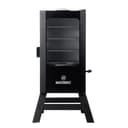
Masterbuilt 30" Digital Electric Smoker
Where charcoal and open flame are prohibited, an electric cabinet is normally what is allowed, because there is no fire and no fuel. Masterbuilt states 730 sq in over four racks and a 100-275°F range, which covers the whole brisket window. Check your own rules before buying - permission is local, not a product feature.
$299.99 · View on AmazonSee electric picksPrice as of October 22, 2026. #ad How we’re funded
The insulated body
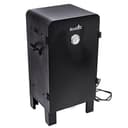
Char-Broil Analog Electric Smoker
Char-Broil publishes a double-wall insulated steel body on this cabinet, which matters twice over here: the outside runs cooler than a single-wall cooker, and it holds temperature better in wind - and a balcony is almost always windier than a yard. It is an analog dial rather than a digital controller.
See cold-weather picksThe cheapest way in
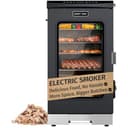
EAST OAK 30" Electric Smoker (PES23001)
A stated 725 sq in over four racks, an 800 W element and digital control from 100-275°F, at the budget end of the category. If the reason you are reading this page is that a balcony is the only outdoor space you have, this is the least money that answers it properly.
$299.99 · View on AmazonSee budget picksPrice as of October 22, 2026. #ad How we’re funded
Frequently asked questions
Can you use a smoker on a wood deck?
Often yes, with precautions, and the precautions are not optional. Three things do the work: distance from the house and from anything overhead, a non-combustible mat or paver under and around the cooker to catch embers and grease, and never leaving a lit charcoal or wood fire unattended on a wood surface. The specific hazards on a deck are embers dropping through gaps between boards, grease soaking into wood and later igniting, and radiant heat from the cooker's base. An electric cabinet removes the first two almost entirely.
Can you use a charcoal smoker on an apartment balcony?
Usually not, and this is the one answer on this page that is likely to be a flat no. Many leases and HOA rules prohibit charcoal and open-flame cooking on balconies outright, and many local fire codes restrict open-flame appliances on the balconies of multi-unit buildings - often with a minimum distance from the building that a balcony simply cannot provide. Check your lease and your local code before you buy anything. Where charcoal is prohibited, an electric smoker is typically what is allowed instead, because there is no fire.
Is an electric smoker allowed on a balcony?
It is the cooker most commonly permitted where charcoal and gas are not, because the heat source is a sealed resistance element and there is no open flame or fuel storage. It is not automatically allowed - some buildings restrict any cooking appliance on a balcony, and that is a rule rather than a safety judgement you can make yourself. Ask your landlord or management company in writing and keep the answer. Our electric roundup covers the cabinets that actually fit a brisket.
How far does a smoker need to be from the house?
Further than most people put it, and the exact figure is set by your local code rather than by us or by the manufacturer. The principle is clearance in three directions: away from the wall, away from anything combustible beside it, and crucially clear of anything overhead - soffits, eaves, awnings, the balcony above yours. The overhead one is the most commonly missed, because people think about the wall and not the ceiling. Check the clearance in your cooker's own manual and the requirement in your local code, and use the larger of the two.
What about the smoke bothering neighbors?
It is the most common reason a balcony cook gets stopped, and it is worth taking seriously because it is a genuine imposition rather than a technicality. A twelve-hour brisket produces smoke for a long time, and on a balcony it goes directly into the airspace and open windows of the units beside and above you. Even where it is permitted, a neighbor complaint can turn into a building rule. Talk to the people next door first; it costs nothing and it is usually the difference between a hobby and a dispute.
Can grease on a deck really catch fire?
Yes, and it is the deck hazard people underestimate most. Rendered beef fat soaks into wood decking and into the gaps between boards, where it accumulates over multiple cooks and does not evaporate. That gives you a combustible residue sitting directly under a heat source. The answer is a non-combustible mat or a slab under and around the cooker, large enough to catch drips from the edges rather than just the middle, and cleaning up spills when they happen rather than at the end of the season.
What is the best smoker for a balcony?
An electric cabinet, in the cases where cooking on the balcony is permitted at all. It has no fire, no fuel to store, no embers, a small footprint, and it holds a set temperature without you opening anything - which also means less smoke escaping into your neighbors' windows than a cooker you have to keep tending. Our electric roundup ranks the cabinets on published cooking area and temperature range, and the small-patio roundup covers the footprint question across the whole registry.
Does a pellet grill count as an open flame?
It has a live fire in it - pellets combusting in a burn pot - so for the purposes of a lease clause or a fire code provision about open-flame or solid-fuel appliances, assume it does unless you are told otherwise in writing. The fact that it plugs into the wall does not make it an electric smoker in the sense those rules mean. This is exactly the kind of question to put to your landlord or building management rather than to resolve by reasoning about it yourself.
Sources
- USDA FSIS — Smoking Meat and Poultry — USDA on safe smoking practices, thermometer use and approved smoker materials (accessed July 22, 2026)
- USDA FSIS — Grilling Food Safely — USDA guidance on safe outdoor cooking, thawing and holding (accessed July 22, 2026)
- USDA FSIS — "Danger Zone" (40°F - 140°F) — USDA: bacteria multiply fastest between 40°F and 140°F — the food-safety basis for the 4-hour rule (accessed July 22, 2026)
Keep reading
Best Smoker for a Small Patio
Six cookers ranked on footprint against cooking area, and whether a packer lies down inside.
See the roundupBest Electric Smoker for Brisket
The cabinets usually permitted where fire is not, on published area and temperature range.
See the roundupCharcoal vs Electric Smoker
What you give up by going electric, argued honestly - and what a smoke tube gets back.
Read the comparisonBest Smoke Tube for Brisket
The accessory that closes most of the smoke-flavor gap on an electric cabinet.
See the picksSmoking Brisket in an Electric Smoker
The method adjustments an element-and-chips cooker needs to produce real bark.
Read the guideBest Budget Smoker for Brisket
If a balcony is your only outdoor space, the least money that answers it properly.
See the roundup