Instant-Read vs Leave-In Thermometer
This is usually framed as a choice, and it is not one. The two types answer different questions - where is the cook, and is it done - and a brisket needs both answered. Which to buy first, and why.
How this is funded: we earn a commission if you buy through our links, at no extra cost to you. It never changes which product we recommend, and we’ll tell you plainly when we’d skip one. Full disclosure.
Buy the instant-read first. It is the tool that tells you the brisket is done; the leave-in only tells you where it has got to. If you own one thermometer, make it a fast instant-read like the TempPro TP19H, which states ±0.9°F and a one-second response for the price of a bag of charcoal. Add a leave-in probe second, when the problem you want to solve is sleeping through the stall rather than judging the finish.
The framing of this question is the problem with it. These are not two grades of the same device. They are two instruments for two jobs, and once you see which job each one is good at, the buying order falls out automatically.
The two questions a brisket cook asks
Over fourteen hours you ask exactly two kinds of temperature question, hours apart.
“Where is it, and where is the pit?”This is a monitoring question, and you ask it continuously — through the climb, through the stall, overnight, while you are indoors. What you need is a number that updates itself without you opening anything, plus the grate temperature so you know whether a flat line is the meat stalling or the fire dying. That is a leave-in probe, and the second channel is the part people skip and later regret.
“Is it done?” This is a judgement you make a handful of times, at the end, and it is not really a temperature question at all. Brisket is done when it is probe-tender— when a thin probe slides into the thick of the flat with almost no resistance — and tenderness is something you test in several places. That is an instant-read, because the whole point is moving from spot to spot in a few seconds.
A leave-in cannot answer the second question properly, and this is the trap. You chose its position at hour two. The flat and the point of a packer do not finish together, and a single fixed reading of 203°F in one muscle tells you very little about the other one.
Side by side, on published figures
| Instant-read (TP19H) | Wired leave-in (TP20) | Wireless leave-in (TempSpike) | |
|---|---|---|---|
| What it is for | Spot checks and calling doneness | Monitoring meat + grate | Monitoring from indoors |
| Stated accuracy | ±0.9°F | ±1.8°F | Not published as a figure |
| Stated response | 1 second | Continuous | Continuous |
| Probes / channels | One, in your hand | 2 (meat + grate) | 2 in the linked pack; internal + ambient per probe |
| Stated range | Not applicable | Up to 500 ft (RF receiver) | Up to 600 ft (gateway) |
| Needs a phone or app? | No | No — RF receiver | Yes |
| Cables under the lid? | No | Yes | No |
| Can it judge tenderness in several spots? | Yes | No | No |
Every figure is the maker’s or the listing’s own, read on the date in each product’s spec table. “Not published” means we could not find the maker stating it — and the stated ranges are line-of-sight claims, not a promise about your particular walls. We have not bench-tested any of these units and publish no accuracy results of our own.
Accuracy matters less here than anywhere else in cooking
Worth saying plainly, because thermometer marketing is built on decimal places. A steak is a five-degree decision — medium-rare and medium are a few degrees apart, and a thermometer that reads 3°F high will cost you a steak.
Brisket is not like that. It finishes over a range, usually somewhere around 200–205°F, and the actual call is made by feel rather than by number. Both figures in the table above — ±0.9°F and ±1.8°F — are comfortably better than this cook requires.
What does matter on an instant-read is speed, and for an unexpected reason. Every second the probe takes to settle is a second you are standing there with the lid open, losing heat and drying the surface you spent eight hours building. A one-second read is not about precision; it is about closing the lid sooner.
There is one safety point where the number genuinely bites, and it is not doneness. It is the reheat: the USDA figure for leftovers is 165°F measured rather than assumed, and gentle reheating is exactly where people undershoot. An instant-read settles that in a second. Our leftovers guide covers it.
The grate probe is the channel nobody buys for
If you take one argument from this page in favor of a leave-in, take this one. Most people buy a dual-probe unit for the meat channel and discover the grate channel is the one that changes how they cook.
Your cooker’s dome thermometer reads the air at the top of the chamber. The brisket is sitting at the grate, and on most smokers those two places are meaningfully different temperatures — worse on a tall cabinet, worse again in cold weather. Clip a probe at grate level beside the meat and you find out what your cook is actually running at, which is often twenty degrees from what the dial says.
It also disambiguates the single most alarming moment of a brisket cook. The meat temperature has not moved for two hours: is that the stall, or has the fire gone out? With one probe you are guessing. With two you know in a glance, and a stall is a perfectly healthy flat line while a dying fire is not.
What we would actually buy, in order
First cook, minimum kit: one fast instant-read. The instant-read roundup starts at the price of a bag of charcoal, and you will use it on everything you cook for the next decade.
Second purchase, if you cook overnight: a leave-in with a grate channel. Wired is cheaper, needs no app, and the dual-probe unit states a 500-foot RF range with alarms. Wireless costs more and removes the cable; if you are choosing between wireless units we have a head-to-head for that.
What we would not buy: a leave-in as your only thermometer. It is the more expensive instrument doing the less important job, and you will end up buying the instant-read anyway on the night you cannot tell whether the point is ready.
One of each, plus the cable-free upgrade
Every accuracy and range figure below is the maker’s or the listing’s own, read on the date in each product’s spec table — we have not bench-tested any of them. Prices are live and refresh daily.
Buy this one first
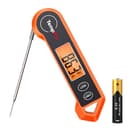
TempPro TempSwift PLUS TP19H Instant-Read Thermometer (the ThermoPro TP19H)
The instant-read is the tool that calls doneness, and this is the cheapest one we would trust to do it: stated ±0.9°F accuracy, a stated 1-second response, IP65 waterproofing and a backlit rotating display for night cooks. If you own exactly one thermometer, own this type.
See instant-read picksThe app-free leave-in
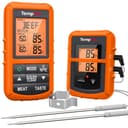
TempPro TempSync CORE TP20B Wireless Dual-Probe Thermometer (the ThermoPro TP20)
Two wired probes - one in the meat, one at the grate - with an RF receiver and alarms, stated to 500 ft and ±1.8°F. No phone, no account, no app update breaking your cook at 3am. The trade is cables running under the lid, which do eventually wear.
See the thermometer hubThe leave-in with no cables
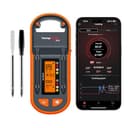
TempPro TempSpike PLUS TP972 Truly-Wireless Thermometer, 2 probes (formerly ThermoPro)
A truly wireless probe with internal and ambient sensors, a stated 600 ft range through its gateway and phone alerts on your target temperature. This is the one that makes an overnight brisket genuinely restful. The linked listing is the 2-probe pack, so it costs accordingly.
See wireless picks
Frequently asked questions
Do I need both an instant-read and a leave-in thermometer for brisket?
Eventually, yes, and if you can only buy one, buy the instant-read. A leave-in probe tells you the trend - where the brisket is, whether it has stalled, whether the pit is drifting - from one fixed spot you chose hours ago. An instant-read lets you check several places in a few seconds, which is the only way to judge a brisket whose thick point and thin flat finish at different times. The leave-in is the better monitoring tool and a worse doneness tool.
Which should I buy first for brisket?
The instant-read, without much hesitation. It is the cheaper of the two, it is the tool that actually calls doneness, it is the only one that lets you probe for tenderness in several spots, and it does not stop being useful when you cook anything else. A good instant-read costs a fraction of a wireless probe set. Buy the leave-in second, when the thing you want to solve is being awake at 3am rather than being unsure whether the brisket is ready.
Can I just use the leave-in probe to tell when brisket is done?
It will get you close and then mislead you at the last step, which is the worst possible place. A leave-in probe sits where you put it eight hours ago, and the flat and the point of a packer do not finish together - so a single reading of 203 degrees F tells you about one point in one muscle. Brisket doneness is probe tenderness rather than a number anyway, and testing tenderness means sliding something into several spots and feeling the resistance. That is an instant-read's job.
Does the leave-in probe ruin the bark where it goes in?
Only at the puncture, and the fix is to put the probe in from the side of the flat rather than down through the top. You get the same depth, the cable or the probe body sits along the meat instead of standing up through the crust, and the one small hole is on a face nobody looks at. The more serious bark question is whether you open the lid to check - every lid opening costs you heat and surface moisture, which is the real argument for having a leave-in at all.
How accurate do these need to be for brisket?
Less accurate than for a steak, which is a genuinely useful thing to know. A steak is a 5 degrees F decision; brisket is done over a range, and being half a degree out changes nothing because you are going to finish on feel rather than on a number. The TempPro instant-read in our registry states ±0.9 degrees F and the dual-probe leave-in states ±1.8 degrees F - both are far better than the cook needs. What matters more than accuracy is speed on an instant-read, because you are holding a lid open while it settles.
Is a wireless probe worth it over a wired one?
For an overnight brisket, it is the single most restful upgrade in this category. A wired dual-probe runs cables out under the lid, which works perfectly and means a cable to route, a receiver to carry and a wire that eventually fails. A truly wireless probe has nothing leaving the cooker; the TempSpike in our registry states a 600 ft range via its gateway and sends alerts to a phone. The costs are real: it is the more expensive option, and it depends on an app and a battery rather than on a wire.
Can I use a dome thermometer instead of a grate probe?
Not for a brisket you care about. A dome gauge reads the air at the top of the cooker, which on most smokers sits a meaningful distance from the temperature at the grate where the meat is - and the gap gets worse in cold weather and on tall cabinets. That is exactly what the second probe on a dual-probe unit is for: clip it at grate level, next to the brisket, and trust that instead. It is also how you discover that your cooker's dial has been lying to you for a year.
Sources
- USDA FSIS — Safe Minimum Internal Temperature Chart — USDA safe minimum internal temperatures, incl. 145°F for beef cuts plus a 3-minute rest (accessed July 22, 2026)
- USDA FSIS — Doneness Versus Safety — USDA on the difference between a safe temperature and the temperature that makes tough cuts tender (accessed July 22, 2026)
- ThermoWorks — Smoked Brisket: A How-To Primer — ThermoWorks on brisket internal temperature, probe tenderness and the stall (accessed July 22, 2026)
Keep reading
Best Instant-Read Thermometer for Brisket
The spot-check tool that calls doneness, ranked on stated accuracy and response time.
See the roundupBest Wireless Meat Thermometer
The cable-free leave-in probes, and what their stated ranges mean in a real backyard.
See the roundupWhat Temp Is Brisket Done?
Why the answer is a range and a feel rather than a single number on a display.
Read the guideTelling Doneness Without a Thermometer
The four tests experienced cooks use, and where a thermometer still earns its place.
Read the guideSmoking Brisket Overnight
The cook that makes a leave-in probe worth the money, planned properly.
Read the guideMEATER vs TempSpike
If you have decided on a wireless leave-in, this is the head-to-head.
Read the comparison