Truly wireless vs cabled: the real trade
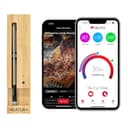
Truly wireless probes are elegant. Nothing runs through the smoker door, so nothing gets pinched, nothing stops the lid closing properly, and nothing gets caught when you move the brisket. They usually read both internal meat temperature and ambient temperature from the same probe, which is genuinely useful. The catches are battery life (the probe itself has to hold charge for the whole cook) and radio range, since a small transmitter buried inside a large piece of meat inside a metal box is a difficult radio environment.
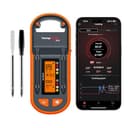
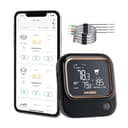
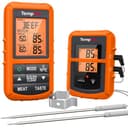
Cabled transmittersare less elegant and more dependable. A wire carries the signal out of the smoker to a transmitter sitting in open air, which solves the radio problem entirely and means the probe needs no battery of its own. They also typically support multiple probes at once — useful when you want one in the flat, one in the point and one measuring grate temperature. The cost is a wire trapped in your smoker door, which will eventually fray at the pinch point. Every cabled probe dies there.
The honest summary: truly wireless is better to use, cabled is more reliable to depend on. For a first probe, cabled is the safer buy. For a second, wireless is the nicer one.
Range claims and what they mean indoors
Manufacturer range figures are line-of-sight in open air. A quoted 165 feet is a real measurement taken in conditions that bear no resemblance to your house, where the signal has to leave a metal smoker, cross a yard, pass through an exterior wall and reach a phone in an upstairs bedroom. Expect a substantial fraction of the quoted figure in practice.
This is the strongest argument for a Wi-Fi unit if you intend to sleep through a cook. A Bluetooth probe needs your phone within radio range all night; a Wi-Fi unit joins your home network and pushes alerts through the internet, so it works from a bedroom, or from the shops. If your smoker sits far from the house, or the house has thick walls, Wi-Fi stops being a luxury.
Where to place the probe
Into the thickest part of the flat, from the side, with the sensing tip in the center of the muscle — not in the fat seam between the point and the flat, and not touching the grate. The fat seam is a genuinely common error and it reads several degrees off, because rendered fat behaves differently from muscle. Most truly wireless probes have a marked safe-insertion depth line; respect it, because the ambient sensor at the other end needs to stay out of the meat to read pit temperature.
If your unit supports a second probe, clip it at grate level near the meat. Pit temperature at the grate is frequently 15 to 25°F different from the reading on the smoker’s built-in lid dial, and knowing that gap is often the explanation for a cook that is running much faster or slower than expected.
Worth saying plainly before you spend this much: a wireless probe is a monitoring tool, not a doneness tool. It reads one spot you chose hours ago, and a packer’s flat and point do not finish together. If you do not already own a fast instant-read, buy that first — we set out why in instant-read vs leave-in thermometer, along with the grate channel most people do not realize they are buying.
Alerts worth setting for a brisket
Set an alert at around 160°Fto catch the beginning of the stall — this is your cue to start thinking about the wrap. Set a second at around 195°F, which is the point at which you should start checking for probe tenderness rather than waiting for a number. Set a pit-temperature alarm with a band of about 25°F either side of your target, so a fire going out or running away wakes you before it becomes a disaster.
What you should not do is set an alert at your target pull temperature and treat it as the finish line. Brisket is done when it probes tender, which can be anywhere from roughly 195 to 210°F depending on the animal — see what temp brisket is done. The thermometer tells you when to start paying attention, not when to pull.