How to Smoke a Brisket on an Offset Smoker
Everything a pellet grill automates, an offset hands back to you. That is the whole trade: the best smoke flavor available to a backyard cook, in exchange for staying awake and feeding a fire every hour for twelve hours.
How this is funded: we earn a commission if you buy through our links, at no extra cost to you. It never changes which product we recommend, and we’ll tell you plainly when we’d skip one. Full disclosure.
An offset smoker is the only common backyard cooker that burns wood the way a commercial pit does: a live fire in a separate box, its heat and smoke drawn through a chamber and out a stack. Everything good about it and everything hard about it comes from that one fact. There is no controller, no auger and no thermostat. There is a fire, and you are the thermostat.
The method below assumes you have read the full brisket method and are adapting it to a stick burner. Trimming, seasoning, the doneness window and the rest do not change because the cooker changed. What changes is the fire.
Build a coal bed before you build a fire
The single most common offset mistake is treating splits as fuel you light. They are not. Splits are fuel you add to something already burning hot. Start with a full chimney of lump charcoal, let it ash over, and pour it into the firebox against the grate. That bed is what ignites each subsequent split quickly and completely.
Drop a cold split onto a cold or dying grate and it will smolder instead of burning — pyrolyzing at a low temperature, releasing heavy particulate and unburned compounds. That is the smoke that tastes like an ashtray. Nearly every bitter brisket traces back to this moment.
Let the steel soak
Run the pit empty until it holds your target steadily — 30 to 45 minutes on a thin-walled smoker, considerably longer on heavy steel. Cook chambers store heat in their mass, and an offset whose walls are still cold will dump temperature every time you open the door and will fight you for the first two hours.
This is also the moment to learn what your pit actually does, because the lid thermometer is almost certainly lying. It sits at the top of the dome, away from the grate, often several inches from where the meat will be. Put a probe at grate level and compare. A 30-40°F disagreement is completely normal, and knowing the offset means every number after this is trustworthy.
Vents: one throttle, not two
The exhaust stack stays fully open for the entire cook. Every temperature adjustment happens at the firebox intake. This is not a stylistic preference — a partially closed stack slows the draw, holds spent smoke against the meat and starves the fire of oxygen, which makes it burn dirty at the exact moment you were trying to cool it down.
Damping the intake reduces air to the fire and brings the chamber down. Opening it feeds the fire and brings it up. Move the intake in small increments and wait ten minutes before judging; an offset responds slowly and the usual failure is chasing the needle with constant adjustments.
Load the meat with the gradient, not against it
Every offset is hotter at the firebox end. Reverse-flow designs, where a baffle plate runs heat down the length of the chamber under the grate before letting it rise, narrow the difference substantially — that is the argument for the reverse-flow Oklahoma Joe’s Highland and similar pits. They do not erase it.
So work with it: point toward the fire, flat away from it. The point is the fatty muscle and it tolerates the hot end; the lean flat is what dries out and belongs in the cooler zone. Rotate the whole brisket 180 degrees once, at around the halfway mark when the bark has set. Once. Every door opening costs you heat and smoke.
The split cycle
This is the rhythm of the cook: roughly every 45 to 60 minutes, add one split to the coal bed. Not two, not an armful. One.
Leave the firebox door cracked for a minute or two after adding so the split catches properly and burns off its initial heavy smoke with plenty of oxygen. You are waiting for the exhaust to go from white and billowing to a barely-visible haze — thin blue smoke — before you close up. That waiting period is the difference between smoke that flavors the brisket and smoke that ruins it.
Expect the chamber to rise 15-20°F after each split and drift back down before the next. Riding that oscillation is normal and correct. Trying to flatten it by adding smaller and smaller pieces more often just means the fire never establishes itself.
The stall, the wrap and the finish
None of this is offset-specific, and it is covered in depth elsewhere: the stall arrives at 150-170°F and lasts for hours, wrapping in butcher paper at around 165-175°F pushes through it while keeping bark firm, and the brisket is done when the probe slides in with no resistance, usually somewhere between 195 and 205°F.
One offset-specific note on the wrap: a stick burner is a dry, hard-drafting cooker, and bark on an offset typically sets earlier and harder than on a pellet grill or an electric cabinet. If anything you will find yourself wrapping slightly sooner than the guides suggest, not later.
Then rest it properly. Vent to about 170-175°F so it stops cooking, then hold in a pre-warmed cooler for an hour minimum. After twelve hours of feeding a fire, slicing early is a genuinely expensive mistake.
Who should not buy an offset
We would rather say this plainly than sell you a pit. An offset asks for your entire day and cannot be run while you sleep. If your realistic brisket schedule involves starting at 10pm and going to bed, an offset is the wrong tool and no amount of technique fixes that — look at gravity-fed charcoal or a pellet grill instead. Buy an offset because you want to tend a fire, not because you have been told it is the only way to make real barbecue.
What an offset cook specifically needs
Nothing here is exotic. An offset asks for fuel you can control and a way to see the temperature where the meat actually is. Prices are live and refresh daily.
The coal bed
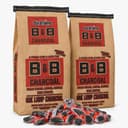
B&B Charcoal Oak Lump Charcoal
An offset runs on a live coal bed with splits on top. Lump lights fast, burns hot and leaves little ash to choke the firebox grate.
See charcoal picksThe splits
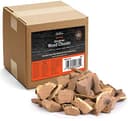
Camerons Products Oak Smoking Wood Chunks
Fist-sized post oak chunks are the closest most people can get to seasoned split logs without a woodpile. Mild enough to burn for twelve hours.
$34.95 · View on AmazonSee wood picksPrice as of October 22, 2026. #ad How we’re funded
The grate probe
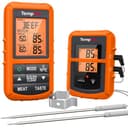
TempPro TempSync CORE TP20B Wireless Dual-Probe Thermometer (the ThermoPro TP20)
The lid thermometer sits in the wrong place and reads the wrong thing. A dual-probe unit gives you grate temperature next to the meat plus the internal.
See thermometer picks
Frequently asked questions
How often do you add wood to an offset smoker?
Roughly every 45 to 60 minutes for a single split, though it depends on the size of your firebox, the size of your splits and the weather. That interval is the defining fact of offset cooking: it means a twelve-hour brisket involves somewhere around a dozen fire interventions and cannot be left alone or run overnight while you sleep. If that sounds unworkable for your life, a gravity or pellet cooker gives you most of the result for none of the attention.
Should the fat side face up or down on an offset?
Fat side down. On an offset the dominant heat source is the firebox below and beside the chamber, and radiant heat comes up off the cook chamber floor, so the fat cap belongs between that heat and the lean flat. This is one of the few cookers where the answer is not genuinely arguable. The side facing up also builds better bark, which is another reason to leave the meat side exposed.
Why does my offset run hotter at one end?
Because that is how the design works — heat and smoke enter at the firebox end and exit at the stack, so there is always a gradient across the chamber. Reverse-flow models like the Oklahoma Joe's Highland run a baffle plate under the grate to push heat to the far end first, which narrows the gap considerably but never eliminates it. Load the point end toward the fire, rotate once mid-cook, and stop treating the gradient as a fault.
Do I need to soak wood for an offset smoker?
No, and it actively hurts. Soaked wood does not smoke for longer — it spends its first several minutes boiling off surface water, which lowers firebox temperature and produces exactly the white, smoldering smoke that deposits creosote. Splits and chunks for an offset should be dry and seasoned. The only thing soaking reliably produces is a dirtier fire.
Can you smoke a brisket overnight on an offset?
Not safely, and not really at all. An offset needs a split roughly every hour, so an unattended overnight run means the fire goes out and the chamber falls through the USDA danger zone with meat in it. The common workaround is to start before dawn and finish in the evening, or to run the first stretch on the offset for smoke and move the wrapped brisket into an oven to coast. If you want to sleep through a cook, buy a controller-driven cooker.
What temperature should an offset smoker run for brisket?
Aim for 250°F at grate level next to the meat, and accept that it will swing. An offset that oscillates between roughly 235 and 265°F across a split cycle is behaving normally and the brisket will not notice; a pit that spikes to 350°F every time you add wood is being fed too much at once or has too little coal bed. Judge the pit by its average, not by the worst number you catch it at.
Sources
- USDA FSIS — Smoking Meat and Poultry — USDA on safe smoking practices, thermometer use and approved smoker materials (accessed July 22, 2026)
- ThermoWorks — Smoked Brisket: A How-To Primer — ThermoWorks on brisket internal temperature, probe tenderness and the stall (accessed July 22, 2026)
- Meathead's AmazingRibs.com — What Causes The BBQ Stall — Documentation (citing Greg Blonder's research) that the stall is evaporative cooling, not fat or collagen (accessed July 22, 2026)
Keep reading
Best Offset Smoker for Brisket
Real stick burners compared on steel, airflow and cook area.
See offset picksBrisket Fire Management
Clean fire, steady temperature, thin blue smoke — how to get all three.
Read the guideOffset vs Pellet Smoker
The category decision, if you have not committed to a stick burner yet.
Read the comparisonWhy Does My Brisket Taste Bitter?
The failure mode offsets are most prone to, and how to avoid it.
Read the diagnosis