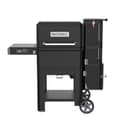
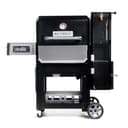
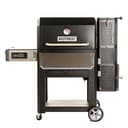
What the three have in common
All three are the same machine at three sizes, and the design is genuinely clever. A tall vertical hopper holds charcoal; gravity drops it onto a burning column at the bottom; a fan and a digital controller decide how hard that column burns by deciding how much air reaches it. The result is real charcoal and real wood smoke, held at a set temperature, without you opening a vent. All three state a 225–700°F range, so all three will cook a brisket at 225°F and sear a steak afterwards. All three need mains power: no electricity, no cook.
That shared design is why this comparison is almost entirely about two numbers — grate area and hopper endurance — and why the second one is the one that decides a brisket purchase. Our gravity versus pellet comparison covers the case for the format as a whole; this page is only about which size.
The hopper figures run backwards
This is the part worth slowing down for, because it is counter-intuitive and it is published rather than inferred.
Masterbuilt states the 600’s hopper at 12 lb of lump or 18 lb of briquettes, up to 18 hours at 225°F. It states the 1050’s at 10 lb of lump or 16 lb of briquettes, up to 10 hours. For the 800, the listing we read publishes neither a capacity nor a duration.
So the smallest cooker in the range holds the most charcoal and runs the longest, and the biggest holds the least and runs the shortest. Two things explain it: the 600 has a physically larger hopper, and a smaller chamber takes less fuel to hold at temperature, so the same charcoal lasts longer. The 1050 is doing the opposite on both counts.
For almost any other kind of cooking this is irrelevant — ten hours is more than enough for ribs, chicken, a pork shoulder, a full day of burgers. Brisket is the one cook where it decides the night. Our time-and-temperature guideputs a typical 14-pound packer at 225°F somewhere in the 12-to-16-hour range before the rest, and the overnight method exists precisely because most people would rather sleep through the middle of it.
Side by side
| | Gravity 600 | Gravity 800 | Gravity 1050 |
|---|
| Stated cooking area | 600 sq in | 800 sq in | 1,050 sq in |
| Whole packers at once | One, comfortably | One, with room | Two |
| Stated hopper capacity | 12 lb lump / 18 lb briquettes | Not published | 10 lb lump / 16 lb briquettes |
| Stated burn time | Up to 18 hours at 225°F | Not published | Up to 10 hours |
| Stated temperature range | 225–700°F | 225–700°F | 225–700°F |
| Connectivity | Wi-Fi + Masterbuilt app | Wi-Fi + Bluetooth | App, up to 4 meat probes |
| Needs mains power | Yes | Yes | Yes |
Every figure is Masterbuilt’s or the listing’s own stated number, read on the dates shown in the spec tables above. “Not published” means we could not find Masterbuilt stating it for that model — it is not an estimate withheld. The “whole packers at once” row is our reading of the stated areas against the footprint of a trimmed packer, not a manufacturer claim.
What a hopper top-up actually costs you
Worth being concrete, because “you might have to add charcoal” sounds trivial and the real cost is specific.
Topping up a gravity hopper mid-cook is not difficult — you open the hopper lid and pour. The cost is that you have to be awake and present at an unpredictable hour, because the hopper empties when it empties rather than on your schedule, and the burn rate depends on your set temperature, the ambient weather and the fuel you loaded. On a 10-hour stated figure with a cook that may run 14, you are planning to intervene at some point between midnight and 4am. That is the entire practical difference between the 600 and the 1050 for a single brisket, and it is why the small one wins a comparison it looks like it should lose.
The mitigation, if you own or want the 1050: start the brisket earlier so the top-up lands at bedtime rather than in the middle of the night, use briquettes rather than lump for the higher stated capacity, and consider the oven handoverafter the wrap — once the brisket is wrapped it is no longer taking smoke, so the fuel question largely disappears.
What the 800 is for
The 800 is the model that sells the most, and not unreasonably: it sits in the middle on grate, it has the Wi-Fi and Bluetooth control, it has a wood chamber for smoke wood alongside the charcoal, and it is the all-rounder of the three. Our full review makes the case, and it is our overall gravity pick and our pick on the grill-and-smoker combo page.
For this specific comparison, the honest statement is that we cannot tell you how long its hopper runs, because Masterbuilt does not publish it on the listing we read. Nor are we going to interpolate between the 600 and the 1050 and present the result as a specification — the two published figures do not sit on a line you can interpolate along, which is exactly the point this page makes. If the 800 is the cooker you want, the sensible thing is to plan your first brisket as though a top-up will be needed and find out on a cook where that is not a crisis.
Which one, in one line each
600— one brisket, overnight, no alarm set. The published 18-hour figure at 225°F is the single most brisket-relevant number Masterbuilt publishes anywhere.
800— the cooker to buy if brisket is one of several things you do and you want the best general-purpose charcoal machine of the three. Plan for a top-up until you know otherwise.
1050 — two packers, or a cook for a crowd. Our large-family roundup picks it for exactly that, and our two-brisket guide covers the timing. Buy it for capacity with your eyes open about the hopper.
And if the whole fan-and-controller premise is what you are unsure about rather than the size, the manual charcoal smokers cost a fraction of any of these and will outlive all three, at the price of managing the fire yourself.