How to Tell If Brisket Is Done Without a Thermometer
Four tests work without one, and the best of them — probe tenderness — is what experienced cooks trust over any number anyway. What a thermometer gives you is not the verdict. It is everything leading up to it.
How this is funded: we earn a commission if you buy through our links, at no extra cost to you. It never changes which product we recommend, and we’ll tell you plainly when we’d skip one. Full disclosure.
Yes, you can tell, and the test that works is the one experienced cooks already trust more than their thermometers: probe tenderness. Slide something thin into the thickest part of the flat. If it goes in and comes out with almost no resistance — the way it would into room-temperature butter — the brisket is done, whatever the temperature happens to be. If you have to push, it is not, and the only remedy is more time.
The reason that is not a compromise is worth saying plainly up front. Brisket does not become tender at a temperature. It becomes tender when enough collagen has converted to gelatin, and that depends on temperature and time together. This is why the famous 203°F is a landmark rather than a target, and why two briskets from the same case can be done nine degrees apart. A thermometer measures one variable of a two-variable process. Feel measures the result.
What you genuinely lose without a thermometer is not the verdict at the end. It is navigation — knowing at hour seven whether you are in the stall or in trouble, knowing when the surface is ready to wrap, and knowing whether a long hold has drifted somewhere it should not. We will come back to that, because it is the honest case for owning one.
Test one: the probe test
This is the test. The other three are confirmations.
What to use. Thin and blunt. A bamboo skewer, a wooden toothpick, a metal cake tester, or the probe of an instant-read thermometer. Nota fork — the tines are thick and spread, so you tear the meat and get a muddled signal — and not a knife tip, because a sharp edge cuts through resistance rather than reporting it, which is the one thing you are trying to measure.
Where to push it in.The thickest part of the flat. The flat is the last part of a packer to finish, so it is the part that decides. Probing the point and declaring victory is the single most common way to pull a brisket early, because the point — fattier, more marbled, more collagen-rich — goes tender well before the flat and will happily tell you a flattering lie. If you are not sure which muscle you are in, our point versus flat guide has the geography.
What you are feeling for.The absence of springback. There will always be resistance at the surface, where the bark is dry and firm — ignore that. What matters is what happens underneath. Push through in one slow motion and pay as much attention to pulling the probe out as to pushing it in; an underdone brisket grips on the way back.
Probe in four or five places.Briskets cook unevenly, and a single soft spot proves nothing. If four spots across the flat feel like butter and one still grips, you are not done — give it another thirty to forty-five minutes and try again. If one area is persistently behind, that is a hot-spot problem rather than a doneness problem, and our uneven-cook page covers it.
Test two: the jiggle
Lift the brisket with gloved hands or two wide tongs, under the middle. A finished brisket has lost most of its structure: it droops heavily on both sides of your hands and wobbles when you move it, closer to a wet towel than to a joint of meat. One that still holds itself more or less straight has collagen left to convert.
This is the test to use as a cross-check on the probe, and it is wonderfully unambiguous when it works. Two caveats. First, it tells you about the point more than the flat, because the point is where the dramatic structural collapse happens — so on a lone flat expect far less jiggle even at perfect doneness, and lean on the probe instead. Second, do it over the cooker rather than over the patio. A brisket that is genuinely done is also genuinely fragile, and this is how people learn that the hard way.
Test three: the bend and the fat cap
Two smaller signals that are worth reading together, neither of them conclusive on its own.
The bend. Pick the brisket up by one end with tongs and see how far the other end hangs. At doneness it folds over on itself readily. Earlier in the cook it stays comparatively rigid. This is the same information as the jiggle, in a form that is sometimes easier to see.
The fat cap.On a finished brisket the remaining fat on the cap has rendered to the point where it is soft and translucent rather than firm and white, and a fingertip pushed into it leaves a dent. Hard white fat anywhere on the brisket means you are not there — and if the brisket is probe-tender while the fat is still hard, that is a specific and diagnosable problem our rendering page addresses.
Test four: the test slice
The only test that is completely unambiguous, at the cost of committing. Cut one slice off the thin end of the flat, across the grain, about the thickness of a pencil, and look at it and pull it.
A finished slice holds together when you lift it by one end but pulls apart with a gentle tug and no snapping. An underdone one is springy and resists the pull. An overcooked one falls apart in your fingers before you have lifted it — which is a real failure mode, and yes, you can overcook a brisket. The thin end of the flat is the right place to take this slice because it is the driest, least valuable part of the brisket and the part most likely to finish first anyway. Do it after the rest, not before, if you possibly can; our slicing guide explains why a hot brisket gives you a misleading answer.
What the four tests do and do not tell you
| Test | What it measures | How much to trust it |
|---|---|---|
| Probe feel | Collagen conversion in the muscle you probed | The primary test. Use it in four or five places on the flat. |
| Jiggle / bend | Loss of structure, mostly in the point | Strong cross-check on a packer, weak on a lone flat |
| Fat cap feel | Whether the fat has rendered | Useful supporting signal; hard white fat is a clear no |
| Test slice | The finished texture, directly | Unambiguous, but you have cut the brisket to find out |
| Time per pound | Nothing, strictly speaking | Plan with it, never pull on it |
This table is our reading of what each test can and cannot report, argued from how brisket actually becomes tender. It is not a measurement, and no part of it comes from a lab — our methodology page sets out exactly what we do and do not do.
Why time per pound is not a fifth test
It gets offered as one constantly, so it is worth closing off. The usual figure is somewhere between one hour and one and a half hours per pound at 225°F, and our time-and-temperature guide uses it to work out when to light the fire. As a planning number it is genuinely useful.
As a doneness test it is close to worthless, because at least four things move it by hours. The grade of the brisket (a Prime packer behaves differently to a Select one). How hard you trimmed. How long the stall ran, which varies with humidity and airflow and is evaporative cooling rather than collagen. And whether and when you wrapped. Two 14-pound briskets from the same case, on the same cooker, can finish two hours apart. A clock cannot see any of that; a skewer can.
The honest case for owning a thermometer anyway
Everything above works, and people cooked brisket for a century before cheap digital thermometers existed. But the argument for one is not really about the moment you pull the meat, which feel handles well. It is about three other things.
Navigation through the middle of the cook.At hour seven, feel tells you nothing — the brisket is nowhere near tender and will not be for hours, so every test on this page returns the same unhelpful answer. A temperature tells you whether you are climbing normally, deep in the stall, or running hot. That is the information that lets you adjust rather than wait.
Knowing when to wrap. The wrap decision is made on bark and on where you are in the stall, not on tenderness, and it is one of the few genuinely consequential choices in the cook.
The two places safety actually bites. By the time a brisket is probe-tender it has spent many hours far above anything that concerns the USDA, so a properly cooked brisket is not a safety question. The danger sits either side: a long holdwhere the meat drifts down through the 40–140°F danger zone unnoticed, and reheating leftovers to less than 165°F. Neither of those can be judged by feel at all, and both are more common than an undercooked brisket.
That is the real pitch. Not that your fingers are unreliable — they are more reliable than a number — but that the hours before the verdict and the hours after it are both invisible without one.
What to buy once you are tired of guessing
We are not going to pretend the tests above are as good as knowing. They are what you use when you have no thermometer, and they work — but the reason every serious brisket cook owns a thermometer is that feel tells you whether you have arrived and temperature tells you how far you still have to go. These three are the cheap end of the answer. Prices are live and refresh daily.
The cheapest way to stop guessing
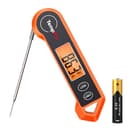
TempPro TempSwift PLUS TP19H Instant-Read Thermometer (the ThermoPro TP19H)
Everything on this page works. What it does not do is tell you where you are in the cook, which is what you need at hour eight when nothing feels right yet. An accurate instant-read answers that in one second for about the price of two briskets' worth of charcoal.
See instant-read picksThe probe that doubles as the feel test
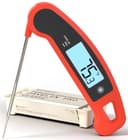
Lavatools Javelin PRO Duo Instant-Read Thermometer
A long, thin instant-read probe is also the best tool for the probe-tenderness test itself — it slides in with less resistance than a skewer and gives you a number at the same moment it gives you the feel. One tool, both tests.
$43.99 · View on AmazonSee instant-read picksPrice as of October 20, 2026. #ad How we’re funded
So you never have to open the lid to ask
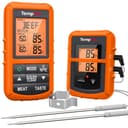
TempPro TempSync CORE TP20B Wireless Dual-Probe Thermometer (the ThermoPro TP20)
A leave-in probe with one lead in the meat and one at the grate tells you whether the brisket is climbing, stalled or finished without lifting a lid. For an overnight cook, this is the difference between sleeping and setting alarms.
See leave-in picks
Frequently asked questions
How do you know when brisket is done without a thermometer?
Probe it. Slide something thin — a skewer, a bamboo toothpick, a cake tester — into the thickest part of the flat. When it goes in and comes out with almost no resistance, the way it would into room-temperature butter, the brisket is done. Back that up with the jiggle test: lifted on gloved hands or wide tongs, a finished brisket droops heavily in the middle and wobbles rather than holding its shape. Both of these are better doneness signals than any single temperature.
What does probe tender actually feel like?
Like pushing a skewer into softened butter, or into a jar of peanut butter at room temperature — resistance at the surface where the bark is, then almost nothing underneath. What you are feeling for is the absence of springback. An undercooked brisket pushes back and grips the probe; a finished one lets it fall through and lets it out again just as easily. If you have to lean on it, it is not ready, and the only cure is more time.
Can you tell brisket is done by time per pound?
Only roughly, and not reliably enough to pull on. The usual figure is somewhere between an hour and an hour and a half per pound at 225°F, but two 14-pound briskets from the same case can finish two hours apart depending on grade, how hard you trimmed, how long the stall ran, and whether and when you wrapped. Use time to plan when to start and when to begin checking. Do not use it to decide when to pull.
Is 203°F the magic brisket temperature?
No, it is a landmark. Brisket becomes tender when enough collagen has converted to gelatin, and that is a function of temperature and time together rather than of hitting one number. Plenty of briskets are probe-tender at 198°F and plenty need 207°F. Treating 203°F as a target is how people pull a brisket that is still tough, because the number arrived before the texture did.
Is it unsafe to cook a brisket without a thermometer?
For whole-muscle beef specifically, this is a quality question far more than a safety one. By the time a brisket is probe-tender it has spent many hours well above any temperature that concerns the USDA, so a brisket you have cooked until it is genuinely tender is not a safety risk. The risks that remain are at the other end of the cook: a long holding period where the meat drifts down through the danger zone unnoticed, and reheating leftovers to less than 165°F. Those are the two places where not having a thermometer genuinely costs you.
Can you use a fork or a knife instead of a probe?
A fork is a poor substitute — the tines are thick and widely spaced, so you tear the meat and get a confused signal. A knife tip is worse, because a sharp edge cuts rather than meeting resistance, which is exactly the information you want. Thin and blunt is the right shape: a bamboo skewer, a wooden toothpick, a metal cake tester, or the probe of an instant-read thermometer. A bamboo skewer costs nothing and works genuinely well.
Does the brisket jiggle test work on a flat?
Less well, and it is worth knowing why. The jiggle comes mostly from the point, which is the fattier, more collagen-rich muscle and so loses its structure more dramatically. A lone flat is leaner and holds its shape more, so a flat that is perfectly done may jiggle only a little. On a flat, lean on the probe test and the test slice instead.
Where should you probe a brisket?
The thickest part of the flat, which is the last part of the brisket to finish and therefore the part that decides whether the whole thing is ready. Probe in several spots across it rather than trusting one, because briskets cook unevenly — if two spots feel like butter and one still grips, it is not done. Avoid probing into the point and calling it: the point gets tender well before the flat does and will tell you a flattering lie.
Sources
- USDA FSIS — Doneness Versus Safety — USDA on the difference between a safe temperature and the temperature that makes tough cuts tender (accessed July 22, 2026)
- USDA FSIS — "Danger Zone" (40°F - 140°F) — USDA: bacteria multiply fastest between 40°F and 140°F — the food-safety basis for the 4-hour rule (accessed July 22, 2026)
- ThermoWorks — Smoked Brisket: A How-To Primer — ThermoWorks on brisket internal temperature, probe tenderness and the stall (accessed July 22, 2026)
- Meathead's AmazingRibs.com — What Causes The BBQ Stall — Documentation (citing Greg Blonder's research) that the stall is evaporative cooling, not fat or collagen (accessed July 22, 2026)
Keep reading
What Temp Is Brisket Done?
The number in context: why about 203°F is a landmark and probe feel outranks it.
Read the guideIs Brisket Done at 200°F?
Sometimes. What to check before you pull, and why the number alone cannot answer it.
Read the guideWhy Is My Brisket Tough?
The failure this page exists to prevent: pulled before the collagen converted.
Read the diagnosisBest Instant-Read Thermometer
The cheap tool that turns all of this from a judgement call into a check.
See the picksThe Brisket Stall
The hours when nothing seems to be happening — and why feel tells you nothing yet.
Read the guideHow to Slice a Brisket
The test slice doubles as the first real slice. Where the grain runs and where it turns.
Read the guide