Kamado Joe Classic Joe vs Big Joe
Same ceramic, same vents, same ash drawer, same temperature range. One is 18 inches across and one is 24, and for a whole packer brisket that single number settles the argument before any other spec gets a vote.
How this is funded: we earn a commission if you buy through our links, at no extra cost to you. It never changes which product we recommend, and we’ll tell you plainly when we’d skip one. Full disclosure.
If you buy whole packers, buy the Big Joe. If you buy flats, the Classic Joe does the same job for a great deal less money and 131 fewer pounds. That is the whole decision, because these two grills are the same cooker at two diameters: the same ceramic body, the same 2-tier Divide & Conquerrack, the same slide-out ash drawer, the same cast iron top vent, the same stated 225 to 750°F range and the same limited lifetime warranty. Kamado Joe publishes 18 inches across for the Classic and 24 for the Big Joe, and on a round grate that number is not a preference. It is a yes or a no.
What follows is the geometry that makes it a yes or a no, the maker’s figures side by side, the two things neither page tells you, and who each grill is honestly for. We have not cooked on either one — our methodology pagesets out exactly what we do instead — so every specification here was read from Kamado Joe’s own product pages on October 18, 2026, and anything that is our arithmetic is labeled as ours.
Why the area figure is the wrong number
Kamado Joe states 250 square inches of cooking space for the Classic Joe and 450 for the Big Joe. Those are consistent with full circles of 18 and 24 inches, and the jump between them looks enormous: 1.8 times the area for a diameter only a third larger. That is simply what happens to circles — area grows with the square of the diameter — and it is the number every listing leads with.
It is also almost useless for this decision. A brisket does not consume area; it consumes a straight run of length. Length grows in proportion to diameter, not to its square. So the honest version of the upgrade is not “80 percent more grill” — it is “six more inches across,” and whether those six inches matter depends entirely on what you put on the grate.
For four chickens or three racks of ribs, the area figure is the right one and the Big Joe is a transformative upgrade. For one brisket, there is a cliff rather than a curve: either the meat lies flat or it does not.
The geometry, in two numbers
A trimmed whole packer commonly runs sixteen to twenty inches long and eight to ten inches wide. Set that rectangle inside a circle and the available length is not the diameter — it is the chord at the edge of the meat. For a nine-inch-wide brisket centered on the grate, the straight run available is about 15.6 inches on an 18-inch grate and about 22.2 inches on a 24-inch grate.
Those two figures are our arithmetic from Kamado Joe’s stated diameters, not numbers the company publishes, and they are the clearest way we know to put this decision. A twenty-inch packer does not fit on the Classic Joe. It fits on the Big Joe with room at both ends. The gap between 15.6 and 22.2 inches is the entire price difference between these two grills, expressed in the only unit that matters here.
One qualification in the Classic’s favor: both figures assume the brisket is centered. Pushed to one side of the dome you can gain a little, and the Divide & Conquer rack lets you set one half higher than the other, so the thin end of a flat can ride up out of the way. Neither trick turns an 18-inch circle into a 20-inch one.
Side by side, on Kamado Joe’s own published figures
| Classic Joe Series I (KJ23RH) | Big Joe Series I (BJ24RH) | |
|---|---|---|
| Cooking surface diameter | 18 in | 24 in |
| Cooking space | 250 sq in | 450 sq in |
| Straight run for a 9 in wide brisket (our arithmetic) | about 15.6 in | about 22.2 in |
| Grill weight | 227.7 lb | 358.9 lb |
| Width x height | 46.2 x 47.6 in | 58.3 x 52.8 in |
| Stated heat range | 225-750°F | 225-750°F |
| Rack system | 2-tier Divide & Conquer | 2-tier Divide & Conquer |
| Ash removal | Patented slide-out drawer | Patented slide-out drawer |
| Top vent | Cast iron | Cast iron |
| Warranty badge | Limited lifetime | Limited lifetime |
| Charcoal capacity | Not published | Not published |
| Burn time on one load | Not published | Not published |
Every row except the third is Kamado Joe’s own published figure, read from the Classic Joe I and Big Joe I product pages on October 18, 2026. The third row is our arithmetic from the stated diameters and is labeled as such. Read the table downward and you will notice how few rows actually differ: diameter, area, weight, footprint. That is the point.
What neither page tells you
How long a load of charcoal lasts.Neither product page states a charcoal capacity or a burn time, for either size. This is the single most-asked question about ceramic cookers and the category answers it nowhere, which is worth saying out loud. What is structural rather than variable: a sealed, heavily insulated ceramic grill at 250°F burns a fraction of what an offsetdoes, and the Big Joe’s larger firebox holds more fuel than the Classic’s. Owners of both sizes routinely describe overnight cooks on one load. Those are their reports, not our measurements, and we are not going to convert them into a number with a decimal point.
What the gasket is made of, on the Classic.Kamado Joe’s Classic Joe I specification list does not name the gasket material; a felt gasket appears only in a gallery caption on the page. Gaskets matter on a cooker whose whole premise is a tight seal, and the wire-mesh gasket is a Series II upgrade. If you are buying a Series I of either size, treat the gasket as a wear part and expect to replace it eventually.
Whether the deflector is in the box.Neither current product page itemizes a ceramic heat deflector, which is a strange omission given that a kamado without one cannot smoke anything. Kamado Joe’s own guide to the Divide & Conquer system does state that the grill comes with a halved heat deflector, and that the Classic I and II and Big Joe I and II come standard with the two-level rack. We cite that guide rather than the product pages for the claim. Confirm it with your retailer before you order, because on three of the six cookers in our kamado roundup the deflector genuinely is a separate purchase.
The cost of the Big Joe that is not money
Kamado Joe states 358.9 pounds for the Big Joe against 227.7 for the Classic. That is 131 pounds of difference, and both figures describe a grill that gets positioned once and then stays there. The Big Joe is also a foot wider: 58.3 inches against 46.2.
Three practical consequences, none of which appears on a spec sheet. A 24-inch ceramic grill takes meaningfully longer to bring up to temperature and longer to bring back down, which is pleasant on a brisket and tedious on a weeknight. It needs a flat, solid, permanent spot — our small-patio roundup covers the measurements to take before delivery day, including gate widths people forget. And if you ever move house, a Big Joe is a two-person lift with a dolly and a plan.
The Classic Joe’s smaller chamber has a genuine cooking advantage too, which gets lost in the upgrade talk: less ceramic to heat means faster starts, and a smaller volume of air responds more quickly to a vent adjustment. For a cook who is learning to run a kamado, that feedback is useful.
Who should buy which
Buy the Big Joe if you buy whole packers and want them to lie flat on ceramic. That is the cook the extra six inches exists for, and nothing else in the lineup under 24 inches does it. Buy it also if you cook for crowds often enough that two racks of a 450-square-inch grate is a number you will actually use.
Buy the Classic Joeif you cook flats, half packers, or a point and flat separated — which, to be clear, is a perfectly good way to cook brisket and arguably a better one on a round grate. Buy it also if weight, footprint or budget is the binding constraint, because the Classic gives up nothing but diameter.
Buy neither if what you actually want is an unattended overnight cook. A ceramic kamado holds temperature beautifully but you are still the thermostat, and at 2am that is a real job. The gravity and pellet cookersexist for exactly this — the Masterbuilt Gravity 1050burns real charcoal under a thermostat and takes two packers, for less than a Big Joe — and the Konnected Joe in the picks below is the ceramic answer to the same complaint: a Big Joe with a fan and a controller bolted on.
Whichever you buy, the thing that will decide your first brisket is not the grill. It is knowing the grate temperature rather than the dome temperature, which on a kamado can differ by a surprising amount. Clip a probe at the grate — our thermometer roundupcovers the dual-probe setup — and read how to smoke a brisket on a kamado before you light it. A long cook that drifts cool is not just a late dinner; it is time the meat spends in the range the USDA calls the danger zone.
The three ways this decision actually resolves
Two sizes, plus the controller-equipped version of the larger one. Every figure is Kamado Joe’s own, read from its product pages on the date in each spec table. Prices are live and refresh daily.
The one that fits a packer
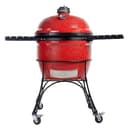
Kamado Joe Big Joe Series I 24" Ceramic Kamado Grill
24-inch grate, 450 sq in of cooking area and 358.9 lb, all maker-stated. The size is the point: on a 24-inch circle a nine-inch-wide trimmed packer has about 22 inches of straight run to lie in, which is more than a packer needs. It is also our top pick in the kamado roundup.
See all kamado picksThe one that fits your patio
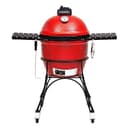
Kamado Joe Classic Joe Series I 18" Ceramic Kamado Grill
18-inch grate, 250 sq in, 227.7 lb - about 130 lb lighter and a foot narrower than the Big Joe, with the same Divide & Conquer rack and the same slide-out ash drawer. Buy it if you cook flats, half packers, or a point and flat separated, which is a perfectly good way to cook brisket.
Read the splitting guideIf the overnight is the problem
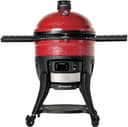
Kamado Joe Big Joe Konnected Joe Digital Charcoal Grill and Smoker
The 24-inch Big Joe with a fan, a Kontrol Board and an electric fire starter added, so it holds a set temperature without vent work. Kamado Joe states two ceramic deflectors and one meat probe in the box. It is the most expensive grill we carry, and it needs a power cord a ceramic grill otherwise never does.
Read the overnight guide
Frequently asked questions
Will a whole brisket fit on a Classic Joe?
Not lying flat, and the reason is geometry rather than squares of area. Kamado Joe states an 18-inch cooking surface diameter for the Classic Joe, and a trimmed packer commonly runs sixteen to twenty inches long and eight to ten inches wide. A brisket is not a line across the middle of the circle - it occupies a band, and the longest straight run available to a nine-inch-wide band inside an 18-inch circle is about 15.6 inches. That is our arithmetic from Kamado Joe's stated diameter, not a figure the company publishes. So on a Classic you roll the flat, fold the thin end up, or separate the point from the flat and cook them side by side. All three work. None of them is the same cook as a packer lying flat.
Is the Big Joe worth the extra money over the Classic Joe for brisket?
If a whole packer lying flat is the cook you want, yes, because the Classic cannot do it and no accessory fixes that. If you mostly cook flats for four to six people, no - you would be paying a large premium and taking on 131 extra pounds of ceramic for capacity you do not use. The honest way to decide is to answer one question first: do you buy whole packers, or do you buy flats? Everything else about these two grills is the same.
What is the actual difference between the Classic Joe and the Big Joe?
Diameter, and what follows from it. Kamado Joe publishes 18 inches and 250 square inches for the Classic Joe Series I against 24 inches and 450 square inches for the Big Joe Series I, with weights of 227.7 lb and 358.9 lb and footprints of 46.2 and 58.3 inches wide. Both state a 225 to 750 degrees F range, both list the 2-tier Divide & Conquer system, the patented slide-out ash drawer, a cast iron top vent, stainless grates, a built-in thermometer, folding side shelves and a limited lifetime warranty. There is no feature on one that is missing from the other.
How much more cooking area does the Big Joe actually have?
Kamado Joe's figures work out at 1.8 times the area - 450 square inches against 250 - for a diameter that is only a third larger. That is what happens when you widen a circle: area grows with the square of the diameter. It also means the area number flatters the upgrade in a way that is irrelevant to brisket. A single brisket does not use area, it uses length, and length grows in proportion to diameter rather than its square. Judge these two grills on inches across, not square inches.
Does a heat deflector come with the Classic Joe and the Big Joe?
Kamado Joe's own guide to the Divide & Conquer system states that the grill comes with a halved heat deflector and that the Classic Joe I and II and the Big Joe I and II come standard with the two-level rack. Neither current product page itemizes the deflector in its specification list, which is why we cite the Divide & Conquer guide rather than the product pages for that claim. It matters more than it sounds: without a deflector between the fire and the meat a kamado is a searing grill, not a smoker, and three of the six kamados in our roundup genuinely do not include one.
Does the Series number change the size question?
No. The Series I, II and III differ in the top vent, the hinge and the gasket - the Kontrol Tower vent and the wire-mesh gasket are Series II upgrades over the Classic I's felt and cast iron. They do not change the diameter, which is the spec this page is about. We have read the Series I pages for both sizes on October 18, 2026, and we are not going to print figures for the Series II or III models we have not read. If you are weighing a Series III Classic against a Series II Big Joe, the brisket answer is still decided by 18 versus 24 inches.
How long will one load of charcoal last on either grill?
Kamado Joe does not publish a charcoal capacity or a burn time for either model, and we will not invent one. What is reasonable to say is structural: a sealed ceramic cooker running at 250 degrees F burns very little fuel compared with an offset, and the larger firebox in the Big Joe holds more of it. Owners routinely report all-night cooks on one load on both sizes; those are their numbers and not ours. If a published burn time is the figure you want before buying, that silence is itself information about how makers in this category talk.
Can you cook a packer on the Classic Joe by rolling it?
Yes, and plenty of people do. The flat end is the thin end, so curling it up the side of the dome or folding the last few inches back on itself gets a twenty-inch brisket onto an eighteen-inch grate. The cost is an uneven cook: the folded section sits in a different part of the airflow and against hotter ceramic, and the fat you were relying on to protect the flat is now on the outside of a curve. Our view is that separating the point from the flat is the better answer on a small round grate, because it gives you two pieces of meat that each lie flat and each get the same heat.
Sources
- Kamado Joe — Big Joe Grill, Series I (BJ24RH) — Kamado Joe's published figures: 24 in cooking surface diameter, 450 sq in cooking area, 358.9 lb, 58.3 in wide by 52.8 in high, 225-750°F, 2-tier Divide & Conquer system, patented slide-out ash drawer, cast iron top vent, folding HDPE side shelves, limited lifetime warranty; again no charcoal capacity and no burn time (accessed October 18, 2026)
- Kamado Joe — Classic Joe Grill, Series I (KJ23RH) — Kamado Joe's published figures: 18 in cooking surface diameter, 250 sq in cooking space, 227.7 lb, 46.2 in wide by 47.6 in high, 225-750°F, 2-tier Divide & Conquer system, patented slide-out ash drawer, cast iron top vent, folding HDPE side shelves, limited lifetime warranty; no charcoal capacity and no burn time are stated, and the felt gasket appears only in a gallery caption (accessed October 18, 2026)
- Kamado Joe — How to Use the Divide & Conquer System — Kamado Joe: the grill comes with a halved heat deflector, and the Classic Joe I and II and Big Joe I and II come standard with the two-level rack (accessed September 15, 2026)
- USDA FSIS — Smoking Meat and Poultry — USDA on safe smoking practices, thermometer use and approved smoker materials (accessed July 22, 2026)
Keep reading
Best Kamado Grill for Brisket
Six kamados ranked on grate size and whether a deflector ships in the box.
See the roundupHow to Smoke a Brisket on a Kamado
The deflector setup, the vent settings and the one mistake that wastes a ceramic cooker.
Read the guideSeparating the Point and Flat
The answer to a round grate that is too small for a packer, done properly.
Read the guideBest Smoker for a Small Patio
The three measurements to take before 358 pounds of ceramic arrives on a truck.
See patio picksWeber Smokey Mountain 18 vs 22
The same 18-versus-bigger decision on charcoal, where the diameters are closer.
Read the comparisonBest Charcoal for Smoking
Lump against briquettes for a sealed ceramic cooker, and what ash does to a vent.
See charcoal picks