The specification nobody publishes
Start here, because it reframes the whole comparison. No cooler maker publishes a hot-hold time. Not YETI, not RTIC, not Igloo, and not Cambro. Every number on a cooler box is a cold-side number: inches of insulation, days of ice retention, cans of capacity. Those are the figures these products are engineered and marketed against, and ice retention is tested in controlled conditions that have nothing to do with a 200°F brisket.
So any page that tells you a particular cooler holds brisket safely for a stated number of hours is giving you someone’s afternoon, not a specification. What insulation actually does is slow the rate at which heat crosses the wall, and it does that in both directions — which is why a good cooler is a good hot box. How long your brisket stays above the safe line depends on the mass of meat, the temperature it went in at, whether you preheated the box, how much air is left around it, and the room. The only honest way to know is to put a probe in it.
That is not a counsel of despair. It is the reason the comparison below ranks on published dimensions and build rather than on hold duration, and the reason the USDA line — above 140°F, continuously — is the figure to cook to rather than a cooler’s marketing.
Side by side
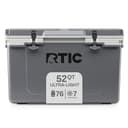
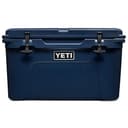
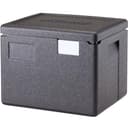
| | RTIC 52 QT Ultra-Light | YETI Tundra 45 | Cambro GoBox 8" |
|---|
| Type | Injection-molded hard cooler | Rotomolded hard cooler | Top-load insulated food pan carrier |
| Stated interior dimensions | 21.25" x 12" x 12" | Not published | One full-size pan, 8" deep |
| Stated capacity | 52 QT / 76 cans (no ice) | 26 cans (no ice) | One full-size food pan |
| Stated insulation | Up to 3 in. closed-cell foam | Up to 3 in. PermaFrost | Molded EPP foam body |
| Stated hot hold time | Not published | Not published | Not published |
| Wrapped packer lies flat? | Yes, per stated interior | Measure first | Yes, in the pan |
| Also useful as a cooler | Yes | Yes | No — single purpose |
Every figure is the maker’s or the listing’s own stated number, read on the dates shown in the spec tables above. “Not published” means we could not find the maker stating it — and on the hot-hold row that is true of all three and of every cooler we have looked at. The “lies flat” row is our reading of the stated interior against the footprint of a wrapped packer, not a manufacturer claim.
Why interior dimensions beat insulation for this job
Both of these coolers claim up to three inches of insulation. At that point the insulation argument is effectively a tie for a four-to-six-hour hold, and arguing about foam chemistry is arguing about the wrong variable.
What is not a tie is fit, and fit matters for two reasons beyond the obvious. The first is that a brisket you have to fold or stand on edge loses its shape while it rests, and the point of a long hold is partly to let the meat settle. The second is air volume: a brisket rattling around in a box three times its size is heating a lot of air you do not care about, and air is the worst thermal mass available. A box the brisket nearly fills, with towels packing the rest, holds longer than a bigger box with the same insulation. That is the real argument for the Cambro — a purpose-built carrier sized to a hotel pan has very little wasted volume by design.
It is also the argument for not buying either of these brands if you are buying purely to hold. Our full cooler roundup covers the middle-ground option that most backyard cooks should actually buy, and the reasoning behind it.
How to hold a brisket in either one, properly
Preheat the box.This is the step people skip and it is the one that matters most. An empty cooler at room temperature is a large heat sink, and the first thing it will do is pull warmth out of your brisket. Fill it with hot tap or boiled water, close the lid for ten or fifteen minutes, then tip it out and dry it just before the brisket goes in. Putting a 200°F brisket into a cold rotomolded box is how a hold that was meant to last five hours gets you to 140°F in two.
Vent the steam first. A brisket straight off the smoker is still cooking, and sealing it hot into an insulated box keeps it cooking. Our resting and holding guide covers why you open the wrap and let the steam off before a long hold, and what happens to the bark if you do not.
Fill the void with towels. Old bath towels, packed around and over the wrapped brisket. They displace the air, add thermal mass and stop the meat sliding. They will smell of brisket afterwards; this is a feature.
Put a probe in it and leave the lid shut. Every time you open the lid to check, you lose the hold you are checking on. A leave-in probe with the display outside the box answers the question without opening it, which is the whole reason we recommend one for this job on the thermometer hub.
Know the line.The USDA puts the danger zone at 40°F to 140°F. A hot hold means staying above 140°F continuously, from the moment the brisket comes off the smoker to the moment it is sliced. If a brisket has drifted below that and sat there, the correct answer is not to reheat it and hope — it is to read our holding and reheating page and understand which of the two problems you now have.
The YETI-versus-RTIC question outside brisket
Since this is the comparison people search for, the honest general answer: on published specifications these two are much closer than the price gap suggests. Both state up to three inches of insulation. RTIC states its Ultra-Light is up to 30% lighter than comparable rotomolded coolers, which is a real convenience when the box is loaded with a brisket and towels. YETI’s rotomolded construction is the tougher of the two and will take more abuse in a truck bed over a decade.
For a brisket hold specifically, toughness is close to irrelevant — the box lives on a kitchen counter for five hours — and dimensions are decisive. That is why the lighter, cheaper cooler wins this particular comparison, and why the thing that actually beats both is a food pan carrier that was designed for hot food in the first place.