Offset vs Vertical Smoker for Brisket
A horizontal barrel and an upright cabinet can carry nearly identical published cooking areas and still be completely different cookers. The difference is which direction the heat has to travel - and how much patio you have.
How this is funded: we earn a commission if you buy through our links, at no extra cost to you. It never changes which product we recommend, and we’ll tell you plainly when we’d skip one. Full disclosure.
Buy a horizontal offset if you want to cook one brisket as well as it can be cooked. Buy a vertical if floor space, not technique, is your binding constraint. The Oklahoma Joe’s Highland publishes 619 square inches of primary cooking area on one level, which is a packer lying flat in roughly even heat. The Banderapublishes 992 square inches across four grates in a body about 40 inches wide including the firebox — far more area in far less patio, at the cost of a top-to-bottom temperature gradient you have to learn to use.
Those headline numbers are also where most comparisons of these two formats go wrong, so it is worth getting the arithmetic straight before anything else.
Why the cooking-area figures are not comparable
A barrel offset’s primary cooking area is one continuous grate. If a maker states 619 square inches, that is a surface a brisket can lie on.
A cabinet’s stated area is the sum of its racks. The Bandera’s 992 square inches is four grates added together; a brisket occupies one of them. So on the question “will my packer fit,” a 992-square-inch cabinet and a 619-square-inch barrel are not in the order the numbers suggest — and the figure that would settle it, the dimensions of an individual rack, is published almost nowhere in the category. Our vertical roundup refuses to rank on headline area for exactly this reason.
What the stacked area genuinely buys you is everything else: ribs under the brisket, a pan of beans, two pork butts, sausage on the top rack. For a household cooking a full menu it is an enormous practical advantage. For a single packer it is close to irrelevant.
Which way the heat travels, and what it costs
This is the real difference between the formats, and both have the same underlying problem in two different orientations.
In a barrel, the gradient is horizontal. Heat enters at the firebox end and leaves at the stack, so the firebox end runs hotter. The traditional fix is to rotate the meat partway through the cook. The engineered fix is reverse flow: a baffle plate carries the heat along the bottom to the far end and brings it back over the meat, which evens the chamber out considerably. The Highland does this and its baffles are removable, so the cooker has two airflow setups rather than one.
In a cabinet, the gradient is vertical.Heat rises, so the top rack is the hot one. On a four-foot cabinet that spread is real and it does not go away — which is why the Bandera’s own cons list names learning the gradient as part of owning it. The upside is that a vertical gradient is more useful than a horizontal one: you can put the thing that wants more heat higher and the thing that wants less lower, deliberately, instead of rotating everything.
Both are managed with the same instrument, and it is not the door-mounted dial. Clip a probe at the level the brisket is actually sitting at. See our instant-read versus leave-in comparison for why the grate channel is the one that changes how people cook.
Side by side, on published figures
| Horizontal offset (Highland) | Vertical offset (Bandera) | Vertical cabinet (Masterbuilt 40") | |
|---|---|---|---|
| Fuel | Charcoal + wood, offset firebox | Charcoal + wood, offset firebox | Electric element + wood chips |
| Stated total cooking area | 900 sq in | 992 sq in | 970 sq in |
| Stated primary cooking area | 619 sq in, one level | 744 sq in, across four grates | Not published separately |
| Gradient to manage | Horizontal — eased by reverse-flow baffles | Vertical — top to bottom | Vertical, but thermostat-controlled |
| Footprint | Long — barrel plus side firebox | About 40 in W x 28 in D x 63 in H (listing stated) | Narrow cabinet |
| Fire management required | Yes — continuous | Yes — frequent, small firebox for the chamber | No |
| Steel gauge | Not published | Not published | Not applicable |
| Stated weight | Not published | 198 lb (listing stated) | Not published |
Every figure is the maker’s or the listing’s own, read on the date in each product’s spec table. “Not published” means we could not find the maker stating it, and the two gaps worth noticing are deliberate findings rather than research failures: neitherOklahoma Joe’s offset publishes a steel gauge, and no cooker here publishes individual rack or grate dimensions — the one figure that would actually settle whether a packer lies flat.
The vertical offset is the interesting answer
Most pages on this question treat it as barrel-versus-electric-cabinet, which quietly smuggles in a second decision about fire. The Bandera separates the two: it is a real stick-burner with a real side firebox, in a cabinet.
Two things follow, one good and one not. The good one is that coals never sit under the brisket — a true offset firebox at the bottom of a tall chamber, which is a cleaner heat path than any cooker where the fire is directly below the meat. The less good one is in its own cons list: the firebox is small relative to the chamber volume, so a long cook needs frequent tending. You are buying floor space with labor.
If the appeal of a vertical was the space rather than the fire, then the honest pick is a thermostatic cabinet instead, and the Masterbuilt 40-inch is the one in our registry that fits a packer. That trade is a whole page of its own: charcoal against electric.
Who should buy which
Horizontal offset if: brisket is the point, you have the driveway for it, you want the packer flat on one grate, and you actively want to learn fire management. Reverse flow if you would rather not rotate the meat.
Vertical offset if: you want stick-burner smoke but your patio is the constraint, you cook a full menu rather than one cut, and you accept a gradient and frequent tending as the price.
Vertical cabinet if: the space mattered and the fire did not. You will give up bark and smoke depth and get back every night of sleep you were going to spend on a firebox.
One of each format, and the compromise
Every area and dimension below is the maker’s or the listing’s own, read on the date in each product’s spec table. Prices are live and refresh daily.
The horizontal offset
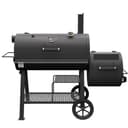
Oklahoma Joe's Highland Reverse Flow Offset Smoker
900 sq in total and 619 sq in primary (stated), with reverse-flow baffles that even out the classic hot-spot problem and come out if you want the stock airflow instead. A full packer lies flat on one level, which is the whole argument for a barrel. The published gap: Oklahoma Joe's states no steel gauge.
$729.00 · View on AmazonSee offset picksPrice as of October 22, 2026. #ad How we’re funded
The vertical offset
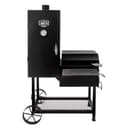
Oklahoma Joe's Bandera Vertical Offset Smoker
992 sq in stated across four adjustable grates in a body about 40 in wide including the firebox - a barrel offset with that area needs far more patio. It is a true side firebox, so coals never sit under the brisket. The cost is a real top-to-bottom gradient you have to learn.
$499.00 · View on AmazonRead the reviewPrice as of October 22, 2026. #ad How we’re funded
The vertical cabinet without a fire
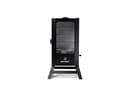
Masterbuilt 40" Digital Electric Vertical Smoker
If your reason for wanting a vertical is floor space rather than fire management, this is the honest option: 970 sq in over four racks (stated), a digital thermostat and a side chip loader so you add smoke without opening a four-foot door. You give up stick-burner smoke; you gain a night's sleep.
$399.99 · View on AmazonSee vertical picksPrice as of October 22, 2026. #ad How we’re funded
Frequently asked questions
Is an offset or a vertical smoker better for brisket?
For one brisket cooked well, a horizontal offset, because the packer lies flat on a single level in roughly even heat. For a brisket plus everything else, in a small space, a vertical, because an upright cabinet buys you several times the rack area for the same patch of ground. The honest version of the answer is that the horizontal format is easier to cook a great brisket on and the vertical format is easier to live with - and the Oklahoma Joe's Bandera exists precisely because people want both.
Do vertical smokers cook unevenly?
Yes, by physics, and the question is only how much. Heat rises, so the top rack of any tall cabinet runs hotter than the bottom one - on a tall offset cabinet that gradient can be substantial. This is not a defect to be fixed; it is a property to be used. Experienced cabinet cooks put the brisket where the temperature suits it and rotate racks through a long cook. What makes it manageable is a probe at the meat's own level rather than trusting a door-mounted dial.
Will a full packer fit in a vertical smoker?
On a rack, usually yes, but you have to check the rack dimensions rather than the headline area - and almost nobody publishes them. A 992 sq in figure on a four-rack cabinet is the sum of four racks; a brisket occupies one. A trimmed packer is commonly 20-24 inches long, and a cabinet rack is typically far shorter than that in one direction. Many cabinet cooks hang a brisket from the top rack or cook it on a half sheet pan instead. The vertical roundup goes into this at length.
What is a vertical offset smoker?
A cabinet with a firebox attached to the side at the bottom, rather than a barrel with a firebox at one end. The Oklahoma Joe's Bandera is the classic example: a true side firebox feeding a tall chamber, so you still burn wood and charcoal and still manage a fire, but the heat travels upward through four racks instead of sideways along a barrel. It is not the same thing as a vertical pellet or electric cabinet, which has no fire to manage at all.
Why does an offset have hot spots?
Because the heat enters at one end and leaves at the other. In a plain horizontal offset the firebox end runs hotter than the stack end, which is why people rotate the meat partway through a cook. Reverse-flow designs - the Highland in our registry is one - run the heat under a baffle plate to the far end first and bring it back across the meat, which evens the chamber out considerably. The Highland's baffles are removable, so you can run it either way and judge for yourself.
Which format uses less fuel?
Neither is reliably cheaper, and no maker in our registry publishes a fuel-consumption figure for any of these cookers, so we are not going to rank them on it. What we can say structurally: a tall cabinet has a large volume of air to heat and a small firebox relative to it, which is why the Bandera needs frequent tending on a long cook - that is in its own cons list. A barrel has less volume but more exposed surface area. Insulation and wind matter more than format.
Is a vertical smoker better for a small patio?
Decisively, and it is the strongest argument for the format. The Bandera is listed at about 40 inches wide including its firebox, with 992 sq in of cooking area; a horizontal offset carrying similar area is considerably longer, because a barrel plus a side firebox is a long object. An upright cabinet converts the problem from floor space into height, which most patios have spare. Our small-patio roundup ranks the whole registry on exactly this trade.
Sources
- USDA FSIS — Smoking Meat and Poultry — USDA on safe smoking practices, thermometer use and approved smoker materials (accessed July 22, 2026)
- USDA FSIS — "Danger Zone" (40°F - 140°F) — USDA: bacteria multiply fastest between 40°F and 140°F — the food-safety basis for the 4-hour rule (accessed July 22, 2026)
Keep reading
Best Offset Smoker for Brisket
The barrel offsets, ranked on published cook area and what each maker will not state.
See the roundupBest Vertical Smoker for Brisket
The upright cabinets, and why we refuse to rank them on headline cooking area.
See the roundupOklahoma Joe's Bandera Review
The vertical offset in detail - the format that is genuinely both answers at once.
Read the reviewSmoking Brisket on an Offset
Fire management on a stick burner, which is the skill both offset formats demand.
Read the guideBest Smoker for a Small Patio
The footprint-against-capacity comparison this page keeps pointing at.
See the roundupOffset vs Pellet Smoker
The other smoker decision: hands-on fire against set-and-forget convenience.
Read the comparison