Brisket & Bark

The Best Instant-Read Thermometer for Brisket

A leave-in probe tells you one spot, all night. An instant-read lets you check six spots in fifteen seconds at the end — which is how you find out whether the flat and the point are actually both done.

By Stephen V.Last updated How we pick

These are two different tools for two different jobs, and brisket wants both. A leave-in probesits in the meat for twelve hours and tells you the trend — when the stall starts, when it breaks, roughly where you are. An instant-read is what you use in the last hour, when the question changes from “how is it going?” to “is every part of this brisket actually done?”

That second question is why an instant-read matters on brisket specifically. A packer is two muscles of different thickness and fat content, and they routinely finish at slightly different moments. One probe in one spot cannot tell you that. The spec that decides an instant-read is read speed— faster means more checks per door opening — and after that waterproofing, because these die from being washed far more often than from heat.

How this is funded: we earn a commission if you buy through our links, at no extra cost to you. It never changes which product we recommend, and we’ll tell you plainly when we’d skip one. Full disclosure.

Quick picks

Ranked on the published specs and how each one fits a brisket cook. Select a row to jump to the full write-up. We have not run this gear in a lab — here is exactly what we do instead.

#ProductBest forPrice
1
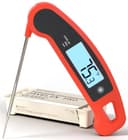
Lavatools Javelin PRO Duo Instant-Read Thermometer

Lavatools Javelin PRO Duo Instant-Read Thermometer

The step-up instant-read: a longer probe, a ~2-3 second reading, a big backlit display, and a magnet so it sticks to the smoker. It's the closest thing to a Thermapen you can buy without paying Thermapen money, and it's built for a working cook.

Best overall
$43.99 · View on Amazon

Price as of September 6, 2026. #ad How we’re funded

2
ThermoPro TP19H Digital Instant-Read Thermometer

ThermoPro TP19H Digital Instant-Read Thermometer

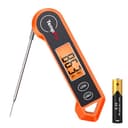
The instant-read most people should buy: fast enough to spot-check doneness, accurate to about a degree, waterproof, and a fraction of a Thermapen's price. For probing a brisket's thickest point to confirm 203°F, it does the one job that matters.

Best value
$13.99 · View on Amazon

$19.9930% off

Price as of September 6, 2026. #ad How we’re funded

3
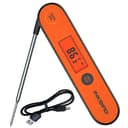
Inkbird IHT-1P Waterproof Instant-Read Thermometer

Inkbird IHT-1P Waterproof Instant-Read Thermometer

A rechargeable instant-read that skips the coin-cell batteries: waterproof, fast, backlit, and cheap. If you hate hunting for a CR2032 mid-cook, the USB charging is the quiet feature that makes this the practical budget pick.

Best waterproofing
$23.99 · View on Amazon

Price as of September 6, 2026. #ad How we’re funded

4
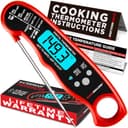
Alpha Grillers Instant Read Meat Thermometer

Alpha Grillers Instant Read Meat Thermometer

The thermometer to buy when you want a second one for the drawer. It reads fast enough to check five spots in a flat before you have lost meaningful heat, and it costs little enough that leaving it out in the rain is a shrug rather than a disaster.

Best second thermometer
$12.97 · View on Amazon

$13.987% off

Price as of September 6, 2026. #ad How we’re funded

5
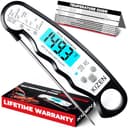
KIZEN Instant Read Meat Thermometer (IP67)

KIZEN Instant Read Meat Thermometer (IP67)

An IP67 rating is the spec that matters on a brisket cook, because the thing that kills cheap thermometers is not heat but the rinse afterwards. This one is rated to survive being washed, which at this price is the difference between a tool and a consumable.

Best budget

The picks in full

#1Best overall

Lavatools Javelin PRO Duo Instant-Read Thermometer

The step-up instant-read: a longer probe, a ~2-3 second reading, a big backlit display, and a magnet so it sticks to the smoker. It's the closest thing to a Thermapen you can buy without paying Thermapen money, and it's built for a working cook.

Strengths

  • Fast ~2-3 second reads with ±0.9°F stated accuracy
  • Long probe reaches into a thick packer safely
  • Backlight + magnet + auto-rotate display

Trade-offs

  • Still a spot-check tool, not a leave-in monitor
  • Pricier than the entry ThermoPro
Fuel / powerNot published
TypeInstant-read (spot check)
Accuracy±0.9°F (stated)
Response2-3 sec (stated)
DisplayBacklit, auto-rotating
MountingMagnetic back

Specs read from the manufacturer listing, on July 22, 2026. “Not published” means the maker does not state that figure.

#2Best value

ThermoPro TP19H Digital Instant-Read Thermometer

The instant-read most people should buy: fast enough to spot-check doneness, accurate to about a degree, waterproof, and a fraction of a Thermapen's price. For probing a brisket's thickest point to confirm 203°F, it does the one job that matters.

Strengths

  • Fast, near-instant reading for spot-checks
  • Waterproof (IP65) and backlit for night cooks
  • Rotating display + ambidextrous design

Trade-offs

  • Not a leave-in probe — you open the lid to check
  • A touch slower than a $100 Thermapen
Fuel / powerNot published
TypeInstant-read (spot check)
Accuracy±0.9°F (stated)
Water resistanceIP65 waterproof
DisplayBacklit, rotating
Response2-4 sec (stated)

Specs read from the manufacturer listing, on July 22, 2026. “Not published” means the maker does not state that figure.

#3Best waterproofing

Inkbird IHT-1P Waterproof Instant-Read Thermometer

A rechargeable instant-read that skips the coin-cell batteries: waterproof, fast, backlit, and cheap. If you hate hunting for a CR2032 mid-cook, the USB charging is the quiet feature that makes this the practical budget pick.

Strengths

  • USB-rechargeable — no coin cells to replace
  • Waterproof and backlit with a magnet
  • Fast reads at a low price

Trade-offs

  • Spot-check only, not a leave-in probe
  • Battery ages over years of charge cycles
Fuel / powerNot published
TypeInstant-read (spot check)
Accuracy±0.9°F (stated)
PowerUSB rechargeable
Water resistanceWaterproof (stated)
DisplayBacklit, magnetic

Specs read from the manufacturer listing, on July 22, 2026. “Not published” means the maker does not state that figure.

#4Best second thermometer

Alpha Grillers Instant Read Meat Thermometer

The thermometer to buy when you want a second one for the drawer. It reads fast enough to check five spots in a flat before you have lost meaningful heat, and it costs little enough that leaving it out in the rain is a shrug rather than a disaster.

Strengths

  • Fast enough to probe several spots per door opening
  • Foldaway probe stores flat in a drawer
  • Cheap enough to own two without thinking about it

Trade-offs

  • Not as fast as a thermocouple pen
  • No backlight on the base model — awkward at 3 a.m.
Fuel / powerNot published
TypeDigital instant-read
ProbeFoldaway stainless
Read speedNot published
WaterproofingNot published

Specs read from the manufacturer listing, on August 10, 2026. “Not published” means the maker does not state that figure.

#5Best budget

KIZEN Instant Read Meat Thermometer (IP67)

An IP67 rating is the spec that matters on a brisket cook, because the thing that kills cheap thermometers is not heat but the rinse afterwards. This one is rated to survive being washed, which at this price is the difference between a tool and a consumable.

Strengths

  • IP67 water resistance (stated) — survives a real rinse
  • Foldaway probe with magnetic back for the smoker lid
  • Budget price with a backlit display

Trade-offs

  • Thermistor probe, so slower than a thermocouple pen
  • Thin probe can bend if you lean on it
Fuel / powerNot published
TypeDigital instant-read
Water resistanceIP67 (stated)
ProbeFoldaway stainless
Read speedNot published

Specs read from the manufacturer listing, on August 10, 2026. “Not published” means the maker does not state that figure.

Thermocouple vs thermistor: what you're paying for

Instant-read thermometers use one of two sensor types, and the price difference between cheap and expensive pens is mostly this.

A thermistoris a resistor whose resistance changes with temperature. It is cheap, accurate enough for cooking, and relatively slow — typically two to four seconds to settle. A thermocouple uses the junction of two dissimilar metals and responds far faster, often under a second, with a smaller sensing tip that reads a more precise point rather than averaging across a length of probe.

For most cooking that difference is a convenience. For brisket it is more than that, because of the door-opening problem: every second the smoker is open, heat and humidity escape. A one-second pen lets you probe six spots and be closed again before a four-second pen has finished its second reading. Over the final hour, when you are checking repeatedly, that adds up to a materially shorter cook.

What kills these, and it isn't heat

Instant-read thermometers rarely fail from being near a smoker. They fail from being washed. Grease and rub get on the body, the body goes under a tap, water enters around the display or the probe hinge, and the electronics corrode.

This is why an IP ratingis the second spec to look at. “IP67” means dust-tight and able to survive immersion in a meter of water for thirty minutes; “water resistant” with no number attached means whatever the marketing department wanted it to mean. If two pens are similarly priced and one has a stated IP rating, take that one. And regardless of rating, wipe rather than rinse where you can.

How to probe a brisket properly

Technique matters more than people assume. Insert into the thickest part of the flat, going in from the side rather than straight down, and push past your target depth then withdraw slowly — watching for the lowest reading as you come out. The coldest point is the true internal temperature, and pushing through and backing off is how you find it rather than accidentally reading a spot near the surface or a pocket of rendered fat.

Then check several places: the thick end of the flat, the thin end, and the point separately. You are looking for two things at once — a temperature in the done range, and the feel of the probe going in. When brisket is ready the probe slides in with almost no resistance, like pushing into softened butter. That feel is the actual doneness test, and it is why a single target temperature is a guide rather than an answer.

Calibration, quickly

Worth checking once a year and after any drop. Fill a glass with crushed ice, top with cold water, stir, and let it sit a minute — a properly made ice bath sits at 32°F (0°C). Put the probe in without touching the sides or bottom. A good thermometer reads within a degree or so. Some models let you recalibrate; most cheap ones don’t, in which case you at least now know your offset and can mentally correct for it. A thermometer that is 5°F out and known is more useful than one that is 1°F out and untested.
Frequently asked questions

Do I need an instant-read if I already have a leave-in probe?

For brisket, yes. They do different jobs. A leave-in probe tracks the trend at one fixed spot across twelve hours — useful for seeing the stall arrive and break. An instant-read lets you check six different spots in seconds at the end, which is the only way to confirm that both the flat and the point are actually done. A packer's two muscles routinely finish at different moments.

What's the difference between a thermocouple and a thermistor thermometer?

The sensor. A thermistor changes resistance with temperature — cheap, accurate enough, and typically two to four seconds to settle. A thermocouple uses a junction of two dissimilar metals, responds in under a second, and has a smaller sensing tip that reads a precise point rather than averaging. On brisket the speed matters because every second the smoker door is open costs you heat and humidity.

Where do I probe a brisket?

The thickest part of the flat, inserted from the side rather than straight down. Push past your target depth and withdraw slowly, watching for the lowest reading — the coldest point is the true internal temperature. Then check the thin end of the flat and the point separately, since the two muscles differ in thickness and fat and don't always finish together.

How accurate does a brisket thermometer need to be?

Less accurate than you'd think, because brisket isn't done at a number — it's done when the probe slides in with almost no resistance. A thermometer within a couple of degrees is entirely sufficient. What matters more is that you know your thermometer's offset: test it in an ice bath, which sits at 32°F. A thermometer 5°F out and known beats one 1°F out and untested.

Why do instant-read thermometers stop working?

Water, almost always — not heat. Grease gets on the body, the body goes under a tap, and water enters around the display or the probe hinge and corrodes the electronics. That's why a stated IP rating matters: IP67 means dust-tight and survives immersion, while 'water resistant' with no number means very little. Wipe rather than rinse whenever you can.

How do I calibrate my thermometer?

With an ice bath. Fill a glass with crushed ice, top with cold water, stir and let it settle for a minute — it will be at 32°F (0°C). Insert the probe without touching the sides or bottom. A good unit reads within a degree. Some models allow recalibration; on those that don't, you at least know your offset and can correct for it mentally. Check annually and after any drop.

Sources

Keep reading