How to choose a charcoal smoker for brisket
Start with grate size, not total cooking area. Manufacturers quote total area by adding every rack together, which tells you how many racks of ribs fit and nothing at all about whether a brisket will. What matters is the largest single grate’s usable dimension. A 22-inch bullet grate takes a full packer without argument. An 18-inch grate takes a trimmed flat comfortably and a whole packer only if you bend it into a horseshoe or hang it. If you always cook whole packers, this single number should decide your purchase.
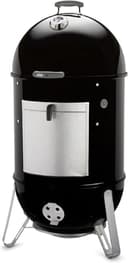
Then look at how the fire is fed. A bullet smoker burns charcoal in a ring underneath a water pan, and the pan is doing more work than most people realize: water cannot exceed 212°F, so it acts as a thermal governor that pins the chamber in the 225-275°F range almost regardless of what the fire does. That is why a bullet is the easiest charcoal smoker to run overnight. A drum has no water pan, so it runs hotter and faster and relies on airflow restriction alone. A vertical cabinet with a side firebox sits somewhere between the two — more control, more attention, and usually more heat variation top to bottom.
Ignore steel gauge marketing on anything at this price. Thick steel genuinely helps — thermal mass smooths temperature swings, especially in wind and cold — but nothing in the sub-$700 charcoal market is heavy enough for that to be the deciding factor. Insulation and a well-fitting lid do more for stability here than a fraction of a millimeter of extra steel, and most makers in this segment do not publish a gauge figure at all. Where a maker doesn’t publish it, we say so rather than repeat a number from a forum.
Bullet, drum, or cabinet?
The bullet is the default recommendation and has been for twenty years, because the water pan makes a steady overnight burn genuinely achievable on your first attempt. Load the charcoal ring, light a small portion, fill the pan, set the vents roughly a quarter open, and it will sit near 250°F for eight to twelve hours. The cost is capacity: you get two round grates, and the second one sits close enough to the first that a big packer on the bottom crowds the top.
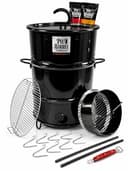
The drum hangs meat vertically on hooks instead of laying it on a grate, which is the neatest solution to the capacity problem in this whole category — Pit Barrel states two full packers of 14-16 pounds fit at once in an 18.5-inch barrel. Hanging also means fat drips through the fire and back up as smoke, which produces a distinctly rich result. The trade is temperature: drums run hot by design, typically 275-300°F, so you are cooking hot and fast whether you planned to or not. That is a legitimate way to cook brisket, but it is a different cook, and the margin for error is smaller.
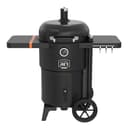
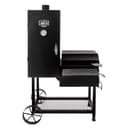
The vertical cabinet gives you square racks — which fit a rectangular brisket better than a circle does — and a firebox you can access without disturbing the food. It also gives you the most temperature variation from top rack to bottom, which means learning your particular cabinet before you trust it with an expensive packer. Cabinets are usually the cheapest way to get a lot of capacity, and the least forgiving of a careless fire.
The kamado is the fourth charcoal shape, and it gets its own page because the fit question plays out differently. A settled ceramic kamado holds 250°F with very little tending, but its grate is round, and only the 24-inch sizes or an oval grate lay a whole packer flat. Our kamado grill roundup compares six on grate size and shape, and on whether a heat deflector ships in the box.
If you have narrowed it to the two drums specifically, they are a closer fight than this page has room for and they are built on opposite convictions — one deliberately gives you nothing to adjust, the other gives you a vent and expects you to use it. The head-to-head is Pit Barrel vs Oklahoma Joe’s Bronco, including the published capacity figures and the hook strategy neither maker documents.
What you actually need to run one
A charcoal smoker without a thermometer you trust is a guessing machine. The dome gauge fitted to most of these units reads the air at the lid, which can be twenty or thirty degrees away from what the meat sits in, and dome gauges are frequently inaccurate out of the box besides. Clip a probe at grate level and run a second probe in the meat — our wireless probe roundup covers the ones that will still be sending you readings at four in the morning.
Fuel matters more here than on any other smoker type, because charcoal is both your heat and part of your flavor. Lump versus briquettes is a real decision with real consequences for burn time and ash volume, and the wood chunks you bury in the charcoal are what make it taste like barbecue rather than a grilled roast. Two or three fist-sized chunks is the whole requirement; more than that on a twelve-hour cook is how briskets end up tasting of ashtray.
Finally, plan for the long hold. A charcoal brisket finishes when it finishes, which is rarely when you hoped, so a pre-warmed cooler that keeps a wrapped packer safely hot for a few hours turns an unpredictable finish into a scheduled dinner. It is the cheapest upgrade on this page and the one most likely to save an occasion.
Who should buy a charcoal smoker — and who shouldn’t
Buy charcoal if you want to be involved in the cook without being enslaved by it, if smoke flavor is a large part of why you are doing this, and if you like the idea that a power cut cannot end your brisket. A bullet in particular is close to unkillable — there is nothing on it to break except a rusted-through body a decade from now.
Look elsewhere if the twelve-hour cook is going to happen on a work night and nobody will be home to check a vent. A pellet grill or a gravity-fed cabinet will hold a set temperature with no human input at all, which is a genuine advantage and not a compromise to be ashamed of. The best smoker is the one that gets used.