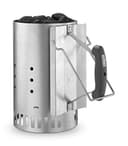
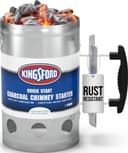
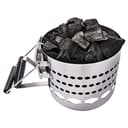
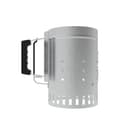
The four things that separate one chimney from another
Load size.A chimney is a measuring cup as much as a lighting tool. When a recipe or a pitmaster says “a full chimney,” that phrase only means something if your chimney and theirs hold roughly the same amount, which is why barrel dimensions are worth reading. A 7.5-inch barrel standing 13 inches tall holds meaningfully more than a compact travel chimney at 8 x 10 inches, and the difference shows up as a pit that reaches temperature in twenty minutes rather than forty-five.
Draw. The physics is simple: hot air rises through the fuel column, pulling fresh air in through the base, which is what makes a chimney faster than a pile of charcoal with a match under it. That only works if air can actually get in at the bottom. A vented base with a real fire-starter chamber under the grate lights the whole column; a solid-bottomed tube with a few holes punched in the side does not, and the symptom is a load where the top is still black after twenty minutes.
The pour. On a kettle you tip a chimney into an open bowl and it is fine. On an offset you are pouring into a firebox door at knee height, often with the pit already warm, and on a bullet you are pouring into a ring you would rather not disturb. This is where a trigger-release base or a helper handle earns its money, and it is the only part of using a chimney where people get genuinely hurt. Wear heat-resistant gloves for it regardless of which one you buy.
Material.Aluminized and stainless steel handle repeated high-heat cycling better than zinc-coated steel, and that is most of the price difference between a $14 chimney and a $35 one. It is not a performance difference on any single cook — a cheap chimney lights charcoal exactly as well as an expensive one. It is a difference in how many seasons you get before the base grate warps or burns through.
How much lit charcoal a brisket actually needs
This is the question the whole purchase turns on, and the answer changes with the method rather than with the meat.
For a Minion burnin a bullet smoker — a full ring of unlit briquettes with a small quantity of lit coals poured into the middle — you want a deliberately small lit load. Eight to twelve lit briquettes is typical. A full chimney poured into a full ring gives you a fire that lights all at once and a pit that overshoots badly. Here the chimney is being used as a partial-fill tool, and almost any size works.
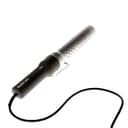
For a snake or fuse burn on a kettle, the lit load is smaller still, and it has to land in exactly one place at one end of the snake. Pouring even a quarter chimney can scatter coals across two or three rows of the snake and collapse a twelve-hour burn into a five-hour one. This is the case where an electric starter that lights the fuel in place is not a gimmick.
For an offset, the requirement inverts. You are building a coal bed that a wood split can sit on and burn cleanly, and that bed wants to be substantial from the start — a full chimney of lump, sometimes more. A larger-capacity starter is a real time saving here, because two sequential chimney loads is forty minutes you did not budget for on a cook that already starts before dawn. Our offset brisket guide walks through building that bed.
For a gravity-fed smoker, you are lighting the bottom of a packed hopper, which you cannot pour into at all. Read the manual; most makers specify a starter cube or an electric starter at the ash-pan end rather than a chimney.
How to use a chimney starter properly
Fill the barrel with charcoal — all the way for an offset coal bed, or the quantity your method calls for. Put one or two paraffin starter cubes, or a couple of sheets of loosely crumpled newspaper, in the chamber underneath the grate. Do not pack the paper tightly; it needs air around it to burn hot rather than smolder. Light it in two or three places and leave it alone.
The load is ready when the coals at the top of the chimney have gone gray around the edges and you can see flame licking through them. That is usually twelve to twenty minutes depending on the charcoal, the weather and the chimney. Pouring early is the most common mistake: black, off-gassing charcoal put into a smoker produces exactly the heavy white smoke that leaves a brisket tasting acrid, and the meat surface is coldest and most receptive to that deposit in the first hour. Our page on bitter, acrid brisket covers what that flavor actually is.
Set the chimney on something that will not mind — concrete, a paving slab, the grate of the grill itself. Never on a wooden deck, a plastic table, or grass you like. And pour with two hands where the design allows it: one on the main handle, one on the helper handle or under the barrel with a glove.
Why not lighter fluid
Because a brisket sits in the smoker for twelve hours, and the first of those hours is when the cold, damp surface of the meat collects everything in the air around it. Lighter fluid and instant-light charcoal off-gas solvent as they burn off, and on a fifteen-minute burger cook the amount that reaches the food is trivial. On a brisket it is not. A chimney costs less than three bags of charcoal, uses a sheet of newspaper, and produces coals that are genuinely ready rather than coals that are still evaporating something. We make the same case at more length in our charcoal roundup.
What we did not pick, and why
Propane torches. A weed-burner-style torch is genuinely the fastest way to light lump charcoal in an offset firebox, and plenty of working pits use one. We have not put one in this roundup because we do not currently carry a verified torch listing in the registry, and we would rather leave the category empty than name a product we have not resolved to a live listing.
Compact and travel chimneys.They exist and they work, but a chimney sized for a hibachi is the wrong tool for a packer brisket — the whole point of the purchase is a repeatable load large enough to matter.
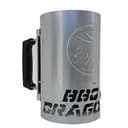
Chimney-and-fan bundles. Several sellers package a chimney with a blower and a bag of starter cubes. If you want forced air, the BBQ Dragon design above is built around it rather than having it added on, and you can drive it with a fan you already own.
The honest verdict
If you own a bullet, a kettle or a drum, buy the Weber and stop thinking about it. If the budget matters more than the lifespan, the Kingsford lights identical charcoal for about half the money and you will not notice a difference on the cook itself. If you run an offset, the extra capacity of the Halftime XL is the pick that actually saves you time on brisket day. And if your fuel bed is a snake or a packed hopper that a pour would ruin, the Looftlighter is solving a different problem than any chimney can — which is why it is on this list despite not being a chimney at all.