The four things that decide a smoke tube for brisket
1. Run time, measured against the pre-wrap window — not against the clock. This is the spec every listing leads with and the one most buyers misread. A brisket cook runs ten to fourteen hours, so a five-hour tube sounds like it covers a third of the job. In practice it covers almost all of the job that smoke can do. Smoke compounds stick to a cool, moist meat surface; as the bark sets and dries, deposition slows sharply, and the moment you put the brisket in butcher paper or foil it stops altogether. That is why our pellet page tells you to wrap later rather than earlier if smoke flavor is your priority. Work backwards from your wrap and the useful window is roughly the first four to six hours. Three hours covers most of it, five hours covers essentially all of it, and twelve hours is marketing. If you cook unwrapped the whole way — which some people do, and our wrapped versus unwrapped page covers the trade — then a longer tube or a second one genuinely helps.
2. Length against the space you actually have. A 12-inch tube is the default size, and on a 20-inch barrel with a full packer laid across the grate there may be nowhere to put it. The tube has to sit on the grate, not under the meat, and not pressed against it — you want the smoke to wash over the brisket, and you do not want a hot steel tube in contact with the bark you are trying to build. On a small pellet grill this is the binding constraint, and it is the reason the expandable Pit Boss earns a place here despite having the shortest stated run time: at its 7-inch setting it fits in the gap beside the meat. If you are cooking on a big cabinet or running a flat rather than a packer, the 12-inch tubes are all fine. Our flat-only guide and two-brisket guide are where grate space gets decided.
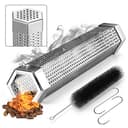
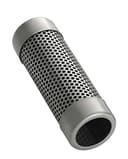
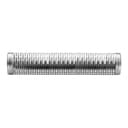
3. Cross-section: hexagonal or round. This sounds like a detail and is not. A round tube is a cylinder sitting on a grate of parallel bars, and it rolls — into the meat, into a drip tray, or off the grate entirely when you open the lid and the grate flexes. Both makers who publish a hexagonal section, Realcook and Z Grills, say in so many words that the flat faces are there to stop it rolling, and that matches what the shape obviously does. The A-MAZE-N and the 9-inch Pit Boss are both round. That is a real mark against two otherwise honest products, and it is worth noting that the original maker of the category has not adopted the fix that its imitators did. If you buy a round tube, use the hooks or wedge it against a grate support.
4. What the maker will put in writing.Search Amazon for a smoke tube and you get hundreds of near-identical perforated steel tubes from sellers with invented names, all claiming 304 stainless and five hours. Most publish nothing you can check. The filter we used here is simple: we only featured a tube whose maker has a real product page with a SKU, or — in LIZZQ’s case — a long-established listing that states its own figures and a brand buyers recognize. Of the five, Realcook is the only one that states a steel grade (304 throughout), a weight and the exact box contents. Pit Boss and A-MAZE-N publish a SKU, a length, a construction material and a duration, but no grade. LIZZQ publishes a length and a duration. Every cell this page cannot source reads “Not published,” which on a commodity product is itself the most useful thing we can tell you.
How the five compare
| Tube | Length | Section | Stated smoke per fill | Steel grade published? |
|---|
| Realcook 12" | 12 in | Hexagonal | Up to 5 hours | Yes — 304 throughout |
| Pit Boss Expandable (41075) | 7-12 in, adjustable | Not published | Approx. 3 hours | No |
| A-MAZE-N 12" | 12 in | Round | Up to 4 hours | No |
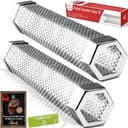
| LIZZQ 12", set of 2 | 12 in each | Not published | Up to 5 hours per tube | No |
| Pit Boss 9" (40974) | 9 in | Round | Approx. 3 hours | No |
Every figure above is the maker’s own, read from its product page on October 4, 2026, except the LIZZQ row, which is the Amazon listing’s own stated figures. “Not published” means the maker does not state that figure anywhere we could find it — we have not substituted an estimate.
What a smoke tube will and will not do
It will add a real, noticeable layer of smoke to a cook on a pellet grill, an electric cabinet or a gas grill. That is not in doubt, and it is the reason we have recommended one for years. The mechanism is simple: your pellet grill’s fire pot is a fan-fed, efficient burn, and efficient combustion produces fewer of the aromatic compounds we taste as smoke, because those compounds are products of incomplete combustion. A tube is a deliberately bad fire — pellets smoldering in a perforated cylinder with limited air — and a bad fire is exactly what makes smoke.
It will not turn a pellet grill into an offset. Nothing will, and anyone selling you that is overselling. Our offset versus pellet comparison states the gap plainly and a tube narrows it rather than closing it. Expect a clear improvement, not a transformation.
It can also make things worse if you run it badly, and this is the part the listings never mention. A tube smoldering in a cabinet with poor airflow — a closed-up electric smoker is the classic case — produces dense, stagnant smoke that deposits as acrid, sooty flavor rather than clean smoke. That is the same failure our bitter-or-acrid page diagnoses. If your cooker has an adjustable vent, open it when the tube is running. If the smoke coming out is thick and white or gray rather than thin and bluish, you have too much fuel and too little air.
How to run one on a brisket
Fill the tube with the same pellets you are cooking with, or a bolder wood than the grill is burning — this is a cheap way to get post oak smoke out of a grill running a competition blend. Our pellet picks cover which bag to buy, and post oak versus hickory covers which wood suits beef. Do not pack it tight; pellets need air between them to smolder.
Stand the tube upright or on an angle and light the top end with a propane torch or a long butane lighter. Hold the flame on it for three to five minutes — this is longer than feels necessary, and under-lighting is the single most common reason a tube goes out twenty minutes later. Then blow the flame out and check that the pellets are glowing and producing smoke rather than burning with a visible flame. A flaming tube is a tube that will be empty in an hour.
Put it on the grate at the cooler end of the cooker, beside the brisket and never underneath it, with the lit end facing away from the meat. Start it when the meat goes on, because that first stretch is when the cold, wet surface takes smoke best. Run the grill at the lowest temperature it will hold for the first few hours if you can — most pellet grills smoke far more at 180-200°F than at 275°F — and then bring it up. Our time and temperature guide covers that schedule. Once the brisket is wrapped, there is no reason to relight the tube.
Let it cool completely before you clean it, then knock the ash out and run the brush through. Ash left in a tube absorbs moisture and makes the next light harder, which is most of why a well-used tube seems not to work as well as a new one.
Tubes we did not pick, and why
Camp Chef 12-inch Stainless Smoke Tube. A real product from a real maker, and it was temporarily out of stock on Amazon when we checked on October 4, 2026. We do not feature gear you cannot buy today.
Z Grills 12-inch Hexagon Tube Smoker. On paper this is the equal of our top pick — Z Grills publishes 304 stainless, a hexagonal 12 x 2 x 2 inch body, five hours per fill, two hooks and a brush. We review a Z Grills pellet smoker elsewhere on the site. The tube is sold direct from zgrills.com rather than on Amazon, so we cannot route a buy link to it the way we do every other product here. If you already shop with Z Grills, buy it with your next pellet order.
The A-MAZE-N 5x8 pellet maze. The tray version of the same idea, and the right answer for a genuinely long unwrapped cold-smoke session — the maker rates it at around twelve hours on a pound of pellets. It has no live Amazon listing, and the twelve-hour figure is worth far less on a wrapped brisket than it sounds, for the reasons at the top of this page. Look for it on the Pit Boss site if you cold smoke cheese and fish as well as cooking beef.
The second A-MAZE-N listing. The same 12-inch tube appears on a second Amazon ASIN at a higher price from a different seller. We linked the cheaper one, as we always do.
The LIZZQ single tube, and the unbranded tubes generally. LIZZQ sells the same 12-inch tube individually, and it is a perfectly reasonable buy; we linked the two-pack because it costs about the same as one mid-priced single and solves the run time problem outright. Beyond that, there are hundreds of unbranded 12-inch tubes on Amazon for six to ten dollars, many of them visibly the same item under different names. Some are fine. We did not feature any of them because there is no maker to publish a steel grade, no SKU to confirm you got what you ordered, and no way for us to tell you anything true about them beyond the price.
A note on cold smoking
Every tube here is sold for cold smoking as well as hot, and that is a legitimate use — cheese, nuts, fish, salt. It is also a food-safety topic rather than a flavor topic: cold smoking holds food in the temperature range where bacteria multiply, and the USDA treats smoking as a cooking method with specific time and temperature requirements rather than as a preservation step on its own. If you are cold smoking anything other than cheese or nuts, read the USDA guidance linked in our sources below first. For brisket none of this applies — the tube is running alongside a cooker holding 225°F or more, which is hot smoking.