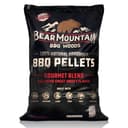
How many pellets does a brisket cook use?
Plan on roughly 1 to 2 pounds per hour at brisket temperatures, so a twelve-hour cook lands somewhere between 12 and 25 pounds depending on your grill, the ambient temperature and how well insulated the cooker is. A 20-pound bag is therefore approximately one brisket. This is worth internalizing before you buy a premium pellet at a premium price — the cost per cook is real, which is why a 40-pound bag at a good price per pound earns its place on this list.
Cold weather changes the arithmetic sharply. A pellet grill in winter can burn close to double its summer rate holding the same set temperature, because it is fighting heat loss the whole time. Running out of pellets at 3 a.m. in hour nine is a genuinely common failure, and an insulated blanket for your grill pays for itself in pellets alone.
Why pellet smoke is milder — and what to do about it
Pellet grills produce less smoke flavor than a stick burner, and this is inherent rather than a defect. Pellets burn very efficiently and very cleanly in a controlled auger-fed fire, and clean efficient combustion produces fewer of the aromatic compounds that we perceive as smoke. A dirtier, cooler, more smoldering fire — which is what an offset runs — produces more of them.
The practical levers are: run the lowest temperatureyour grill will hold for the first few hours, because most pellet grills produce noticeably more smoke at 180-200°F than at 275°F; use a filler-free or single-species pellet so the flavor wood is doing the work; and wrap later rather than earlier, since the wrap stops smoke deposition entirely. Some cooks also add a smoke tube. None of these will make a pellet grill taste like an offset, and any guide that promises otherwise is overselling. See pellet vs charcoal for the honest version of that trade.
Storage is a real issue with pellets
Pellets are compressed sawdust held together by the wood’s own lignin, and they are held together only as long as they stay dry. Absorb moisture and they swell, crumble back into sawdust, and then jam your auger — which on most grills means a shutdown, a cold brisket and a strip-down to clear it. This is the most common pellet-grill failure and it is entirely preventable.
Keep pellets in a sealed container, not the paper bag they arrived in, and not on a garage floor where concrete wicks moisture upward. Empty the hopper if the grill is going to sit unused for weeks, especially in a humid climate — hoppers are not sealed and are vented by design. A 40-pound bag is excellent value right up until half of it turns to mush.
Do brand-matched pellets matter?
No. Any food-grade hardwood BBQ pellet of standard 1/4-inch diameter works in any pellet grill, regardless of brand. Traeger pellets work in a Pit Boss; Pit Boss pellets work in a Traeger. What you must not use is heating pellets sold for pellet stoves — those can contain softwoods, bark and binding agents that have no business near food. The distinction that matters is food-grade versus heating, not brand versus brand.