Brisket & Bark

The Best Smoker for Cold Weather

No manufacturer publishes a cold-weather rating, so almost every list of 'best winter smokers' is invented. These five are ranked on two things that are actually written down: the wall construction the maker states, and whether the cooker corrects a temperature drop without you.

By Stephen V.Last updated How we pick

For cold-weather brisket on a normal budget, buy the Char-Griller AKORN. It is the only cooker here whose listing states its wall construction in so many words — triple-wall insulated steel — and insulation is the whole question. It weighs and costs a fraction of a ceramic kamado while doing the same job of keeping heat inside the cooker instead of radiating it into a January afternoon. Two things to budget for before you buy: the listing puts no heat deflector in the box, and a brisket needs one, so Char-Griller’s Smokin’ Stone is a second purchase. If you want the cooker to also correct its own temperature overnight, skip to the Masterbuilt Gravity Series 600.

Now the part most cold-weather roundups leave out. No maker in this category publishes an insulation value, a cold-weather rating, a minimum ambient temperature or a fuel-consumption figure at 20°F. Not one. So any page that ranks smokers by how they perform in the cold is either describing someone’s winter or making it up. What we can do honestly is rank on the two things that arepublished — what the walls are made of, and whether a thermostat and fan will chase your set temperature when the weather pulls it down — and then tell you what cold actually does so you can judge the rest yourself.

The method side of this is a separate page: smoking a brisket in cold weather covers what to change about the cook itself, which matters more than which cooker you own. Read that one first if you already have a smoker and the forecast has just dropped.

How this is funded: we earn a commission if you buy through our links, at no extra cost to you. It never changes which product we recommend, and we’ll tell you plainly when we’d skip one. Full disclosure.

Quick picks

Ranked on the published specs and how each one fits a brisket cook. Select a row to jump to the full write-up. We have not run this gear in a lab — here is exactly what we do instead.

#ProductBest forPrice
1
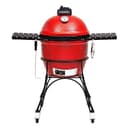
Char-Griller AKORN 20" Kamado Charcoal Grill and Smoker

Char-Griller AKORN 20" Kamado Charcoal Grill and Smoker

Not ceramic at all: triple-wall insulated steel, which is why it costs and weighs a fraction of everything above it. For brisket the 20-inch cooking diameter is borderline for a packer. The real catch is that the listing puts no heat deflector in the box. Char-Griller sells its Smokin' Stone separately, and without one this is a grill, not a smoker. Budget for both.

Best overall
$399.99 · View on Amazon

Price as of October 22, 2026. #ad How we’re funded

2
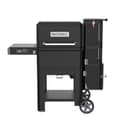
Masterbuilt Gravity Series 600 Digital Charcoal Grill + Smoker

Masterbuilt Gravity Series 600 Digital Charcoal Grill + Smoker

The most interesting gravity smoker for brisket specifically, because the published burn time is the longest in the range: Masterbuilt states up to 18 hours at 225°F from one hopper load. It has the smallest grate of the three, and for a single packer that hardly matters.

Best for an overnight cook in the cold
$749.00 · View on Amazon

Price as of October 22, 2026. #ad How we’re funded

3
Kamado Joe Classic Joe Series I 18" Ceramic Kamado Grill

Kamado Joe Classic Joe Series I 18" Ceramic Kamado Grill

An 18-inch grill is the wrong size for a whole packer, and we will not pretend otherwise. On a 250 sq in grate you roll the flat or cook the point and flat separately. It is on this list because plenty of people cook a flat, or half a packer, for four. For that cook it is the least expensive Kamado Joe, with the same deflector system and ash drawer as the Big Joe.

Best thermal mass
$999.00 · View on Amazon

Price as of October 22, 2026. #ad How we’re funded

4
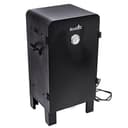
Char-Broil Analog Electric Smoker

Char-Broil Analog Electric Smoker

An insulated steel box with a dial and a chip tray — the least complicated smoker in this guide. It won't give you a heavy smoke ring, but it will sit at 250°F for twelve hours in cold weather without a single adjustment, which is exactly what a first brisket needs.

Simplest insulated cabinet
$204.99 · View on Amazon

$249.9918% off

Price as of October 22, 2026. #ad How we’re funded

5
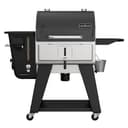
Camp Chef Woodwind Pro WiFi 24 Pellet Grill

Camp Chef Woodwind Pro WiFi 24 Pellet Grill

The pellet grill that answers the usual complaint about pellet grills. Camp Chef's Smoke Box burns wood chunks, chips or lump charcoal alongside the pellets, with a damper to dial the output — so you get closer to stick-burner smoke without standing over a fire. Underneath it is a conventional WiFi PID pellet grill with 811 square inches and a pull-knob ash cleanout.

Best pellet grill for a cold cook

The picks in full

#1Best overall

Char-Griller AKORN 20" Kamado Charcoal Grill and Smoker

Not ceramic at all: triple-wall insulated steel, which is why it costs and weighs a fraction of everything above it. For brisket the 20-inch cooking diameter is borderline for a packer. The real catch is that the listing puts no heat deflector in the box. Char-Griller sells its Smokin' Stone separately, and without one this is a grill, not a smoker. Budget for both.

Strengths

  • Triple-wall insulated steel holds heat without ceramic's weight (listing stated)
  • Indexed dual dampers and an EasyDump ash pan (listing stated)
  • 8 in locking casters and folding side shelves, so it actually moves

Trade-offs

  • No heat deflector in the box; the Smokin' Stone is sold separately, and a brisket needs one
  • 20 in cooking diameter, so a trimmed packer will usually need the flat rolled
  • 1-year repair-or-replace warranty (listing stated), against lifetime cover on Kamado Joe ceramics
Fuel / powerCharcoal + wood chunks
Cooking diameter20 in (listing stated)
Total cooking area445 sq in incl. warming rack (listing stated)
BodyTriple-wall insulated steel (listing stated)
Heat deflectorNot included; Smokin' Stone sold separately
Temperature range200-700°F (listing stated)
Warranty1 year, repair or replace (listing stated)

Specs read from the manufacturer listing, on September 15, 2026. “Not published” means the maker does not state that figure.

#2Best for an overnight cook in the cold

Masterbuilt Gravity Series 600 Digital Charcoal Grill + Smoker

The most interesting gravity smoker for brisket specifically, because the published burn time is the longest in the range: Masterbuilt states up to 18 hours at 225°F from one hopper load. It has the smallest grate of the three, and for a single packer that hardly matters.

Strengths

  • Up to 18 hours at 225°F on one hopper (stated) — covers a whole brisket
  • 600 sq in (stated) is ample for one full packer
  • Wi-Fi app control with up to 4 meat probes (stated)

Trade-offs

  • Smallest cook area in the Gravity range — no room for a second packer
  • Still a powered smoker: no electricity, no cook
Fuel / powerCharcoal + wood (gravity-fed)
FuelLump/briquette charcoal + wood
Total cooking area600 sq in (stated)
Hopper capacity12 lb lump / 18 lb briquettes, up to 18 hours at 225°F (stated)
Temp range225-700°F (stated)
ConnectivityWi-Fi + Masterbuilt app (stated)

Specs read from the manufacturer listing, on August 11, 2026. “Not published” means the maker does not state that figure.

#3Best thermal mass

Kamado Joe Classic Joe Series I 18" Ceramic Kamado Grill

An 18-inch grill is the wrong size for a whole packer, and we will not pretend otherwise. On a 250 sq in grate you roll the flat or cook the point and flat separately. It is on this list because plenty of people cook a flat, or half a packer, for four. For that cook it is the least expensive Kamado Joe, with the same deflector system and ash drawer as the Big Joe.

Strengths

  • Same Divide & Conquer deflector system and slide-out ash drawer as the Big Joe (maker stated)
  • 227.7 lb (maker stated), with a far smaller footprint than any 24-inch grill here
  • A smaller chamber to bring up to temperature and hold there

Trade-offs

  • A whole packer will not lie flat on an 18 in grate, so plan to roll, fold or split it
  • Felt gasket (maker stated), not the double-thick wire-mesh gasket on the Big Joe II
  • Kamado Joe publishes no burn time for a load of lump
Fuel / powerLump charcoal + wood chunks
Grate diameter18 in (maker stated)
Cooking area250 sq in (maker stated)
Heat deflectorHalved deflector included, part of Divide & Conquer (maker stated)
Temperature range225-750°F (maker stated)
GasketFelt (maker stated)
Weight227.7 lb (maker stated)

Specs read from the manufacturer listing, on September 15, 2026. “Not published” means the maker does not state that figure.

#4Simplest insulated cabinet

Char-Broil Analog Electric Smoker

An insulated steel box with a dial and a chip tray — the least complicated smoker in this guide. It won't give you a heavy smoke ring, but it will sit at 250°F for twelve hours in cold weather without a single adjustment, which is exactly what a first brisket needs.

Strengths

  • Double-wall insulated body holds temperature in cold weather
  • Dial-and-forget operation with nothing to learn
  • Among the cheapest ways into a genuine low-and-slow cook

Trade-offs

  • Lightest smoke flavor of any smoker type here
  • Smaller capacity — a big packer may need trimming to fit
Fuel / powerElectric + wood chips
FuelElectric element + wood chips
Temperature controlAnalog dial
BodyDouble-wall insulated steel
Total cooking areaNot published
ElementNot published

Specs read from the manufacturer listing, on August 10, 2026. “Not published” means the maker does not state that figure.

#5Best pellet grill for a cold cook

Camp Chef Woodwind Pro WiFi 24 Pellet Grill

The pellet grill that answers the usual complaint about pellet grills. Camp Chef's Smoke Box burns wood chunks, chips or lump charcoal alongside the pellets, with a damper to dial the output — so you get closer to stick-burner smoke without standing over a fire. Underneath it is a conventional WiFi PID pellet grill with 811 square inches and a pull-knob ash cleanout.

Strengths

  • Smoke Box takes wood chunks, chips or charcoal for heavier smoke
  • 811 sq in over two racks fits a full packer with room to spare
  • Ash cleanout knob empties the fire pot into a cup — no vacuuming

Trade-offs

  • No Slide and Grill direct-flame searing — Camp Chef dropped it on the Pro
  • The Smoke Box is another fire to load and damper; it is not automatic
Fuel / powerWood pellets (+ Smoke Box wood or charcoal)
FuelWood pellets + Smoke Box wood or charcoal
Total cooking area811 sq in (429 + 382, stated)
Temperature controlDigital PID (WiFi)
Temp range160-500°F (stated)
CleanupAsh cleanout knob + cup

Specs read from the manufacturer listing, on August 24, 2026. “Not published” means the maker does not state that figure.

What cold weather actually does to a brisket cook

Four effects, in descending order of how much they matter. Understanding them is what lets you read a spec sheet usefully instead of trusting a list.

1. Wind, not temperature, is the real enemy.A cooker loses heat three ways: conduction through the walls, radiation from the hot surfaces, and convection as moving air strips warmth off the outside. Still air at 25°F is a much easier cook than a breezy 45°F, because moving air carries heat away far faster than cold still air does. This is the single most useful thing to know, and it is why a windbreak is worth more than almost any upgrade. It also means the cooker property you want is a tight body with few leaks, not just thick walls.

2. You will burn substantially more fuel. Every watt leaving the cooker has to be replaced. On charcoal that means a shorter burn from the same load and a real chance of running out partway through a brisket; on pellets it means a noticeably faster hopper; on electric it means the element spends far more of its time on and, in a cheap cabinet, may not keep up at all. Plan for more fuel than your summer cook needed, and read the published burn times on this page with that in mind.

3. The cook takes longer, and the stall can get worse. A colder chamber and a colder meat surface mean a slower climb, and the stall— which is evaporative cooling, not collagen — is driven by moisture leaving the surface. Dry winter air can make that evaporation more aggressive, not less. Pad your timeline generously; our start-time guide works the schedule backwards from when you want to eat.

4. Your thermometers get less trustworthy, in a specific way.A dome gauge reads the air at the top of a cold cooker, which in winter can sit a long way from the temperature at the grate. Trust a probe at grate level beside the meat instead. And remember that most wireless and WiFi units publish an operating temperature range for the transmitter, not just the probe — the electronics are sitting outside in the cold too.

What we ranked on, and what we refused to rank on

Ranked on: published wall construction.Three of the five state it. Char-Griller’s listing says triple-wall insulated steel for the AKORN. Char-Broil publishes double-wall insulated steel for its analog cabinet. Kamado Joe’s cooker is ceramic, which is both insulating and massive. The remaining two are conventional single-wall steel bodies, and we say so.

Ranked on: whether the cooker corrects itself.A fan-and-controller cooker responds to a temperature drop by burning harder, which is exactly what you want when the weather is working against you. A manual cooker responds by getting colder until you open a vent. That is why the Gravity 600 sits second despite Masterbuilt publishing no insulation figure for it: it states up to 18 hours at 225°F from one hopper, which is the longest published unattended burn in our registry, and the controller spends that time chasing your number.

Refused to rank on: cold-weather performance claims.We found no maker publishing a minimum ambient temperature, an insulation rating, or a fuel-consumption figure in the cold for any cooker in our registry. We are not going to convert that silence into a ranking. Where a maker’s own words bear on the question — Char-Broil’s double-wall body, Char-Griller’s triple-wall body — we quote them and attribute them. Where they do not, the spec row says “Not published.”

How the five compare

CookerWall construction (maker/listing stated)Corrects a temperature drop by itself?Published unattended burnNeeds mains power?
Char-Griller AKORN 20"Triple-wall insulated steelNo — manual dual dampersNot publishedNo
Masterbuilt Gravity 600Not publishedYes — digital fan + hopperUp to 18 hours at 225°FYes
Kamado Joe Classic Joe ICeramic (227.7 lb, maker stated)No — manual ventsNot publishedNo
Char-Broil Analog ElectricDouble-wall insulated steelYes — analog thermostatMains powered — no fuel limitYes
Camp Chef Woodwind Pro 24Not publishedYes — digital PIDNot publishedYes

Wall construction is quoted from the maker’s or the listing’s own words, read on the date shown in each product’s spec table below. “Not published” means we could not find the maker stating it. No cooker in this table carries a published insulation value, cold-weather rating or minimum ambient temperature from its maker, which is why this page ranks on construction and self-correction rather than on winter performance.

Thermal mass and insulation are not the same thing

Worth separating, because the marketing blurs them. Insulationslows heat escaping — a double or triple wall with air or material between the skins. Thermal massstores heat — a ceramic kamado at 227 pounds holds a great deal of energy in its walls, which is why it recovers so well after the lid opens. In cold weather you want both, and they behave differently: insulation reduces how much fuel you burn, while mass reduces how much your temperature swings.

The ceramic cooker’s cold-weather weakness is the one nobody mentions: thermal shock. A cold ceramic body heated fast, or a hot one hit with cold water or sleet, is at risk in a way steel is not. In winter, bring a kamado up slowly and keep the lid shut. Kamado Joe states a 225-750°F range for the Classic Joe I and publishes no burn time for a load of lump, so plan the fuel rather than assume it.

Pellet grills in the cold: the honest position

Pellet grills get a bad reputation in winter and it is half-deserved. The good half: a PID controller is genuinely helpful, because it responds to the cold by running the auger harder, and you never have to leave a warm house to open a vent. The bad half: a typical pellet grill is a thin single-wall steel barrel, so it is burning a lot of pellets to replace the heat it is losing, and a hopper that lasts a summer brisket may not last a winter one.

The Woodwind Pro is here for a reason specific to cold weather rather than in spite of it. Camp Chef’s Smoke Box burns wood chunks, chips or lump charcoal alongside the pellets, which matters in winter because the complaint that pellet grills produce thin smoke gets worse in the cold — the controller holds temperature by running efficiently, and efficient fires make less of the aromatic compounds we taste as smoke. Camp Chef publishes 811 square inches over two racks and an ash-cleanout knob. It publishes nothing about wall construction, and we are not going to invent it. For thermal-blanket questions, see the FAQ below — the answer is “ask your maker,” not “wrap it in anything.”

What we did not pick, and why

Thin-steel offsets. The offset roundupis explicit that the Oklahoma Joe’s Highland’s thinner-than-custom steel “needs fire tending in wind and cold.” That is the honest read and it keeps every barrel offset off this page. An offset can absolutely cook a winter brisket — competition cooks do it in February — but it will be a hands-on night, and none of these makers publishes a steel gauge you could use to compare them.

The Weber Smokey Mountain. Our top charcoal pick overall and a perfectly capable winter cooker in still air, because the water pan is a large thermal buffer. It is porcelain-enameled single-wall steel, Weber publishes no insulation figure, and in wind it is noticeably affected. If you own one, read the cold-weather method guide; the windbreak advice there is worth more than a new cooker.

Insulated welded cabinets. The genuinely correct answer to this question is a purpose-built insulated competition cabinet, and nothing in that class is verified to a live retail listing we could route a buy link to. We would rather name the gap than fill it with something that does not do the job.

Welding blankets and thermal jackets.Several makers sell an own-brand insulated cover for specific models, and a correctly specified one is a cheap, effective upgrade. We do not carry any in our registry and we are not going to recommend a generic blanket for a cooker it was not made for — the failure modes involve covering vents and melting materials. Ask the maker of your smoker what they sell for it.
Frequently asked questions

What is the best smoker for cold weather?

On published specs rather than marketing, an insulated-wall cooker that also corrects its own temperature. The Char-Griller AKORN is our overall pick because its listing states triple-wall insulated steel — the only wall construction claim in its price bracket — and the Masterbuilt Gravity Series 600 is the pick if you want the cooker to chase your set temperature overnight, because Masterbuilt states up to 18 hours at 225°F from one hopper. No maker in this category publishes a cold-weather rating, so treat any ranking that claims winter performance figures with suspicion, including a stated minimum ambient temperature.

Is cold weather or wind worse for a smoker?

Wind, clearly. Moving air strips heat off the outside of a cooker far faster than still cold air does, which is why a breezy 45°F day is harder work than a calm 25°F one. The practical consequence is that a windbreak — a fence panel, a wall, the leeward side of the house — does more for your cook than almost any equipment upgrade. Just keep combustible material well clear and never block the cooker's intake or exhaust vents.

Do I need an insulated smoker to cook brisket in winter?

No. Insulation reduces how much fuel you burn and how hard the cooker has to work; it does not decide whether the brisket is possible. People cook excellent brisket on single-wall bullet smokers in February. What changes is your planning: more fuel than a summer cook needs, a windbreak, a longer timeline, and a probe at grate level rather than trusting the dome gauge. Our cold-weather method guide covers all of it.

Can I wrap my smoker in a welding blanket?

Ask the maker of your smoker what they sell for that model. Several manufacturers offer a fitted insulated cover and a correctly specified one is a cheap, effective upgrade. We are not going to recommend a generic blanket, because the failure modes are real: covering an intake or exhaust vent changes how the fire behaves, and the wrong material next to a hot surface is a hazard rather than an improvement. We carry no insulating covers in our product registry, so there is nothing here for us to point you at honestly.

Will a pellet grill hold 225°F in freezing weather?

Usually yes, and it will burn considerably more pellets doing it. A PID controller responds to the cold by running the auger harder, which is genuinely helpful. The limit is the hopper: a load that comfortably covers a summer brisket may not cover a winter one, so check it before you go to bed rather than after. Expect lighter smoke too, because the controller holds temperature by burning efficiently and efficient fires produce less of what we taste as smoke — a smoke tube is the usual fix.

Is a ceramic kamado good in the cold?

Very, with one caveat nobody mentions. The ceramic body is both insulating and massive, so it holds heat and recovers well after the lid opens. The caveat is thermal shock: a cold ceramic cooker heated too fast, or a hot one hit with cold water or sleet, is at risk in a way steel is not. Bring it up slowly, keep the lid shut, and keep it covered when it is not in use.

Does cold weather change the brisket's internal temperature targets?

Not at all. Brisket is done when it is probe-tender, which usually happens somewhere around 200-205°F regardless of the weather, and the food-safety rules are the same in January as in July — the USDA danger zone is 40°F to 140°F whatever it is doing outside. What cold changes is the time it takes to get there and the fuel it takes to do it, not the destination.

Sources

Keep reading