How we ranked these, and what we refused to rank on
Four criteria, in the order they actually matter to a brisket cook. None of them is flavor, because nothing published about any of these jars supports a flavor claim and we have not run a blind tasting.
1. Format, which is the only criterion that changes your cook.Tallow goes into a wrap as two to four tablespoons of solid or semi-solid fat, spooned onto the paper before the brisket goes down on it. A wide tub takes a spoon. A narrow glass jar fights the spoon. A spray cannot deliver that volume at all — it delivers a film, which is a genuinely useful but completely different job. Rank the format against the job and this category sorts itself out in about a minute.
2. Quantity against how often you cook. A wrap uses roughly two ounces. A 42 oz tub is therefore about twenty wraps; an 11.5 oz jar is about five. Tallow is a rendered animal fat, and no maker here publishes a shelf life or tells you whether to refrigerate it after opening, so buying four times what you will use inside a season is not thrift. Match the jar to your calendar.
3. What the label is prepared to state.This is where the jars genuinely differ, and not in the direction the marketing suggests. South Chicago Packing publishes a net weight and “100% pure beef tallow — no artificial ingredients or preservatives” on its own site. Cornhusker Kitchen’s listing states made in the USA and — refreshingly — that the cattle are corn fed, which is a thing most brands selling a premium fat would simply leave out. First Light Farms states grass-fed and finished plus Certified Humane. Fatworks states certified organic and non-GMO. Those are all real, checkable claims about sourcing. They are also, unanimously, claims about the animal rather than the fat.
4. Price per ounce, read live. We do not print a price in this text, because a number typed into a sentence is stale the week after it is written. Every buy button on this page reads the current price at request time, and the honest ranking on value almost always comes out the same way: the big tub wins per ounce, the small jar wins on what you will actually finish, and the spray is the most expensive fat per ounce on the page by a distance because you are paying for the can.
What we refused to rank on
Smoke point.Not one of these makers publishes one. You will find figures around 400°F quoted on reseller pages and in blog posts, and we are not going to repeat a number whose origin we cannot trace to the people who rendered the fat. It is also close to irrelevant here: a brisket cooks at 225 to 275°F, so a smoke point anywhere in the normal range for a rendered animal fat is not the constraint. If you are searing steaks at 500°F in a skillet, that is a different page and a different question.
Wagyu against standard. Five of these six are sold on a wagyu claim and we have kept it in the spec tables because it is what the labels say. What we will not do is tell you that it changes your brisket. No maker here publishes a melting point or a fat composition, so there is no published basis for claiming one jar spreads more easily or renders differently than another. The pick we call out as the certified-organic option carries no wagyu claim at all and does the wrapping job identically as far as anything published can establish.
What tallow actually does on a brisket, and what it does not
Worth being precise about, because this is where most of the money in this category gets spent on the wrong expectation.
In the wrap, it is insurance for a lean flat. When you wrap at the stall, a spoonful or two of tallow on the butcher paper gives the lean side of the meat a layer of fat to sit in for the back half of the cook. On a well-marbled Prime packer you may not notice it at all. On a Choice or Select flat with the fat cap trimmed hard, it is the difference between the thin end being pleasant and the thin end being chalky. Our wrapping guide puts it in sequence.
At the slice, it revives yesterday’s brisket. This is the use most people underrate. A spoon of tallow warmed and spooned over reheated slices does more for them than any sauce, because what reheated brisket has lost is fat and moisture, not seasoning. It is also the legitimate rescue for a brisket that came out dry.
What it does not do is save a cook that went wrong. Tallow is not a cure for pulling the meat at the wrong internal temperature, for a fire that ran hot, or for skipping the rest. Most of what gets credited to a tallow wrap is really the rest doing its job. If you are choosing between buying a jar of tallow and buying a thermometer you trust, buy the thermometer: our thermometer roundup is the more consequential purchase by a wide margin.
And it is not a binder. Tallow is solid and greasy at room temperature; it does not help rub adhere the way mustard or a thin oil does. The binder question is answered on its own page, and the answer is not this.
The six jars side by side
Every figure below is the maker’s or the listing’s own, read on the date in each product’s spec table. The empty cells are not gaps in our research — they are what the category declines to publish.
| Tallow | Size | Format | Sourcing claim | Smoke point |
|---|
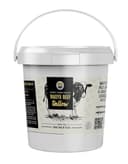
| Cornhusker Kitchen Rendered Wagyu Tub | 1.5 lb / 24 oz | Wide tub | Wagyu, corn fed, made in USA | Not published |
| South Chicago Packing Wagyu Tallow | 42 oz | Tub | Wagyu; 100% pure beef tallow, no preservatives | Not published |
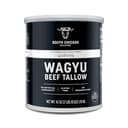
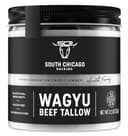
| South Chicago Packing Wagyu Tallow | 11.5 oz | Glass jar | Wagyu | Not published |
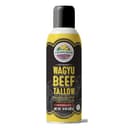
| Cornhusker Kitchen Wagyu Tallow Spray | 10 oz | Aerosol spray | Wagyu | Not published |
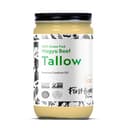
| First Light Farms Wagyu Tallow | 14 oz | Jar | Wagyu, 100% grass-fed and finished, Certified Humane | Not published |
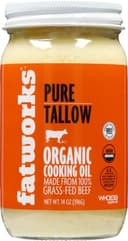
| Fatworks Organic Grass-Fed Tallow | 14 oz | Jar | Certified organic, non-GMO, pasture-raised | Not published |
Five rows, one column, the same answer in every cell. That is the most useful thing on this page: once you know that no maker publishes the specification people argue about, the decision collapses into format and quantity, and you can stop reading comparisons of fats that nobody has measured.
How much to buy, and how to store it
Work backward from wraps. Two to four tablespoons per brisket is a normal amount on the paper, which is roughly one to two ounces. If you cook a brisket a month, a 14 oz jar is most of a year and the 1.5 lb tub is comfortable. If you cook most weekends in season, the 42 oz tub is the only one of these that makes economic sense. If you have never used tallow and want to find out whether you can tell, buy the 11.5 oz jar and spend the difference on paper you will also use.
Storage is the one place we will go beyond the labels, because the labels are silent and the question is a food-safety question rather than a cooking one. Rendered fat is shelf stable in the sense that it is not a growth medium the way a wet food is, but it does go rancid with time, heat and air — and rancid tallow smells like crayons and will carry that straight into a twelve-hour cook. Keep the jar closed, keep it out of the sun and off the top of the smoker, use a clean dry spoon every time, and if it smells wrong, it is wrong. For everything the USDA does say about handling beef and leftovers, the sources below are the authorities we cite throughout the site.
One practical note on the tub-against-jar question: cold tallow is hard. A wide tub lets you lever out a lump with a spoon straight from the pantry. A narrow jar usually wants ten minutes on the counter first, which is fine if you plan it and annoying at the moment you are trying to wrap a brisket with greasy hands and a stall that has just broken.