Brisket & Bark

The Best Knife for Trimming Brisket

The long slicer gets the glory at the end. The knife that decides how evenly a packer cooks is the short one you use before it goes on: a thin, 6-inch boning knife. Six compared on flex, grip and steel.

By Stephen V.Last updated How we pick

Every guide on this site that touches a raw packer says the same thing: trim it with a thin, flexible boning knife, not the slicer. Our trimming guide says it, our slicing knife roundup says it, and until now neither of them told you which one to buy. This page does. A brisket trim is a particular job: forty minutes of shallow, pulling cuts through cold beef fat, working around two muscles that meet at a seam of hard fat, on a piece of meat that weighs more than most cutting boards. The knife that does it well is not the knife that bones a chicken well, even though they sit in the same drawer.

So the six knives below are ranked on four things, in this order. Blade flex, because it changes how the knife behaves on a cold fat cap more than any other spec, and because it is the one most makers refuse to state plainly. Grip when greasy, because by the second brisket your hand is coated in tallow and a handle that slips is a handle that cuts you. The steel and what the maker publishes about it: hardness, edge angle, stamped or forged. And care, because half of these are dishwasher safe and half are not, and the makers say so.

One honesty note. We have not trimmed a brisket with each of these knives. Every blade length, hardness figure and handle material below was read from the maker’s own product page or the retail listing on September 20, 2026, and each spec says which. Where a maker does not state a figure, and no boning-knife maker we found publishes blade thickness, the cell reads “Not published.” Our methodology page explains what we do instead of testing.

How this is funded: we earn a commission if you buy through our links, at no extra cost to you. It never changes which product we recommend, and we’ll tell you plainly when we’d skip one. Full disclosure.

Quick picks

Ranked on the published specs and how each one fits a brisket cook. Select a row to jump to the full write-up. We have not run this gear in a lab — here is exactly what we do instead.

#ProductBest forPrice
1
Victorinox Fibrox Pro 6" Curved Flexible Boning Knife

Victorinox Fibrox Pro 6" Curved Flexible Boning Knife

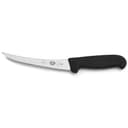
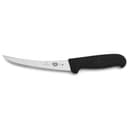
The trimming knife most pits actually own, for the same reason their slicer is a Victorinox. A narrow curved blade with a flexible spine rides under the fat cap and follows the seam between the point and the flat, and the Fibrox handle holds on when your hand is coated in cold beef fat. Victorinox states a 5.9 in blade and 3.2 oz, so it stays agile for an hour of trimming.

Best overall
$31.99 · View on Amazon

$40.0020% off

Price as of September 22, 2026. #ad How we’re funded

2
Victorinox Fibrox Pro 6" Curved Semi-Stiff Boning Knife

Victorinox Fibrox Pro 6" Curved Semi-Stiff Boning Knife

The same knife as our top pick with less bend in the blade, and for a lot of brisket cooks that is the better trade. The listing's own words are that thick meats like beef require a less flexible knife, and on a cold fat cap that is exactly right: a semi-stiff blade shaves in long, even sheets where a flexible one wants to dive. Victorinox states a 5.9 in blade and 3.4 oz. It was also the cheaper of the two on the day we checked.

Best for shaving the fat cap
$25.50 · View on Amazon

$40.0036% off

Price as of September 22, 2026. #ad How we’re funded

3
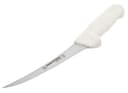
Dexter-Russell Sani-Safe S131F-6PCP 6" Flexible Curved Boning Knife

Dexter-Russell Sani-Safe S131F-6PCP 6" Flexible Curved Boning Knife

The knife behind a great many American meat counters, and the one to buy if the Victorinox handle has ever slipped on you. Dexter's textured Grip-Tex polypropylene handle is built for wet hands, the blade is a flexible curved 6 in in the company's own DEXSTEEL high-carbon stainless, and the whole thing is made in the USA. Dexter seals the blade to the handle so fat and water cannot work into the joint.

Best grip with greasy hands
$23.79 · View on Amazon

$27.4013% off

Price as of September 22, 2026. #ad How we’re funded

4
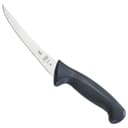
Mercer Culinary Millennia 6" Curved Boning Knife (M23820)

Mercer Culinary Millennia 6" Curved Boning Knife (M23820)

The culinary-school knife, and a stiffer blade than either Victorinox. Mercer publishes what most makers do not: high-carbon Japanese steel at 53-54 HRC, ground to 15 degrees, on a one-piece stamped blade with a Santoprene handle that has textured finger points and a guard. That softer steel sharpens in a minute on a steel. Restaurant suppliers list this exact model as the curved stiff version, which is the one you want for the deckle.

Best value
$23.70 · View on Amazon

Price as of September 22, 2026. #ad How we’re funded

5
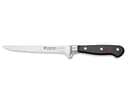
Wüsthof Classic 6" Flexible Boning Knife (1040101416)

Wüsthof Classic 6" Flexible Boning Knife (1040101416)

The forged option, and the only knife here that is not stamped. Wüsthof forges the Classic from one blank, hardens it to 58 HRC and grinds it to 14 degrees per side, which is a harder, keener edge than any of the stamped knives above. On brisket that shows up as a blade that is still sharp at the end of a long trim. It costs several times what the Victorinox does, and it does not trim a packer several times better.

Best forged knife
$120.00 · View on Amazon

Price as of September 22, 2026. #ad How we’re funded

6
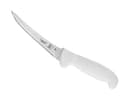
Mercer Culinary Ultimate White 6" Curved Boning Knife (M18180)

Mercer Culinary Ultimate White 6" Curved Boning Knife (M18180)

The cheapest knife here, and not a compromise on the part that matters. Mercer publishes the same high-carbon Japanese steel as the Millennia, at a stated 56 HRC, on a 6 in curved blade with a 15 degree edge. What you give up is the softer Santoprene grip: this handle is plain textured polypropylene. If you trim two briskets a year, this is all the knife the job needs.

Best budget
$10.99 · View on Amazon

Price as of September 22, 2026. #ad How we’re funded

The picks in full

#1Best overall

Victorinox Fibrox Pro 6" Curved Flexible Boning Knife

The trimming knife most pits actually own, for the same reason their slicer is a Victorinox. A narrow curved blade with a flexible spine rides under the fat cap and follows the seam between the point and the flat, and the Fibrox handle holds on when your hand is coated in cold beef fat. Victorinox states a 5.9 in blade and 3.2 oz, so it stays agile for an hour of trimming.

Strengths

  • Flexible, curved blade follows the curve of the flat and the point-flat seam (maker stated)
  • Fibrox handle is slip-resistant and NSF approved (listing stated); dishwasher safe (maker stated)
  • Swiss made with Victorinox's lifetime guarantee against defects (maker stated)

Trade-offs

  • Flex is a liability on the hard deckle fat, where a stiffer blade bites more cleanly
  • Stamped blade, so plan on regular honing; it is a working tool, not an heirloom
  • Sold on Amazon by a third-party seller at the time of writing
Fuel / powerNot published
Blade length5.9 in (maker stated); sold as 6 in
Blade shape and flexNarrow, curved, flexible spine (maker stated)
HandleFibrox thermoplastic elastomer, NSF approved (maker and listing stated)
Weight3.2 oz (maker stated)
Blade thicknessNot published
Made inSwitzerland (maker stated)

Specs read from the manufacturer listing, on September 20, 2026. “Not published” means the maker does not state that figure.

#2Best for shaving the fat cap

Victorinox Fibrox Pro 6" Curved Semi-Stiff Boning Knife

The same knife as our top pick with less bend in the blade, and for a lot of brisket cooks that is the better trade. The listing's own words are that thick meats like beef require a less flexible knife, and on a cold fat cap that is exactly right: a semi-stiff blade shaves in long, even sheets where a flexible one wants to dive. Victorinox states a 5.9 in blade and 3.4 oz. It was also the cheaper of the two on the day we checked.

Strengths

  • Semi-stiff curved blade holds a flat angle on cold fat instead of flexing into the meat (listing stated)
  • Same Fibrox handle, NSF standard and Swiss lifetime guarantee as the flexible version (maker and listing stated)
  • Sold by Amazon.com at the time of writing, at a lower price than the flexible blade

Trade-offs

  • Less feel for silverskin and the point-flat seam than the flexible blade
  • Victorinox's own page does not state the flex; the semi-stiff description is the listing's
  • The Amazon listing title is a garbled mix of words; check the part number 5.6603.15 in the details
Fuel / powerNot published
Blade length5.9 in (maker stated); sold as 6 in
Blade shape and flexCurved, semi-stiff (listing stated); Victorinox states curved only
HandleFibrox thermoplastic elastomer, meets NSF standards (maker and listing stated)
Weight3.4 oz (maker stated)
Blade thicknessNot published
Made inSwitzerland (maker stated)

Specs read from the manufacturer listing, on September 20, 2026. “Not published” means the maker does not state that figure.

#3Best grip with greasy hands

Dexter-Russell Sani-Safe S131F-6PCP 6" Flexible Curved Boning Knife

The knife behind a great many American meat counters, and the one to buy if the Victorinox handle has ever slipped on you. Dexter's textured Grip-Tex polypropylene handle is built for wet hands, the blade is a flexible curved 6 in in the company's own DEXSTEEL high-carbon stainless, and the whole thing is made in the USA. Dexter seals the blade to the handle so fat and water cannot work into the joint.

Strengths

  • Textured, slip-resistant Grip-Tex handle built for a wet meat counter (maker stated)
  • Impervious blade-to-handle seal, NSF certified (maker stated)
  • Made in USA, guaranteed against defects for the life of the product (maker stated)

Trade-offs

  • White handle shows every stain from rub and smoke
  • Dexter does not publish the blade's thickness or a usable weight
  • Sold on Amazon by a third-party restaurant supplier at the time of writing
Fuel / powerNot published
Blade length6 in (maker stated)
Blade shape and flexNarrow, curved, flexible (maker stated)
SteelDEXSTEEL stain-free high-carbon steel (maker stated)
HandleTextured Grip-Tex polypropylene, sealed to the blade (maker stated)
Blade thicknessNot published
Made inUSA (maker stated)

Specs read from the manufacturer listing, on September 20, 2026. “Not published” means the maker does not state that figure.

#4Best value

Mercer Culinary Millennia 6" Curved Boning Knife (M23820)

The culinary-school knife, and a stiffer blade than either Victorinox. Mercer publishes what most makers do not: high-carbon Japanese steel at 53-54 HRC, ground to 15 degrees, on a one-piece stamped blade with a Santoprene handle that has textured finger points and a guard. That softer steel sharpens in a minute on a steel. Restaurant suppliers list this exact model as the curved stiff version, which is the one you want for the deckle.

Strengths

  • Mercer publishes the steel, the 53-54 HRC hardness and the 15 degree edge (maker stated)
  • Santoprene and polypropylene handle with textured finger points and a finger guard, NSF certified (maker stated)
  • Sold by Amazon.com at the time of writing

Trade-offs

  • Not dishwasher safe; Mercer says hand wash only (maker stated)
  • Mercer's own page does not state the flex; the stiff description comes from restaurant-supply listings
  • Softer steel loses its edge faster than the Wüsthof, though it also comes back faster
Fuel / powerNot published
Blade length6 in / 15.2 cm (maker stated)
Blade shape and flexCurved (maker stated); listed as curved stiff by restaurant suppliers
Steel and hardnessHigh-carbon Japanese steel, 53-54 HRC, 15 degree edge, stamped (maker stated)
HandleSantoprene and polypropylene, textured finger points, NSF certified (maker stated)
Blade thicknessNot published
WarrantyLimited lifetime (maker stated)

Specs read from the manufacturer listing, on September 20, 2026. “Not published” means the maker does not state that figure.

#5Best forged knife

Wüsthof Classic 6" Flexible Boning Knife (1040101416)

The forged option, and the only knife here that is not stamped. Wüsthof forges the Classic from one blank, hardens it to 58 HRC and grinds it to 14 degrees per side, which is a harder, keener edge than any of the stamped knives above. On brisket that shows up as a blade that is still sharp at the end of a long trim. It costs several times what the Victorinox does, and it does not trim a packer several times better.

Strengths

  • Forged from a single blank, 58 HRC, 14 degrees per side (maker stated)
  • Wüsthof's own name for it is the flexible boning knife: a 6.0 in narrow blade, 1.2 in wide (maker stated)
  • Full tang, triple-riveted handle, made in Solingen, Germany (listing and maker stated)

Trade-offs

  • The most expensive knife in this roundup by a wide margin
  • Hand wash only (listing stated); harder steel takes longer to sharpen at home
  • Sold on Amazon by a third-party seller at the time of writing
Fuel / powerNot published
Blade length6.0 in, 1.2 in wide (maker stated)
Blade shape and flexNarrow, flexible (maker stated)
Steel and hardnessForged stainless, 58 HRC, 14 degrees per side (maker stated)
Handle4.4 in, full tang, triple riveted (maker and listing stated)
Blade thicknessNot published
Made inGermany (maker stated)

Specs read from the manufacturer listing, on September 20, 2026. “Not published” means the maker does not state that figure.

#6Best budget

Mercer Culinary Ultimate White 6" Curved Boning Knife (M18180)

The cheapest knife here, and not a compromise on the part that matters. Mercer publishes the same high-carbon Japanese steel as the Millennia, at a stated 56 HRC, on a 6 in curved blade with a 15 degree edge. What you give up is the softer Santoprene grip: this handle is plain textured polypropylene. If you trim two briskets a year, this is all the knife the job needs.

Strengths

  • High-carbon Japanese steel, 56 HRC, 15 degree edge (maker stated)
  • Textured polypropylene handle with finger points and a guard, NSF certified (maker stated)
  • Sold by Amazon.com at the time of writing, at the lowest price in this roundup

Trade-offs

  • Plain polypropylene grip is harder and slicker than Santoprene or Fibrox when greasy
  • Not dishwasher safe; Mercer says hand wash only (maker stated)
  • White handle stains; Mercer's own page does not state the blade's flex
Fuel / powerNot published
Blade length6 in / 15.2 cm (maker stated)
Blade shape and flexCurved, narrow (maker stated); flex not stated
Steel and hardnessHigh-carbon Japanese steel, 56 HRC, 15 degree edge, stamped (maker stated)
HandleTextured polypropylene with finger guard, NSF certified (maker stated)
Blade thicknessNot published
WarrantyLimited lifetime (maker stated)

Specs read from the manufacturer listing, on September 20, 2026. “Not published” means the maker does not state that figure.

The four things that decide a trimming knife for brisket

1. Flex.Boning knives come in flexible, semi-stiff and stiff, and the difference is not marketing. A flexible blade bends to follow a curve, which is exactly what you want when the knife is riding under the thin membrane on the meat side, or tracing the seam between the point and the flat. A stiff blade does not bend, so it holds a flat angle and bites cleanly into dense fat, which is what you want on the hard deckle wedge that a flexible blade skates over. The fat cap sits between the two: long shaving strokes with the blade almost flat, taking the cap down to about a quarter inch in sheets, and here a semi-stiff blade is the easiest to control. The Amazon listing for Victorinox’s semi-stiff knife puts it plainly: thick meats like beef require a less flexible knife. If you only own one, the flexible Victorinox is the better all-rounder. If you trim briskets often, own a flexible and a stiff one and switch between them; together they cost less than one forged knife.

Be warned that makers are cagey about this spec. Victorinox’s own pages state “flexible spine” for one of its two knives here and say nothing at all for the other. Mercer’s pages say “curved” and stop, and it is restaurant suppliers who list the Millennia as the curved stiffversion. Wüsthof and Dexter say “flexible” in the product name. Every spec row on this page says whose word the flex is.

2. Grip when greasy.Trimming is done on a cold brisket, and cold beef fat coats a handle faster than anything else in the kitchen. The handles here fall into three groups. Textured thermoplastic elastomer, which is Victorinox’s Fibrox, and Santoprene, which Mercer uses on the Millennia, are soft and tacky and hold on when wet. Textured polypropylene, which Dexter and Mercer’s Ultimate White use, is harder; Dexter’s Grip-Tex texture is built for a wet meat counter and the maker says so, while Mercer’s cheaper white handle relies on molded finger points and a guard. Wüsthof’s riveted handle is the most elegant and the least grippy, which is one reason it ranks fifth here rather than first. Whatever the handle, wear a nitrile glove on the knife hand and a cut-resistant or nitrile glove on the hand steadying the meat.

3. Steel, and what the maker will tell you about it. This is where the price differences live. Five of the six are stamped, meaning cut from a sheet of steel, and one is forged from a single blank. Mercer is the most forthcoming maker here, publishing both the hardness of its Japanese high-carbon steel (53-54 HRC on the Millennia, 56 HRC on the Ultimate White) and its 15-degree edge. Wüsthof publishes 58 HRC and 14 degrees per side. Victorinox and Dexter publish neither a hardness figure nor an angle for these knives, though Dexter names its DEXSTEEL alloy. The practical translation: a harder blade stays sharp longer and takes longer to bring back; a softer blade dulls sooner and comes back in a minute on a honing steel. For a knife used two hours a month on beef fat, soft and easy to sharpen is not the wrong answer.

4. Care. Victorinox states that both Fibrox knives are dishwasher safe. Mercer states that neither of its knives is, and asks for hand washing. The Wüsthof listing says hand wash only. Dexter does not say. A dishwasher is hard on any edge, but on a knife that is going to sit in a drawer between briskets, being able to run it through the machine after a trim is a real convenience, and it is one the two Victorinox knives have and the others do not.

Flex, grip and steel at a glance

The table puts the four criteria side by side. Flex is stated as the maker or, where the maker is silent, the listing or supplier states it. Hardness and edge angle are published figures or “Not published.”

KnifeFlex (whose word)HandleSteel, hardness, edgeDishwasher
Victorinox Fibrox Pro curved flexibleFlexible (maker)Fibrox TPE, NSFStamped; hardness and angle not publishedYes (maker)
Victorinox Fibrox Pro curved semi-stiffSemi-stiff (listing; maker says curved only)Fibrox TPE, NSFStamped; hardness and angle not publishedYes (maker)
Dexter-Russell Sani-Safe S131F-6Flexible (maker)Grip-Tex polypropylene, sealed, NSFDEXSTEEL stamped; hardness and angle not publishedNot stated
Mercer Millennia M23820Stiff (restaurant suppliers; maker says curved only)Santoprene and polypropylene, NSFJapanese high-carbon, 53-54 HRC, 15° (maker)No (maker)
Wüsthof Classic 6" flexibleFlexible (maker)Riveted full tangForged, 58 HRC, 14° per side (maker)No (listing)
Mercer Ultimate White M18180Not statedTextured polypropylene, NSFJapanese high-carbon, 56 HRC, 15° (maker)No (maker)

Why 6 inches, and why curved

Boning knives are sold in 5, 5.5 and 6-inch blades, and for a brisket the 6 is the right one. The fat cap on a packer is a broad surface, sometimes 20 inches long, and a longer blade shaves it in wider sheets with fewer strokes. A 5-inch blade is built for working around chicken thigh bones and it feels short on a 14-pound piece of beef. Victorinox’s stated blade length is actually 5.9 inches on both of its knives here, which is why the spec rows say so; the difference from a 6 is not one you will notice.

Curved beats straight for the same reason. The curve keeps the handle up and away from the fat cap while the edge lies nearly flat against it, so you can take long, shallow strokes without your knuckles dragging in the tallow. On the meat side it lets the tip get under the membrane and lift. A straight boning knife is a fine knife; it just asks for a more awkward wrist angle on this particular job. Victorinox makes a straight, narrow 6-inch Swiss Classic that costs about the same as the Fibrox curved knives. We left it off the list only because three Victorinox knives on one page would tell you less than two.

How a brisket trim actually uses the knife

Working through the trim in order shows why flex matters as much as it does. Start meat side up, and the first cuts are the lightest: slide the tip under the papery membrane and the silverskin, angle the blade up slightly, and pull. A flexible blade follows the surface here and lifts the membrane off in strips; a stiff one wants to dig. Then flip it and shave the fat cap to about a quarter inch. Now you want the blade held almost flat and the strokes long and shallow, taking the excess off in sheets. Here is where the semi-stiff Victorinox or the stiff Mercer holds its angle better, and a fully flexible blade can dive into the meat if you push it.

The hard part is the deckle, the wedge of dense, waxy fat between the point and the flat that will not render at smoking temperatures. Open the seam and cut it out without splitting the two muscles apart, then square off the thin corners of the flat so nothing burns to jerky before the rest is done. This is stiff-blade work; a flexible blade skates over hard fat and makes you saw. If you have only a flexible knife, keep it very sharp and take the deckle in short, deliberate cuts rather than long ones. Our step-by-step trimming guide walks through the whole sequence, and our page on separating the point and flat covers the case where you do want to split them. Whatever knife you use, trim the brisket cold, straight from the refrigerator. Firm fat cuts clean; warm fat smears, and a smeared cut is the main way a sharp knife slips.

Stamped or forged, honestly

One knife on this list is forged and five are stamped, and the forged one costs roughly four to five times the others. The case for the Wüsthof is a real one: it is hardened to 58 HRC and ground to 14 degrees per side, it has a full tang and a bolster, and it will still be sharp at the end of a long trim where a softer stamped blade has started to drag. It is also a beautiful object, and there is nothing wrong with wanting one. But the honest assessment for brisket is that the job is done in 30 to 40 minutes of shallow cuts through fat, with the knife touching no bone and almost no hard fibrous tissue. That is not the work that separates a forged knife from a stamped one. The Victorinox slicing knife wins our slicing roundup on exactly this logic, and the same logic ranks the Victorinox boning knife first here. Buy the Wüsthof because you want it, not because your brisket needs it.

Keeping it sharp

A dull boning knife is a dangerous one, because you push harder and the blade goes where the push takes it. All six knives here respond to a honing steel before each trim; the softer Mercer blades in particular come back in a few strokes, and Mercer recommends hand washing precisely to protect that edge. None of the six makers in this roundup sells a sharpener we have verified a listing for, so we will not pretend to recommend one. What we will say is that a 15-degree edge, which is what Mercer publishes, and a 14-degree edge, which Wüsthof publishes, are both finer than the angle most pull-through sharpeners are set for, so a whetstone or a guided system that matches the maker’s angle serves these knives better.

What to budget for on top of the knife

Gloves. A nitrile glove on each hand keeps the grip from greasing over and keeps raw beef off your skin; a cut-resistant glove on the hand steadying the meat is cheap insurance against a pulling cut that slips. Our glove roundup covers the nitrile layer and the liner system.

A board that fits the brisket. A trimmed packer commonly runs 16 to 20 inches, and it is the untrimmed one you are working on. A board with a juice groove keeps the meat side from sliding on its own liquid. See our cutting board roundup for the sizes that fit.

A bowl for the trimmings. The clean fat you take off the cap renders into tallow, and our page on beef tallow for brisket explains how and what to do with it. The hard deckle fat is not worth keeping.

What we did not pick, and why

5-inch and 5.5-inch boning knives.Several excellent ones exist, including ZWILLING’s 5.5-inch flexible Pro. They are a size short for a packer’s fat cap, and on the day we checked, the ZWILLING was sold by a third-party seller with limited stock at a price above the Wüsthof. We would rather leave it off than send you to a listing that may not be there.

Dalstrong’s 6-inch boning knife. Popular with the barbecue crowd and live on Amazon, but the listing we found does not say which Dalstrong series the knife belongs to, and we do not link a product whose listing title we cannot match to a model.

A second Dexter listing. The same S131F-6 knife appears on Amazon under a second listing that did not return a live offer from our check on September 20, 2026. We link the one that did.

The Victorinox Swiss Classic 6-inch narrow flexible. A good knife with a straight rather than curved blade, in the same price bracket as the Fibrox knives. Left off for the reason given above: a third Victorinox adds nothing the first two do not tell you.

Your slicing knife. Not because it cannot trim; a very sharp 12-inch Granton slicer will take a fat cap down. It is the wrong shape for the seam and the membrane, it puts a lot of blade in play near your steadying hand, and it dulls the edge you want pristine for the against-the-grain slices at the end.

The honest verdict

Buy the Victorinox Fibrox Pro curved flexible boning knife. It is the knife most pits trim with, it is inexpensive, Victorinox says it is dishwasher safe, and its handle holds on when it is greasy. If you find a flexible blade diving into the meat when you shave the fat cap, the semi-stiff Victorinox is the same knife with the bend taken out, and it was cheaper on the day we checked. If your hands run wet and the Fibrox has ever slipped on you, the Dexter’s Grip-Tex handle is made for that. If you want a stiff blade for the deckle at the lowest price, the Mercer Millennia is it, and Mercer tells you more about its steel than anyone else here. The Wüsthof is the knife to buy when you want a forged one, and the Mercer Ultimate White is the knife to buy when you want to spend as little as possible and still trim a packer properly. Whichever you choose, trim cold, keep it sharp, and wear a glove on the hand that is not holding it.
Frequently asked questions

What kind of knife is best for trimming brisket?

A thin, curved 6-inch boning knife. The narrow blade rides under the fat cap and the membrane on the meat side, the curve keeps your knuckles out of the fat while the edge lies flat, and 6 inches is long enough to shave a broad packer in sheets. Our top pick is the Victorinox Fibrox Pro 6-inch curved flexible boning knife, with the semi-stiff version of the same knife a close second for the fat cap.

Should a brisket trimming knife be flexible or stiff?

Flexible for the membrane, the silverskin and the seam between the point and the flat, because it follows the surface. Stiff for the hard deckle fat, because it holds its angle and bites instead of skating. The fat cap sits in between, and a semi-stiff blade is the easiest to control on it. If you own one knife, flexible is the better all-rounder; if you trim briskets often, a flexible and a stiff knife together still cost less than one forged knife.

Can I trim a brisket with my slicing knife?

You can take the fat cap down with a very sharp slicer, but it is the wrong tool. A 12-inch blade is awkward on the seam and the membrane, it puts a lot of edge close to the hand steadying the meat, and it dulls the edge you want sharp for slicing at the end. Trim with a short boning knife and keep the slicer for the finished brisket.

What size boning knife for brisket?

6 inches. Boning knives also come in 5 and 5.5 inches, and those are built for working around poultry bones; on a packer's broad fat cap they feel short and take more strokes. Victorinox states 5.9 inches for both of its Fibrox knives here, which is close enough that you will not notice the difference.

Is the Victorinox boning knife good for brisket?

It is our top pick. The Fibrox Pro 6-inch curved flexible knife has a narrow blade with what Victorinox calls a flexible spine, a textured Fibrox handle that the listing describes as slip resistant and NSF approved, a stated weight of 3.2 oz, and Victorinox says it is dishwasher safe. The same knife in semi-stiff form is better for shaving the fat cap in even sheets and was cheaper on the day we checked.

Do I need an expensive knife to trim brisket?

No. A brisket trim is 30 to 40 minutes of shallow cuts through fat, touching no bone. That is not the work that separates a forged knife from a stamped one. The Victorinox, Dexter and Mercer knives here are all inexpensive stamped blades and all trim a packer properly. The forged Wüsthof holds its edge longer and is a pleasure to own, but it does not trim a brisket several times better for several times the price.

How do I keep a trimming knife from slipping when my hands are greasy?

Three things. Choose a textured handle: Victorinox's Fibrox and Mercer's Santoprene are soft and tacky when wet, and Dexter's Grip-Tex is built for a wet meat counter. Wear a nitrile glove on the knife hand. And trim the brisket cold, straight from the refrigerator, because firm fat cuts clean where warm fat smears over everything.

Are these boning knives dishwasher safe?

Two are and three are not, according to their makers. Victorinox states that both Fibrox Pro knives are dishwasher safe. Mercer states that the Millennia and the Ultimate White should be hand washed only. The Wüsthof listing says hand wash only. Dexter does not state either way for the S131F-6. Hand washing is kinder to any edge regardless.

What is the difference between the two Mercer knives?

Steel hardness and handle. Mercer publishes 53-54 HRC for the Millennia M23820 and 56 HRC for the Ultimate White M18180, both in high-carbon Japanese steel at a 15 degree edge. The Millennia has a Santoprene and polypropylene handle with textured finger points; the Ultimate White has a plain textured polypropylene handle. Restaurant suppliers list the Millennia as the curved stiff version; Mercer's own pages do not state the flex of either.

Which knife should I trim the deckle with?

A stiff or semi-stiff blade. The deckle is the wedge of hard, waxy fat between the point and the flat, and a flexible blade skates over it and makes you saw. The Mercer Millennia is the stiffest knife on this list according to the suppliers who sell it, and the semi-stiff Victorinox is the middle ground. Take it in short, deliberate cuts and open the seam without splitting the two muscles apart.

Sources

Keep reading