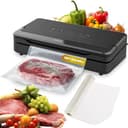
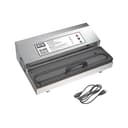
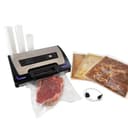
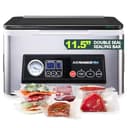
Why a brisket cook wants one of these at all
Three reasons, and only one of them is leftovers.
The reheat.This is the real argument. Brisket reheats badly in an oven and worse in a microwave, because both of them drive moisture out of meat that has already given up most of what it had. A sealed bag dropped into water held around 150°F warms the slices through without losing a drop, because there is nowhere for the moisture to go. It is the single best thing you can do with day-two brisket, and it requires a bag that will not leak. Our holding and reheating guide covers the method; this page is about the bag. Note the safety line that applies either way: the USDA says to reheat leftovers to 165°F, measured.
The freezer.Freezer burn is dehydration, and dehydration needs air. Pulling the air out is the only genuine fix — and brisket, with its large exposed cut faces and rendered fat, is especially prone to it. USDA guidance for cooked leftovers is three to four months in the freezer for best quality, and a vacuum seal is how you get the top of that range instead of the bottom.
Buying in bulk. The reason to care about widebags. If your warehouse club or butcher puts packers on sale, the economics favor buying two and freezing one — and a raw whole packer is a very large, very wet object to get safely into a freezer. See where to buy a brisket for what that actually costs, and how to thaw a brisket for the other end of the trip, which takes longer than nearly everyone plans for.
What we ranked on
Published bag or roll width.The whole page. A clamp sealer can only seal a bag that fits across its heat bar, so the widest roll a maker states it accepts is a direct statement about the biggest piece of meat you can bag. FoodSaver states 11 and 8 inch rolls. NESCO states roll storage up to 11 inches. Weston’s listing states bags up to 15 inches. Anova states nothing at all, and neither does most of this category.
How it handles wet food.Brisket is wet. A clamp sealer removes air by pulling it out through the open mouth of the bag, which means it is also pulling at whatever liquid is in there — and liquid that reaches the heat bar gives you a seal that fails in the freezer, or a pump that needs cleaning. The mitigations, in ascending order of effectiveness: a moist mode that shortens the vacuum, a pulse control you stop by hand when you see the liquid move, a dedicated liquid system like NESCO’s LiquidLock, and a chamber, which removes the problem rather than managing it.
What the bags cost.The machine is the cheap part. Embossed channel bags — the kind every clamp sealer needs, with the textured surface that gives the air a path out — cost several times what a plain smooth pouch costs, and a chamber sealer takes the plain ones. Over a few years of brisket that difference is larger than the gap between the cheapest and the most expensive machine here. Rolls beat pre-cut pouches for the same reason they suit brisket: you cut to the meat instead of buying a size that nearly fits.
Warranty, where one is published. FoodSaver states five years, Anova two. Neither NESCO nor Avid Armor publishes a term on the pages we read, which is worth knowing before you spend three hundred dollars.
What we refused to rank on.Vacuum pressure. It is the number this category is marketed on — inches of mercury, or kilopascals — and none of the five machines here states one on its current maker page or listing. The figures that circulate for these models come from retailer copy and review sites rather than from the makers, and we are not going to rank five appliances against each other on numbers their manufacturers do not stand behind. We also ignored “keeps food fresh five times longer,” which is a marketing claim with no stated test behind it.
How the five machines compare
| Machine | Type | Published bag / roll width | Wet-food handling | Published warranty |
|---|
| Anova Precision Vacuum Sealer Pro | Clamp (external) | Not published | Moist setting + pulse | 2 years |
| Weston Pro-2300 | Clamp (external) | Bags up to 15 in | Manual seal mode (stop the vacuum by hand) | Not published on this listing |
| NESCO VS-22LB | Clamp (external) | Rolls up to 11 in | LiquidLock + dedicated dry/liquid mode | Not published |
| Avid Armor USV20 | Chamber | Pouches to 11 x 10 in (maker stated) | Chamber — seals liquid outright | Not published |
| FoodSaver VS2150 | Clamp (external) | Rolls 11 in and 8 in | Moist mode | 5 years, limited |
Every figure above is the maker’s or the listing’s own stated number, read on the date shown in each product’s spec table below. Where a cell says “not published,” we looked and the maker does not state it — that is the finding, not a gap. No vacuum pressure figures appear because no maker here publishes one.
Clamp or chamber: the honest version
Five of the six picks on this page are what the trade calls external or clamp sealers. You feed the open end of a bag into a slot, the machine draws air out through that opening, and a heated wire welds the bag shut. It is cheap, compact, and it works perfectly on anything dry.
A chamber sealer works the other way around. The whole bag goes inside a box, the box is evacuated, and because the pressure inside and outside the bag falls together, nothing moves. No suction across the bag mouth means no liquid traveling, which is why restaurants use them for stocks and sauces and why the Avid Armor is the only machine here that will seal a cup of brisket juice without an argument.
The trade is size and money. Avid Armor states the USV20 takes pouches up to 11 by 10 inches — that is the chamber talking, and it is a hard limit, because the bag has to fit inside the lid. So a chamber sealer means portioning the brisket every single time, with no exceptions and no cutting a long bag to cheat. It is also three to four times the price of a competent clamp machine. If you render tallow, save jus, or make burnt ends with sauce on them often enough to care, that trade is worth it. If you are mostly bagging sliced meat, it is not.
Four ways people ruin a brisket with a vacuum sealer
Sealing it hot.The most common and the most dangerous. A vacuum bag is an insulator, and a hot brisket sealed into one cools far more slowly than loose slices on a tray — which is precisely the wrong direction, because the clock you are racing is time spent between 40°F and 140°F. The USDA line for leftovers is two hours from the cook or from coming out of a warm-holding appliance, one hour if it is above 90°F where you are standing. Slice or chunk it, spread it out, chill it, then seal it.
Treating the seal as preservation.It is not. Removing oxygen slows spoilage organisms and stops freezer burn; it does nothing about the organisms that do not need oxygen, and some of those are the ones that matter most. A vacuum-sealed brisket is a refrigerated or frozen brisket with better packaging — it is never a pantry item. Our spoilage guide covers how to read a brisket you are unsure about.
Crushing it. Full vacuum on a tray of carefully sliced brisket compresses it into a brick and squeezes out the juice the slices are holding. Use the pulse control and stop early; a bag that is merely snug does everything a bag that is shrink-wrapped does. This is the single best argument for buying a machine with a manual or pulse mode rather than a one-button one.
Bagging the bark. Vacuum sealing is humid, airless storage, and bark goes soft in exactly those conditions. Nothing recovers a sealed-and-frozen bark fully. If the crust is what you care about, keep the point and its bark for day one and seal the flat, which reheats far better than it slices cold.
Bags: the part that actually costs money
Clamp sealers need embossed bags, and the embossing — a textured, channeled inner surface — exists so air has a path to travel when the bag is pressed flat against itself. Smooth bags do not work in a clamp machine, which is why you cannot buy the cheap pouches and use them in a FoodSaver. Chamber machines take smooth pouches, because nothing has to travel anywhere.
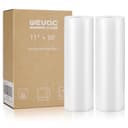
For brisket, buy rolls, not pouches, and buy them 11 inches wide. That is the widest roll both the FoodSaver and the NESCO here state they accept, it comfortably clears a trimmed flat laid lengthwise, and you cut each bag to the length of the meat in front of you. Two 50-foot rolls is a hundred feet of bag, which outlasts a lot of briskets. A 15-inch machine like the Weston needs 15-inch rolls to use its advantage, and those are both pricier per foot and harder to find on a shelf — a real ownership cost, not a footnote.
What we did not pick, and why
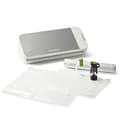
Handheld and cordless sealers. They work with zipper-style bags and they are genuinely useful for a bag of salad. They cannot hold a vacuum well enough for a long freeze and no maker claims they can, so they have no business near a brisket you paid for by the pound. The FoodSaver pick includes one in the box, which is the right place for it.
Larger chamber machines.Avid Armor’s own range goes up to pouches of 11 by 13 inches and beyond, and there are floor-standing chambers above that. None of them changes the brisket answer, because none of them will take a whole packer either — past a certain point you are buying throughput for a business, not fit for a packer.
A sous vide circulator to go with the bags.The water-bath reheat is the best reason to own a sealer, and a circulator is how you hold the bath at a steady 150°F. We carry no circulator in our registry, so there is nothing here we can point you at with a verified listing — we would rather name the gap. A big pot, a stove on its lowest setting and an instant-read thermometer does the same job with more attention.
Bag sealers without a vacuum pump. Impulse sealers weld bags shut and do nothing else. For freezer brisket, the welding is the easy half.