Who each of these is for, in one line
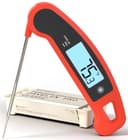
- Lavatools Javelin PRO Duo— for the cook who wants one good instant-read and no second thoughts. ±0.9°F and 2–3 seconds, stated.
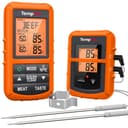
- TempPro TempSync CORE TP20— for the cook who wants to watch the pit and the meat from the kitchen, with no app and no account. Two probes, RF, up to 500 ft stated.
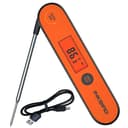
- Inkbird IHT-1P— for the cook who is tired of coin cells: USB rechargeable, stated waterproof, ±0.9°F.
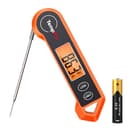
- TempPro TempSwift PLUS TP19H— for the cook who wants the most published spec sheet per dollar in the band: a 1-second stated response, IP65, a 3-year warranty after registration.
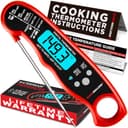
- Alpha Grillers Instant Read— for the second thermometer that lives in the kitchen so the good one stays by the smoker.
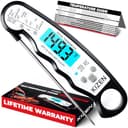
- KIZEN Instant Read— the budget pick: the cheapest one here that states a real IP67 rating, so grease and brisket purge are not a death sentence.
How we ranked thermometers at this price
Four criteria, and the first one is the only one makers consistently publish.
1. Stated accuracy.Four of these six state ±0.9°F, which is the number to look for and is genuinely close to what a $100 thermometer claims. The TP20 states ±1.8°F, which is fine for a leave-in whose job is trend rather than verdict — you are watching for a 15-degree drift in the pit, not arguing about one degree in the meat. A note worth having: the TP19H’s ±0.9°F is specified by its maker across 14–212°F in the product FAQ, which is a narrower window than the thermometer’s full −58 to 572°F range. That is unusually transparent rather than a weakness — brisket lives at 160–205°F, inside the specified window.
2. Response time, where it is published.Lavatools states 2–3 seconds and TempPro states 1 second for the TP19H with no test conditions given. Alpha Grillers and KIZEN publish no read speed at all, so their spec rows say “Not published” — we are not going to time a thermometer we do not own. For brisket this matters less than it sounds: you are probing a 200°F piece of meat in five places, not checking a steak on a hot grill.
3. Whether you can wash it.This is the one that actually kills thermometers. Brisket means rendered fat, purge and hands you cannot keep clean, and a thermometer that cannot be rinsed gets rinsed anyway and then dies. KIZEN states IP67, Inkbird states waterproof, TempPro states IP65 and “safe to rinse under running water.” Alpha Grillers publishes no rating, which is the finding for that entry.
4. Where it lives. Unglamorous and decisive. A magnetic back (Lavatools, Inkbird) means the thermometer is on the smoker when you need it. A thermometer in a kitchen drawer is a thermometer you cook without.
What we refused to rank on
Calibration.Not one maker in this band publishes a calibration procedure or an adjustment range — we checked, and it is the reason there is no calibration column in the table. Do the ice-water check yourself: a glass packed with ice and topped with water reads 32°F (0°C) within a degree, and boiling water reads 212°F at sea level, lower as you go up in altitude. If a thermometer is off by more than a couple of degrees in ice water, it is telling you something.
Any score out of ten. We own none of these units. Ranking is editorial and argued in prose, and our methodology page is the long version of that sentence.
The six under $50, side by side
Every figure is the maker’s own, read from the listing on the date in each product’s spec table. Empty cells are specs the maker does not publish.
| Thermometer | Type | Stated accuracy | Water rating | Power | Price |
|---|
| Lavatools Javelin PRO Duo | Instant-read | ±0.9°F | Not published | Battery, magnetic back | |
| TempPro TempSync CORE TP20 | Dual-probe leave-in (RF) | ±1.8°F | Not published | Battery, 500 ft RF | |
| Inkbird IHT-1P | Instant-read | ±0.9°F | Waterproof (stated) | USB rechargeable | |
| TempPro TempSwift PLUS TP19H | Instant-read | ±0.9°F (14-212°F) | IP65 | 1 x AAA | |
| Alpha Grillers Instant Read | Instant-read | Not published | Not published | Battery | |
| KIZEN Instant Read | Instant-read | Not published | IP67 | Battery | |
Read the type column first. Five of these six do the same job and one does a different one, which is why the sensible purchase in this band is one of each rather than the “best” of six.
If your budget stretches to $100
One band up, the same money buys a different shape of kit: all four thermometer types have a qualifier under a hundred dollars, including a fully wireless probe and a multi-channel WiFi unit. The under $100 page picks one of each, and makes the point that nothing we recommend on this site costs more than that cap.
Using a cheap thermometer well
A $14 thermometer used properly beats a $100 one used badly, and brisket is where that shows up.
- Probe the thickest part of the flat, not the point. The point is fattier and reads done earlier. Our done-temperature guidecovers the target window; the short version is around 203°F, but it is a range and not a number.
- Probe in four or five places and feel for resistance. You are looking for the probe sliding in like warm butter everywhere, not for one reading. This is why you need an instant-read even if you own a leave-in.
- Put the pit probe at grate level next to the meat, not in the lid vent. A dome gauge can read 25 degrees away from the grate.
- Check it in ice water once a season. Thirty seconds, no cost, and the only calibration check available in this price band.
- Keep the probe out of the fat cap and off the grate.Fat and metal both lie to you — fat renders hotter, metal conducts.
If you want to spend more, spend it on wireless rather than on accuracy: accuracy is close to solved at this price, and the thing $80 to $100 buys is a probe with no wire running out of your smoker. The wireless roundup has those, and the instant-read roundup covers spot-check tools at every price.