Who each of these is for, in one line
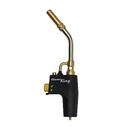
- Flame King FK4500CGA— for the cook who would rather own one tool that lights charcoal on Saturday and sweats a pipe joint on Sunday.
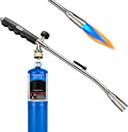
- JJGeorge Grill Torch— for the cook who wants a long wand and a trigger, and does not want to crouch over a firebox in the dark.
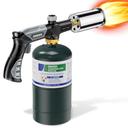
- Sondiko L8010— for the cook who also wants to sear a steak or finish something sous vide off the same cylinder.
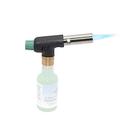
- Flame King FK-PV777CGA mini— for the tightest budget, and for anyone who mostly burns briquettes rather than big lump.
The specs this category publishes, and the two it does not
This is a category where the honest page is shorter than the marketing. Across all four listings there is onepublished output figure — the mini head’s 10,000 BTU — and no run time and no fuel consumption rate anywhere. That means nobody can tell you how many chimneys a $4 cylinder lights, including us, and any page that gives you a number for it made it up.
What you can compare is fuel compatibility, whether there is a wand, and whether the ignition is a trigger or a separate striker. Those three decide how the tool feels in use, and they are all on the listings.
| Torch | Fuel | Published output | Ignition | Price |
|---|
| Flame King FK4500CGA | MAPP / MAP-Pro / propane, 1 lb CGA | Not published | Not stated | |
| JJGeorge Grill Torch | Propane, 1 lb cylinder | Not published | Trigger start | |
| Sondiko L8010 | Propane, 1 lb cylinder | Not published | Trigger with safety lock | |
| Flame King FK-PV777CGA mini | Propane, 1 lb CGA | 10,000 BTU | Not stated | |
Read the fuel column first. MAPP and MAP-Pro burn hotter than propane, and the FK4500CGA is the one head here whose listing states it takes all three, so you can buy the hotter yellow cylinder if lighting big lump is the job. The other two propane torches will light the same charcoal; they will just take a few seconds longer per handful.
How to actually light a chimney with a torch
- Fill the chimney, do not pack it. Air has to move up through the charcoal. Dump lump in loose and let it find its own level.
- Point the flame in from the side, near the bottom. Through the vent holes if your chimney has them. You are not trying to heat the whole load, only to get two or three pieces properly burning.
- Hold it for twenty to thirty seconds, then stop. When you see a piece glowing orange on its own, the chimney will take it from there.
- Walk away. A chimney of lump needs ten to fifteen minutes to ash over, torch or no torch. What the torch bought you is the certainty that it lit, not a shortcut to ashed-over coals.
In an offset firebox without a chimney, the method is the same but the target is different: light the charcoal bed on one side and lay your splits or chunks against it rather than on top of it, so the wood catches from radiant heat and not from a torch flame. A split lit directly with a torch smolders, and smoldering wood is where acrid smoke comes from.
Torch, chimney, electric starter or cubes?
All four light charcoal. They cost different amounts of money, time and attention, and they are not substitutes for one another in the way the search results imply.
- Chimney plus a natural starter is the default, the cheapest and the most reliable. It is what we recommend to everyone, and the starter you put under it matters more than the chimney does.
- Torch is the fastest and the one that works in wind and rain, when a paper or cube start is at its worst. It is also the only one of the four that doubles as a searing tool.
- Electric starter (a hot-air or hot-rod tool) needs an outdoor outlet and gives you no flame at all, which is the right answer for a balcony where an open flame is a problem. See the full comparison of the four methods.
- Lighter fluid is the one we would not use. It works, and it leaves a solvent note that survives into the bark on a cook long enough for it to matter.
Safety, said once and plainly
A 1 lb propane or MAPP cylinder is a pressurized fuel container with an open flame on top of it. Use it outdoors, keep it upright, do not leave a lit torch unattended on a table, let the head cool before you pack it away, and never point it at a bag of charcoal or at a lit fire you are about to add fuel to. None of that is specific to barbecue — it is how the tool is sold to plumbers — and all of it matters more at four in the morning on a overnight cook than it does in daylight.