Who each of these is for, in one line
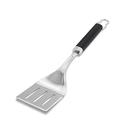
- Weber Precision Grill Spatula— for almost everybody: three beveled sides, a grippy handle, dishwasher safe, and the lowest price here.
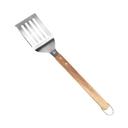
- BBQ-AID Pro 17"— for the cook working over an open firebox who wants a serrated edge so they are not reaching for a knife.
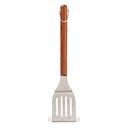
- RSVP Endurance 18"— for maximum distance between your hand and the fire, with nothing on the tool that can fail.
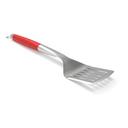
- Kamado Joe Krafted— for the cook who wants the widest blade on the page and already owns the matching tongs.
What a spatula actually does on a brisket cook
Four jobs, none of them the brisket:
- Moving the things that cook alongside. Sausage, chicken thighs, a tray of burnt endsyou are glazing — all spatula work, all awkward with tongs.
- Lifting a wrapped packer off and on. Not by the blade alone. A wide spatula under one end while a gloved hand or a second tool takes the other is how you move fifteen pounds of hot meat in butcher paper without tearing it.
- Getting under something stuck. A beveled or serrated edge will release a chicken skin welded to a grate. A rounded kitchen turner will not.
- Scraping the grate while it is hot. Not as good as a dedicated scraper and much better than nothing, which is why the long-handled ones earn their place.
Notice what is absent. Lifting a bare, unwrapped, fully rendered packer off a grate is a two-hand job with gloves, or a pair of long tongsfront and back. A twelve-pound brisket at 203°F has the structural integrity of a wet towel, and balancing it on a four-inch blade is how it ends up on the patio. We say the same thing on the tool set page and it is worth repeating here.
The four side by side
Every figure below is the listing’s own, read on the date in each product’s spec table. Two of the four do not state an overall length, and none of the four states a steel gauge, a thickness or a weight — so those rows say “Not published” rather than guessing.
| Spatula | Overall length | Edge | Handle | Price |
|---|
| Weber Precision | Not published | 3-sided beveled | Soft-touch, non-slip, hanging loop | |
| BBQ-AID Pro 17" | 17 in | Serrated knife edge | Acacia wood | |
| RSVP Endurance 18" | 18 in | Plain | Rosewood | |
| Kamado Joe Krafted | Not published | Cutting edge, large surface | Long heat-safe | |
The length column is the one to read first, because it is the only figure here that maps onto a real risk. An offset firebox is open flame at waist height; a 17 or 18 inch handle is the difference between reaching in comfortably and singeing the hair off your forearm. If your cooker is a pellet grill or an electric cabinet, where you never put a hand near fire, the shorter Weber is more pleasant to use and the length stops mattering.
Beveled, serrated or plain?
Beveled— the leading edge is ground thin so it slides under food rather than pushing it along. The Weber is beveled on three sides, which is unusually useful: it means approaching from the left, the right or head-on all work the same way.
Serrated— teeth along one side, so the tool cuts as well as lifts. Genuinely handy for separating sausage links or cutting a test slice off a point, and genuinely bad for your cutting board, which it will score if you use it there.
Plain— nothing but a flat blade. The RSVP is plain, and that is not a criticism: a plain blade has no edge to dull, nothing to catch and nothing to fail, and it is the tool most likely to be in the drawer in ten years.
Wood handle or synthetic?
Wood stays cool next to hot steel and wants hand washing. Synthetic soft-touch grips go in the dishwasher and get slippery when they are greasy. Both of the long tools here are wood, which is not a coincidence: a long tool is a firebox tool and a firebox tool wants a handle that does not conduct. If you want dishwasher convenience, that is the Weber and the Kamado Joe, and both are shorter in the hand.
One thing no listing on this page states: a warranty. Not one of the four publishes one, the same gap we found across the tongs and tool sets. In a category where nothing states a steel thickness either, buying the cheapest one that is comfortable is a more rational strategy than paying up for a notional build quality nobody will quantify.