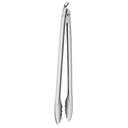
How we chose, and the four specs that exist
This is the least documented category on the site, and that is not a complaint about one brand — it is the whole market. Not one of the five listings here states a heat rating, a steel gauge or thickness, a weight, or a warranty on the tool. Compare that with a thermometer, where the maker publishes accuracy, range, response time and probe length, or a kamado, where you get grate area and a temperature range. With tongs you get four figures, so those four figures are the criteria:
- Length, in inches. The one spec that changes what the tool can do. Sixteen inches is a grate tool. Eighteen inches is a firebox tool. The difference is whether your knuckles are over the coals when you move a log.
- Whether it locks, and how.A lock is a storage feature first — locked tongs hang on a hook instead of splaying open in a drawer. Rosle’s one-handed release is the only lock here that is also a working feature.
- Tip shape. Scalloped tips bite; a flat front edge slides underneath. For sliced brisket that distinction is the difference between lifting a slice and shredding it.
- Material, and whether the handle is bare steel. All five are stainless. Two have insulated or soft-touch handles and three do not, and bare steel 16 inches from a fire gets hot enough to matter.
Everything else that gets written about tongs — spring tension, “600°F rated,” forged versus stamped — is either unpublished for these products or printed only on anonymous listings we would not send a reader to. We left it out instead of repeating it.
Who each of these is for, in one line
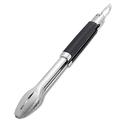
- Weber Precision Grill Tongs, 18"— for the cook who wants one pair that reaches into a firebox and still handles a slice, at a price that makes owning two painless.
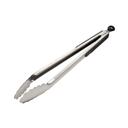
- OXO Good Grips 16" Locking Tongs— for the cook whose tongs live in the kitchen between cooks and need to be good at both jobs.
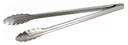
- Winco 16" Extra Heavyweight Utility Tong— for the cook who wants a tool with nothing to break, and does not care that it was sold for a buffet line.
- Kamado Joe Krafted 18" BBQ Tongs— for the kamado or deep-grate owner who wants heft and finish and is willing to pay for it.
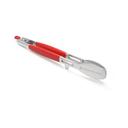
- Rosle 25054 One-Handed Lock & Release, 17"— for the cook working alone at an open pit who wants to open and close the tong without a second hand.
The five side by side
Every figure below is the one the listing states, read on the date in each product’s spec table. Blank columns would be guesses, so where a maker publishes nothing the spec tables say “Not published” rather than filling in a plausible number. Prices are live and each row carries its own stamp.
| Tong | Length | Lock | Tip | Price |
|---|
| Weber Precision Grill Tongs | 18 in | Hands-free locking | Flat front edge | |
| OXO Good Grips Locking Tongs | 16 in | Locking, hanging loop | Not published | |
| Winco Extra Heavyweight Utility Tong | 16 in | None - coiled spring | Scalloped | |
| Kamado Joe Krafted BBQ Tongs | 18 in | Locking, grooved grip | Not published | |
| Rosle 25054 Barbecue Tongs | 17 in | One-handed lock and release | Not published | |
Read that table and the price order stops making sense, which is the honest finding of this page. The cheapest tong and the most expensive tong are within an inch of each other on the only spec that changes what the tool can reach. What the money buys above about twenty dollars is build quality and mechanism — neither of which any maker here quantifies.
What tongs are actually for on a brisket cook
Tongs and a turner are the pair, and the other half of it now has its own page: four BBQ spatulas compared on the three specs the category publishes, with the same honest caveat about what should and should not be used to move a cooked packer.
Five jobs, in the order they come up. None of them is “pick up the brisket.”
- Building and feeding the fire. Moving lit coals from a chimney starter into a basket, adding a wood chunk without dropping it, raking coals to one side for an indirect setup. This is the job that wants 18 inches, and it is most of the work on an offset or a drum. Our fire management guide covers the fire itself.
- Pulling and setting a hot grate. Every charcoal cooker needs the grate lifted at some point mid-cook, usually with a fire underneath it. Locked tongs hooked under a grate bar do this better than gloves.
- Repositioning early, before the bark sets. In the first few hours a brisket is still firm and a flat end sitting over a hot spot can be turned end-for-end safely. After the bark sets, stop touching it with steel.
- Handling everything that is not the brisket. A water pan, a foil boat, the wrap, the chunks, the chimney itself, the second cut you put on to fill the grate.
- Serving. Lifting finished slices off a carving board onto a tray or a bun. This is the job where tip shape matters, and where a flat-edged tong beats a scalloped one.
Why not to lift a cooked brisket with tongs
Because of what a finished brisket is. Collagen that was tough connective tissue at the start has broken down into gelatin, which is exactly why the meat is tender — and exactly why it no longer holds itself together under a point load. Two steel jaws concentrate the whole weight of a twelve-to-sixteen-pound packer into two small contact patches, usually on the thin end of the flat, which is the weakest part of the cut. Best case you leave a pair of dents in the bark. Common case the flat tears.
The right moves instead, all of which we cover elsewhere: slide a sheet pan or a board under the brisket and lift the pan; keep it in its butcher paper and lift the paper with both gloved hands; or lift it on the wrap straight into the cooler you hold it in. If you are moving a cooked packer any distance at all, our guide to transporting a cooked brisket is the one to read first.
One pair or two?
Two, and not for the reason you would expect. The sensible split is one dedicated fire tong and one food tong. The fire tong gets black, lives by the cooker, handles charcoal and wood and does not need to be clean. The food tong handles the wrap, the second cut and the sliced beef, and stays clean enough to use on cooked meat after it has touched raw.
Keeping those jobs separate matters more than most gear advice on this site, because it is a food-safety point rather than a preference: anything that touches raw brisket should not then touch the cooked slices. USDA’s own grilling guidance makes the same point about utensils and platters. At these prices buying two tongs is the cheapest safety upgrade available — the Winco plus the Weber together cost less than the Kamado Joe tong alone.
What to buy instead, if you only have one more purchase in you
Honest order of operations, because a tong is not the tool that changes a brisket. If you do not yet own all of these, buy them before you upgrade from a twenty-dollar tong to a sixty-dollar one:
- An instant-read thermometer.The single tool that decides whether the brisket is done — see our thermometers under $50.
- Heat-resistant gloves. The tool that actually moves the brisket: our glove picks.
- A long slicing knife.A brisket is ruined at the board as easily as on the pit — slicing knives here.
- Then tongs. And then nothing else in this category, because there is nothing else in this category worth buying.
If you want the whole kit in one purchase rather than one tool at a time, our BBQ tool set roundupcovers what the multi-piece sets actually contain — and which pieces to ignore. The brisket accessories list is the same argument across every category on the site: one pick per job, ordered by how much each one changes the result.