How we chose, with one category-wide caveat
Tool sets are the least documented products on this site, and it is worth being blunt about what that means for a buyer’s guide. Not one of these four listings states a heat rating, a steel gauge, a weight, a tool length or a warranty. A smoker publishes cooking area and a temperature range. A thermometer publishes accuracy and response time. A tool set publishes a piece count and a finish. So the criteria are the few things that can honestly be compared:
- Piece count, treated as a cost signal and not a quality signal. More pieces is more plastic-wrapped stainless, not better stainless.
- Whether the listing itemizes the box. If a maker will not tell you what the 36 pieces are, that is information too.
- How many of the stated pieces a brisket cook actually uses. Our count, openly reasoned below, not a number from a maker.
- Handle material. Bare steel conducts; a stated non-slip or soft-touch handle does not. Two of these four state one.
We own none of this gear and we do not claim to have run it over a fire — the methodology pagesays exactly how these pages are researched. Everything in the spec tables is the listing’s own statement, dated.
The three tools a brisket cook uses, and the ones sets pad with
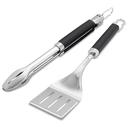
Work through a cook and the honest list is short. Tongs for the fire, the grate and the serving board. A wide, stiff spatula— the one tool that can actually get under something heavy, which matters for a separated point or a flat you are moving onto a tray. A basting brush, occasionally, if you sauce at the end; most Central Texas cooks never will.
Here is what sets pad with, and why each one is filler on a brisket:
- A barbecue fork. The classic third piece of a three-piece set, and the one tool you should never put into a brisket. Two tines through the bark is two channels for rendered fat and moisture to run out of the meat you spent twelve hours rendering it into. Use it to steady a roast, never to lift or turn a packer.
- Skewers. Usually six or eight of them, and the single biggest contributor to a high piece count. Nothing to do with brisket.
- Corn holders. Often sixteen in a 36-piece set, counted individually.
- Spare brush heads, knives, and a cleaning brush. A grate brush is genuinely useful; it is also a two-dollar item inflating a piece count.
That is the arithmetic behind our top pick. A two-piece set where both pieces get used every cook is worth more than a 36-piece set where four do, even when the 36-piece set is cheaper per piece.
The four sets side by side
The “contents stated?” column is the one to read first. Prices are live and each row carries its own stamp.
| Set | Pieces | Contents stated? | Material | Price |
|---|
| Weber Precision Tongs & Spatula | 2 | Yes - locking tongs + 3-sided beveled spatula | Stainless, soft-touch handles | |
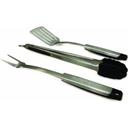
| Cuisinart CGS-333 Professional | 3 | No - count only | Black and stainless | |
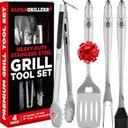
| Alpha Grillers Grill Tools Set | 4 | Yes - spatula, fork, brush, tongs | Heavy-duty stainless | |
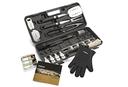
| Cuisinart CGS-8036 | 36 | No - count only | Stainless | |
Two patterns fall out of that table. The sets that tell you what is inside are the small ones, and the per-piece price falls as the usefulness per piece falls. Neither is an accident: a 36-piece count is a merchandising decision, and a maker that itemizes a 36-piece box has to admit how many of them are corn holders.
Set or single tools?
If the tool you actually need is the spatula, buy a spatula. The stand-alone version of Weber’s three-sided beveled turner costs less than any set here, and four spatulas are compared on length, edge and handle material on the best BBQ spatula.
Single tools, if you are buying for yourself and already own a tong. A set, if you are starting from nothing or buying for somebody else. The maths is simple enough to do in public:
- Starting from zero— usually because the smoker is new too; if that is where you are, our smokers under $300 page is the other half of this purchase. A four-piece set covers tongs, spatula and brush for roughly what a good 18-inch tong costs on its own. Buy the set, then buy a thermometer.
- Already own tongs.Buy the one tool you are missing. A set that duplicates your tongs is a set you paid for twice — and the tongs are the piece most likely to be the weakest item in a cheap box.
- Buying a gift. Piece count works as a gift. That is not cynicism: a big box with a case reads as a real present in a way that two excellent tools in a polybag does not. Our gifts for brisket lovers page is built around that problem, and the gifts under $50 and under $150 pages sort it by budget.
If you want the tongs decision on its own — length, locking and tip shape, which is where sets are quietest — our BBQ tongs roundup compares five pairs on the four specs this category actually publishes.
What no tool set includes, and what to buy instead
In the order that each one changes the brisket. A set gets you none of the first two, and they are the two that matter most:
- A thermometer. Brisket is done by feel and by internal temperature, not by time, and no set on the market contains one. Start with thermometers under $50, or read what temperature brisket is done first if you have not cooked one yet.
- Heat-resistant gloves. The tool that actually lifts a finished packer. The glove picks compare published heat ratings and cuff length.
- Butcher paper.The wrap is part of the method, not an accessory — see butcher paper.
- A long slicing knife and a board big enough for a packer. Knives and boards, both of which a brisket needs in a size the kitchen drawer does not have.
The complete version of that argument, with one pick per job across every category on this site, is the brisket accessories list. If you are shopping in late November, the Black Friday BBQ deals page tracks which of these categories actually discount.