Who each of these is for, in one line
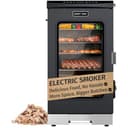
- EAST OAK 30" Electric (PES23001)— for the first-time brisket cook who wants the cook to be about the meat, not about the fire, and still wants a probe and a chip loader.
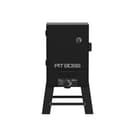
- Pit Boss 3-Series Electric Vertical— for the cook who needs area above all: 880 stated square inches over four racks, with an analog dial instead of a digital thermostat.
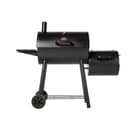
- Char-Griller Smokin’ Pro offset— for the cook who wants real charcoal-and-wood smoke at this money and accepts that tuning the pit is part of the deal.
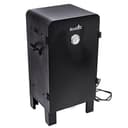
- Char-Broil Analog Electric— for the tightest budget, the smallest patio and the shortest learning curve on the site.
The decision this band actually asks you to make
It is not a brand decision. It is heavier smoke flavor against a cook you can walk away from, and under $300 you cannot have both.
An electric cabinet holds 250°F for twelve hours without a single adjustment. It does that because an element and a thermostat do not care about wind, rain or January, and because the body is an insulated box. What it cannot do is burn wood properly: a handful of chips smoldering on a tray makes a fraction of the combustion gases that a live fire makes, so the smoke flavor is lighter and the smoke ring is thinner. Our charcoal against electric comparison is the long version of this argument.
The offset in this band is the opposite trade. It burns charcoal and wood splits, so it produces the real thing — and it runs hot near the firebox, leaks at the seams out of the box, and needs a water pan, some gasket or sealant and a few cooks of learning before it holds a steady temperature. Thin steel is the reason: there is not enough thermal mass to smooth out a fire, so every adjustment you make shows up fast. That is the honest trade at $300, and plenty of very good brisket has come off exactly this kind of pit.
If you want the middle of that trade, it costs about a hundred dollars more than this page’s ceiling. A charcoal bullet gives real smoke with a body heavy enough to be forgiving, which is why it is our overall recommendation on the under $500 page and on the main smoker roundup.
The four under $300, side by side
Every figure below is the maker’s own, read on the date in each product’s spec table. Where a maker does not publish a figure — Char-Broil states no total cooking area, the Char-Griller states no steel gauge — the spec tables say “Not published” rather than filling in a number. Prices are live and each row carries its own stamp.
| Smoker | Type | Cooking area | Control | Price |
|---|
| EAST OAK 30" Electric | Electric cabinet | 725 sq in, 4 racks | Digital, 100-275°F | |
| Pit Boss 3-Series Electric | Electric cabinet | 880 sq in, 4 racks | Analog dial, 100-300°F | |
| Char-Griller Smokin’ Pro | Barrel offset | 1,130 sq in incl. warming rack | Dampers and fire management | |
| Char-Broil Analog Electric | Electric cabinet | Not published | Analog dial | |
Read the area column against the type column and the ranking makes sense. The offset publishes the biggest number and spends most of it on a grill surface that runs too hot for brisket at the firebox end. The electric cabinets stack their area vertically over four racks, which is the right shape for a packer, a second cut and a tray of beans at the same time — and an electric never asks you to choose which rack is closest to the fire, because there is no fire.
What $300 does not buy, said plainly
Four classes of cooker have nothing in this band on this site, and it is worth knowing why before you go looking:
- No charcoal bullet. The 18-inch Weber Smokey Mountain is the cheapest one we recommend and it sits above this cap. It is the single best value in brisket smoking and it is worth waiting for.
- No drum.Both drums we rate — the Pit Barrel and the Oklahoma Joe’s Bronco — are in the $400s.
- No gravity-fed charcoal cabinet.The cheapest is Masterbuilt’s AutoIgnite 545, around $500, and it is the best of both worlds for exactly that reason.
- No pellet grill. This is the one to be careful about. There are pellet grills advertised under $300, and we do not have one in the registry with a live price we would stand behind. A pellet grill is a hopper, an auger, a fan, a controller and an igniter; at the bottom of the market those are the parts that fail, and a failed auger mid-brisket is a ruined cook. Our pellet picks start higher for that reason.
Our budget smoker guide covers the whole bottom of the market without a hard cap, including the cookers just above this one, and explains what thermal mass actually buys you.
The $10 upgrade that changes an electric smoker
And if you bought the offset in this band instead, the equivalent cheap win is sealing it. A thin-steel barrel leaks at the lid and the firebox door from new, which is why it runs hot and will not come down — a roll of high-temp gasket tape costs less than a bag of lump and puts the vents back in charge. Pair it with a charcoal basket and the pit becomes a different cooker.
If you buy one of the three electric cabinets here, buy a pellet smoke tube with it. A tube of smoldering pellets sitting on the bottom rack runs for hours and adds the smoke the chip tray cannot, which narrows the single biggest gap between an electric brisket and a charcoal one. It is the cheapest meaningful upgrade in this guide and it costs about the price of a bag of charcoal.
Then spend your next money in this order, which is the same order we recommend to everyone regardless of cooker:
- An instant-read thermometer. Brisket is done by internal temperature and probe feel, not by time. Six come in under fifty dollars on this page.
- Gloves and a long knife. Gloves move a finished packer; a slicing knife keeps you from ruining it at the board. A pair of long BBQ tongs handles everything that is not the brisket.
- Wood that suits beef. Oak, then hickory — see the wood guide. On an electric that means chips or a tube; on the offset it means splits and chunks.
Can you actually cook a good brisket on a $300 smoker?
Yes, with two caveats that are about size and about expectations rather than about quality.
Size first.A 30-inch electric cabinet is roughly 15 to 17 inches wide inside, and a whole untrimmed packer runs 18 to 20 inches long. You will trim hard, fold the thin end of the flat, or separate the point from the flat and cook both — all three are normal, and the last one has the side benefit that each muscle finishes when it is actually ready. Our guides to trimming and separating the point and flat both cover this, and the electric-smoker method is written for exactly this cooker.
Expectations second.What a cheap smoker costs you is margin for error, not the possibility of a good brisket. Thin steel and small cabinets react faster to weather and to an open door, so you do more watching. Where the money genuinely shows is on the fifth brisket, not the first — a heavier cooker makes the same brisket with less attention. If you want to understand the whole decision before you buy anything, start at the beginner smoker guide and the method pillar.