Who each of these is for, in one line
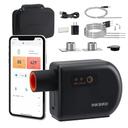
- INKBIRD ISC-027BW— for almost everyone: four probes, published accuracy, a lid detector, and the lowest price in the category.
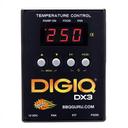
- BBQ Guru DigiQ DX3— for the cook who wants a controller and not a smart-home device, and who values Adaptive Control over an app.
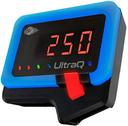
- BBQ Guru UltraQ— for the cook who wants published figures, text and email alerts, and a unit that keeps working with the network off.
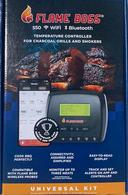
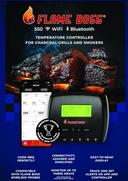
- Flame Boss 550 Universal— for a Weber bullet, a drum or an offset: the listing names exactly those, and the four-line screen shows the pit plus three meats at once.
- Flame Boss 550 Kamado— the same controller with the ceramic adapter. On a kamado the adapter is the compatibility question.
What a temperature controller actually does
Every charcoal cooker is an air pump. Open the bottom vent and more oxygen reaches the coals, the fire burns harder and the chamber gets hotter; close it and the opposite happens. Holding 250°F by hand means making small vent adjustments as the fuel bed burns down, the wind changes and the weather cools — the skill our fire management guide is about.
A controller automates that one variable. It consists of three parts: a pit probe clipped at grate level, a controller holding your setpoint, and a fansealed to the cooker’s intake with an adapter. When the pit drifts below the setpoint, the fan pushes air; when it drifts above, the fan stops and the cooker falls back to whatever the natural draft gives you. Every unit on this page works that way. What separates them is how finely they modulate the fan, how much they publish about their own accuracy, and whether they need your phone.
For brisket specifically, the payoff is the overnight cook. A packer takes ten to sixteen hours, which means a start time that lands either in the small hours or in the previous evening, and the hard part of an evening start has never been the cooking — it is the two or three times you get up to check the pit. A controller converts those checks into a graph on your phone, or in the DigiQ’s case into a number on a display you can read from the kitchen window.
How we ranked these, and the specs this category hides
Five criteria, in the order that decides whether a controller is any use on a brisket.
1. Does it fit your cooker?This is first because it is the one that makes a unit worthless if you get it wrong. The fan has to seal to the intake, and every cooker’s intake is a different shape: a kamado has a round bottom vent, a Weber bullet has a damper door, a drum has a ball valve or a hole, a gravity cabinet has a hopper intake. That is why Flame Boss sells the same 550 as a Universal version (the listing names Weber, drum and offset) and a Kamado version (ceramic), and why BBQ Guru sells adapters per cooker. Buy the adapter that matches your smoker, not the prettiest controller.
2. What accuracy and range does the maker publish?Here the category splits cleanly and not in the direction price suggests. Inkbird publishes ±0.9°F probes with a ±12°F calibration range and both a continuous (32–482°F) and a short-term (32–572°F) window. BBQ Guru publishes 32–475°F at ±2°F for the UltraQ. For the DigiQ DX3 and for both Flame Boss 550 variants, neither maker publishes an accuracy figure or a temperature range — so those rows in the tables below say “Not published,” and we are not going to invent them. On a brisket the practical consequence is small (you are aiming at a 25-degree window, not a degree) but a maker that will not state a figure is telling you something.
3. Fan output, and whether the speed varies.A fan that is either on or off overshoots; one that modulates holds a tighter line. All five of these vary their output, and two publish how much air they move: BBQ Guru’s Pit Bull fan is stated at 25 CFM and the DigiQ can drive two of them, while the UltraQ’s Pit Viper is stated at 10 CFM with an adjustable slide damper. Flame Boss states a “patented variable speed blower” with no output figure, and Inkbird publishes no CFM at all. More air is not automatically better — on a sealed ceramic 10 CFM is plenty and 25 CFM can overshoot — but on a big drum or a leaky cabinet it matters.
4. Does it work without an app, an account or a network?This is the criterion gear reviews skip and the one that bites at 2 a.m. in a backyard with one bar of signal. The DigiQ DX3 has no connectivity listed at all, which is the point of it. The UltraQ runs fully from three buttons on the unit, with Wi-Fi and Bluetooth as additions rather than requirements. The Inkbird and the Flame Boss are both app-first designs: they have displays, but the configuration and alerting you are paying for lives on your phone. Note also that both Wi-Fi units state 2.4GHz only — worth knowing if your router hands out a single combined network name.
5. Probes: how many, how long, how hot.You want at least two (pit and meat) and a brisket cook benefits from three, because the point and the flat finish at different moments. Inkbird ships four probes in the box. BBQ Guru’s kits ship two 6-foot probes, pit and food, stated dishwasher safe. Flame Boss ships two with the 550 kits and the four-line screen can display up to three meat temperatures. The limit to watch is heat: Flame Boss rates its high-temperature multipurpose probe to 475°F and its legacy 500 manual puts probes at 450°F, which is also the default high-temp alarm — fine for brisket at 250°F, relevant if you also sear at 600°F.
What we refused to rank on
How long a controlled fire holds.Nobody publishes it, because it depends on your charcoal, your cooker and the weather — the three things the controller does not change. A controller makes a fuel load last longer than an open vent would, by never burning harder than it has to. It does not add fuel.
Any score out of ten. We have not run these units; our methodology pageis the long version of that sentence. Everything above is the maker’s own published figure, read on the date in each product’s spec table.
The five side by side
Every figure is the maker’s own. Empty cells are what each maker declines to publish — read them as part of the comparison. Prices are live and each row carries its own “as of” stamp.
| Controller | Probes | Fan (stated) | Works offline? | Published range / accuracy | Price |
|---|
| INKBIRD ISC-027BW | 4 (1 pit + 3 meat) | Variable; CFM not published | Display yes, setup app-led | 32-482°F continuous, ±0.9°F | |
| BBQ Guru DigiQ DX3 | 2 (6 ft pit + 6 ft food) | Up to two Pit Bull 25 CFM | Yes - no app exists | Not published | |
| BBQ Guru UltraQ | 2 (6 ft pit + 6 ft food) | Pit Viper 10 CFM, damper | Yes - three buttons on the unit | 32-475°F, ±2°F | |
| Flame Boss 550 Universal | 2 (3 meat readable) | Variable-speed blower | Four-line LCD, app-led setup | Not published | |
| Flame Boss 550 Kamado | 2 (3 meat readable) | Variable-speed blower | Four-line LCD, app-led setup | Not published | |
Read the last two columns together and the price order stops looking like a quality order. The cheapest unit here publishes the most about its probes; the most expensive publishes a range and an accuracy figure and gives you the only genuinely app-independent smart controller; and the two units in the middle of the price list publish neither a range nor an accuracy figure at all.
What a controller will not fix
Four things, and they are worth knowing before you spend, because every one of them gets blamed on the controller.
A leaking cooker.A fan can only control the air that comes in through the intake it is sealed to. If your kamado’s gasket is shot, your drum’s lid is warped or your cabinet’s door does not close square, air arrives somewhere else and the controller spends the night fighting it — usually by running the fan constantly and still undershooting. Fix the leak first.
Not enough fuel. A controller modulates a fire; it does not build one. Load the basket or firebox for the whole cook, light it properly with a chimney or a small lit patch, and use fuel that burns long: our charcoal roundup covers which bags hold up over twelve hours, and big-piece lump outlasts briquettes for exactly this reason.
A dirty fire.The classic complaint about fan controllers — “my brisket tastes acrid” — is usually a smoldering fire being revived by bursts of air. The fix is the same as for any charcoal cook: get the fire fully lit before you set the controller, add wood chunks onto hot coals rather than burying them, and keep the top vent open enough for the smoke to leave. Our bitter-or-acrid troubleshooting page walks through it.
The need to judge the meat.A pit probe tells you about air. A brisket is finished on probe feel somewhere around 203°F, which still means getting up, opening the lid and pushing an instant-readinto the thickest part of the flat in four or five places. Every controller here will hold 250°F all night. None of them will tell you the brisket is ready.
Controller plus charcoal smoker, against a gravity or pellet cooker
This is the comparison worth doing before you buy anything, because the money lands differently than people expect. A controller on a cooker you already own is the cheapest route to hands-off charcoal barbecue there is. Buying a cooker with the controller built in — a gravity-fed charcoal cabinet or a pellet grill — costs more up front and gives you a hopper that feeds itself, which a fan controller does not.
The honest split, for brisket:
- You own a kamado, bullet or drum:buy a controller. You already have the best part — a sealed, insulated chamber — and a fan finishes the job for a fraction of a new cooker.
- You are buying new and want hands-off charcoal: compare a gravity cabinet against a controller-plus-bullet. Our Masterbuilt gravity alternatives page costs both routes out, and the gravity roundup covers the cabinets themselves.
- You want the least work of all: buy a pellet grill and skip this page. A controller cannot add fuel; an auger can.
- You cook on an offset: a controller helps a charcoal-and-chunk fire hold between splits, and it cannot feed the fire. Most offset cooks who want to sleep buy a second cooker rather than a fan.
One last note on where the category is thinner than it looks: FireBoard’s Drive controllers are the other unit enthusiasts recommend, and they have no live Amazon listing we can point you at — a search for them returns stands and unrelated stove thermometers. We have not invented an entry for a product we cannot send you to buy. If you want one, buy it from FireBoard directly; we earn nothing from that and it is still the right advice.